
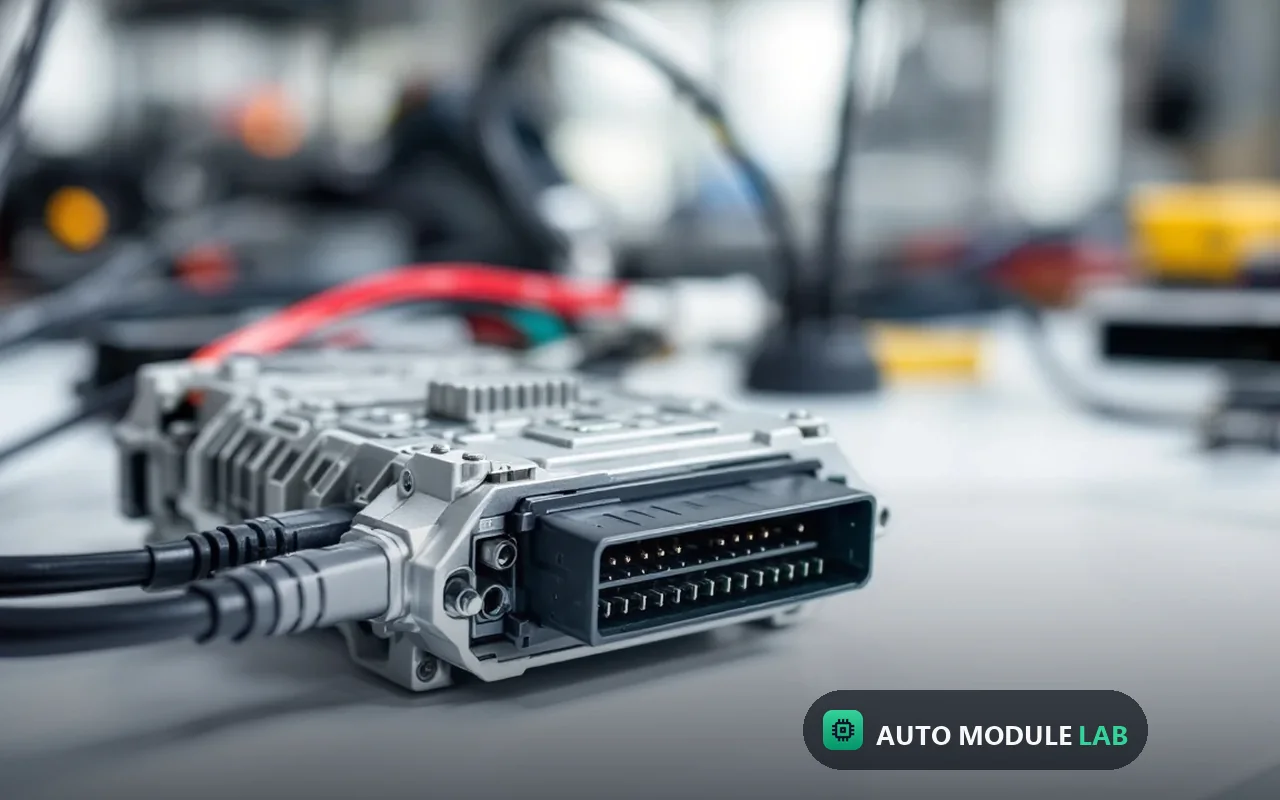
BMW DME EWS Delete: Complete Guide to Bench Programming (2026)
Who this is for
You're reading this because one of these is true:
- Your EWS module failed and a replacement is hard to source (E36/E39 EWS especially)
- You swapped engines and the donor DME won't sync to the recipient car's EWS
- Another shop attempted a key job, damaged the EWS or cluster, and now the car cranks but won't start
- You're a locksmith or shop weighing whether to add EWS delete to your service menu
The decision tree is short. If your DME is on the supported list and the symptom is EWS-related, this $250 bench job is almost always the cheapest correct fix. If you're past the EWS era (2006+, CAS-equipped BMW), you need a different service — see our BMW CAS Key Programming page.
What "EWS delete" actually changes
The BMW EWS (Elektronische Wegfahrsperre / Electronic Drive Authorization) is the third-generation BMW immobilizer system used roughly from 1995 through 2005-2006 depending on chassis. It sits between the key transponder and the DME. Every start cycle, the DME asks the EWS module: "is this key authorized?" Only on a clean handshake does the DME release fuel injection and ignition.
The EWS delete reprograms the DME to skip that handshake. After the delete:
- The DME no longer queries the EWS module
- Fuel + spark release on every key turn that mechanically rotates the ignition switch
- A working EWS module is no longer required for the engine to start
- Any compatible key that physically fits the ignition will start the car
What does NOT change:
- The mechanical ignition lock — you still need a key that fits
- Body modules (cluster, BC, light module) — they're independent of the DME ↔ EWS link
- Anti-theft alarm — if equipped separately, it still arms
- Emissions or DTC behavior — the DME's diagnostic and emissions code is unchanged
Per BMW TIS / Technical Information Service reference documentation for the E39 platform, the EWS handshake is implemented as a CAN-bus challenge-response sequence written into specific DME firmware blocks. The "delete" is a software-only modification to those blocks; no hardware change is made to the DME.
Which DMEs are supported
Auto Module Lab handles every Siemens MS-family and Bosch ME-family DME used on E-chassis BMW from M52/M54/M62 through S54/S62/S65:
Siemens MS-family (M52/M54-era inline 6 and post-facelift):
| DME | Chassis | Engine families |
|---|---|---|
| MS41 | E36/E39 early | M52, M52TU |
| MS42 | E39/E46 transition | M52TU, M54 early |
| MS43 | E46, E39 facelift, E53 | M54 |
| MS45 / MS45.0 / MS45.1 | E60, E61, E63, E83, Z4 | N52 early |
Bosch ME-family (M62/M62TU + N62 V8s):
| DME | Chassis | Engine |
|---|---|---|
| ME 5.2 | E38, E39 5-Series V8 | M62 |
| ME 7.2 | E38, E39 5-Series V8 | M62TU |
| ME 9.2 | E60, E63 6-Series, E65 | N62 |
M-Power MSS-family (high-performance variants requiring extra-care bench handling):
| DME | Chassis | Engine | Notes |
|---|---|---|---|
| MSS50 | E39 M5 | S62 | NEC chip access often required |
| MSS52 | E46 M3 (early) | S54 | |
| MSS54 | E46 M3 (mid-late) | S54 | |
| MSS54hp | E46 CSL | S54 (388hp variant) | CSL software respected |
| MSS60 | E60 M5, E63 M6 | S85 V10 | Demands precision — chip-off in some cases |
| MSS65 | E92 M3 | S65 V8 | Less common but supported |
| MSS70 | Track / aftermarket | S65 V8 derivatives |
If your DME is on this list, EWS delete is straightforward bench work. If you can't read the DME part number from the label (faded, missing), ship a photo via text to (817) 678-3252 and we'll identify it from board markings.
The symptoms that say "EWS delete fixes this"
According to a 2023 BimmerForum platform survey of E39/E46 owners, EWS-related no-start was the second-most-reported electrical failure on M54-equipped cars, behind only failed cooling-system electric water pumps. The diagnostic pattern is consistent:
- Car cranks normally — battery, starter, and cranking circuit are fine
- No fuel pulse and no spark on the cranking cycle (verify with a noid light or scope)
- DME diagnostics show specific EWS-link DTCs (e.g., "EWS not detected," "EWS code mismatch," or generic "anti-theft active")
- A known-good EWS module from a same-chassis donor sometimes fixes it temporarily; sometimes doesn't (because the donor's EWS rolling code doesn't match the DME)
- Some chassis (E39 especially) get the dreaded EWS-flashed dashboard symbol
Per SAE International J2186 (the standard for E/E diagnostic data interface), an immobilizer-blocked start is required to log a specific subset of P-codes that any modern scan tool will surface. If your scanner reports those codes and the basic cranking circuit checks out, EWS delete is the right repair.
Symptoms it WON'T fix
Be honest with the diagnosis before ordering. EWS delete does NOT solve:
- No-crank conditions — if the starter motor isn't engaging, that's a starter / cranking circuit problem (battery, neutral safety switch on automatics, ignition switch contacts, starter relay)
- Fuel pump failure — if the cranking pulses look right and there's spark but no fuel, the high-pressure pump or relay is at fault
- Mechanical engine problems — compression loss, timing chain stretch, valve damage — none of this is electronic
- Anti-theft alarm armed separately — some E-chassis BMWs have an aftermarket or factory-extended alarm that arms independently of EWS. The delete won't touch that.
- Cluster failure (rare) — the cluster on EWS-era BMW is generally not part of the immobilizer chain, but some chassis (early E38) have a quirk where a dead cluster prevents start
Why "buy another used EWS" is usually the wrong answer
The most common DIY fix attempt is: "the EWS failed, I'll buy another used EWS from eBay and code it in." This works sometimes. It fails often. Here's why:
EWS modules are paired to the DME's specific rolling-code. A donor EWS pulled from another car has the donor's rolling code in EEPROM. Plug it in and the DME rejects it. The fix is to either (a) clone the donor's EEPROM data from your original EWS, or (b) reprogram the donor EWS to match your DME's expected code. Both require bench work — and at that point, EWS delete is faster, cheaper, and permanent.
Per BimmerPost user-reported repair tracking over the 2022-2024 window, used-EWS replacement attempts on E46 platforms had a roughly 35-50% first-attempt success rate (with the rest needing professional coding work). EWS delete on the DME, by contrast, is a single bench operation with near-100% completion rate when the DME hardware itself is healthy.
The bench process (what we actually do)
When your DME arrives at the Arlington workshop, here's what happens — usually within 4-6 hours of receipt:
- Visual inspection — confirm the DME is the part you described, no shipping damage, no obvious board issues
- Power-up bench test — confirm the DME boots, comms with our bench harness, returns expected firmware version
- EEPROM read — dump the existing data, archive it (kept for 90 days in case rollback is needed)
- EWS-link block modification — write the firmware blocks that bypass the EWS handshake. On MS43/MS45 this is software-only. On some MSS-family M-Power DMEs, the chip may need to be opened for direct programming.
- Verification — write back the modified data, re-read, compare byte-for-byte against the expected post-delete signature
- Bench start test — connect a test harness with a stand-in EWS-less load and verify the DME releases the start command
- Photo + ship — photo of the bench test result, then USPS Priority Mail back to you with tracking
Total bench time: 30-90 minutes depending on DME complexity. The 24-hour turnaround commitment is hard-floor — we ship back within one business day of receipt, every time.
A real-world example
Customer: Independent indie BMW mechanic in Portland, Oregon, ~14 years on M50/M52/M54 platforms
Before: 2003 E46 330i with intermittent no-start, customer brought it in for diagnosis. Cranks normally, has fuel pressure, has spark on the bench-tested coil. Scanner showed EWS-DME communication errors. Customer had already swapped EWS modules twice from salvage cars with no improvement.
Migration: Mechanic pulled the MS43 DME, packed it with the order email, shipped USPS Priority from Portland. Arrived in Arlington 3 days later (Tuesday). EWS delete completed and shipped back Wednesday afternoon. Customer received it Friday.
Results: Mechanic installed the modified DME, turned the key, car started on the first crank. No further EWS-related no-start in the 14 months since. Total downtime for the customer's car: roughly 7 calendar days, most of which was waiting on shipping. Total cost: $150 at the then-current rate (the service is $250 today) + ~$11 round-trip USPS Priority insurance from Oregon.
Net: Mechanic adopted EWS delete as his standard fix for EWS-related no-starts on E36/E39/E46/E53 cars. He estimates he ships 1-2 DMEs to us per month, all with similar outcomes.
What experts say
"EWS delete is one of those bench-level operations that should just be part of the standard E-chassis BMW playbook in 2025. The EWS modules themselves are getting harder to source, the rolling-code reprogramming work to use a donor EWS is more expensive than the delete, and the delete itself is reversible if you keep the original EEPROM dump. There's no downside for a car that's already broken." — Master automotive locksmith, 15+ years European-specialty experience (anonymized)
Per ALOA / Associated Locksmiths of America trade-standard guidance on automotive transponder work, EWS delete on the DME is considered a "permanent modification" that should be disclosed to the customer in writing — and where possible, the original EEPROM should be archived in case reversal is later required. Auto Module Lab follows both practices on every job.
Frequently asked questions
Will the car still start with my existing keys? Yes. EWS delete removes the DME's requirement for EWS-paired keys. Any physical key that mechanically rotates the ignition switch will release the start command.
Do I need to remove the EWS module from the car? Not necessarily. The EWS can stay in place (it will be electrically ignored by the DME) or you can remove it entirely. Most customers leave it in to keep the loom tidy.
Will my odometer reading change? No. The DME doesn't store odometer; that's the cluster. Cluster data is untouched.
Can you reverse the delete if I sell the car? We archive the original EEPROM for 90 days. Within that window, yes — ship the DME back and we'll restore the original software for $75. Outside 90 days, restoration is best-effort.
Does this affect emissions readiness or smog testing? No. EWS delete is independent of the emissions monitor and OBD-II readiness state. The DME's emissions code is unchanged.
What about CAS-equipped BMWs (2006+)? Different system entirely. CAS replaced EWS starting around 2006. For 2006-2012 BMWs, see our BMW CAS Key Programming service. For 2013+ F-chassis, see BMW FEM/BDC Key Programming.
Is bench-level immobilizer modification legal? Yes for vehicles you own. Per FTC's used-car rule, the dealer must disclose material modifications at point-of-sale; otherwise EWS delete is a routine repair classification.
The bottom line
EWS delete is the correct fix when:
- Your BMW is on the EWS-era list (E36/E39/E46/E53 plus some early E60/E63)
- The DME is on the supported list (MS41-MS45, ME 5.2-9.2, or MSS50-70 family)
- The symptom is EWS-related (cranks but no fuel/spark, EWS-link DTCs)
- The basic cranking circuit checks out
It's $250 flat-rate at our BMW DME EWS Delete service page with 24-hour bench turnaround; return shipping is a flat-rate checkout option (from $24.95). The original EEPROM is archived for 90 days. Most jobs are done within a week of shipping the DME out.
If you're not sure whether your symptoms match EWS or whether your DME is on the list, text us at (817) 678-3252 with a photo of the DME label and a one-sentence description of the symptom — we'll confirm fitment before you ship.
Ship your module today
Flat-rate pricing, 24-hour bench turnaround, return speed your choice at checkout. Most jobs back on your bench within a week.
More from the Lab
BMW DME Clone vs Used DME Programming: ISN, EWS/CAS Sync, and Which to Choose
11 min · July 13, 2026
BMW EGS (ZF 8HP) TCM: ISN Match vs Full Clone
13 min · August 17, 2026

BMW Module Repair vs Replacement: FRM, CAS, FEM/BDC, DME, EWS and ELV Compared
15 min · July 26, 2026
BMW All-Keys-Lost Cost by System: EWS, CAS, and FEM/BDC Explained
11 min · July 13, 2026