
Mail-In Module Programming: How It Works + What It Costs (2026 Guide)
Who this is for
You're reading this because one of these matches your situation:
- You own a car that won't start, you've diagnosed an electronic module fault, and the dealer quoted you $1,500+ to fix it
- You're an independent mechanic or body shop with a customer car needing module work you can't do in-house
- You're a locksmith with a job (especially key programming on European cars) that's outside your bench equipment
- You're a used-car dealer with a no-start car sitting on the lot blocking a sale
- You're a DIY enthusiast who already knows what the failed module is and wants it programmed properly
For all five, mail-in module programming is the same answer. The mechanics, the cost structure, and the timeline are essentially identical regardless of who's shipping. This post explains how it actually works.
What "module programming" means
Modern cars are computers on wheels. A typical 2010+ vehicle has 30-80 individual electronic modules controlling everything from engine timing to seat heaters. When one fails, in most cases the physical replacement is straightforward — but the new module needs to be programmed to match the specific vehicle's:
- VIN
- Other modules already in the car (cryptographic pairing)
- Customer's keys (for immobilizer-related modules)
- Mileage (for instrument clusters)
- Coding options (for body / convenience modules)
Per Society of Automotive Engineers J2534 (the standard for OEM diagnostic / programming hardware), each manufacturer publishes a programming protocol that requires either dealer-level tooling, online dealer-portal access, or both. The complexity has grown faster than independent-shop tooling can keep up.
Mail-in module programming is the practical workaround: instead of every shop investing $5,000-$30,000 in dealer-specific bench tools they'll use occasionally, the work is centralized at specialty workshops that own all the tools and do nothing else. Independent shops, locksmiths, and DIYers ship in, the workshop does the bench work, ships back. Same outcome as the dealer, at a fraction of the cost.
What "bench programming" actually means
Most module programming has historically been done on the car — connect a diagnostic interface to the OBD-II port, talk to the module while it's installed. That's how dealers do it.
Bench programming does the same work with the module removed from the car. The technician powers the module via a bench harness, talks to it directly, performs the same reads/writes the dealer would do over OBD-II — but without the car present. There are three reasons this is preferred in many cases:
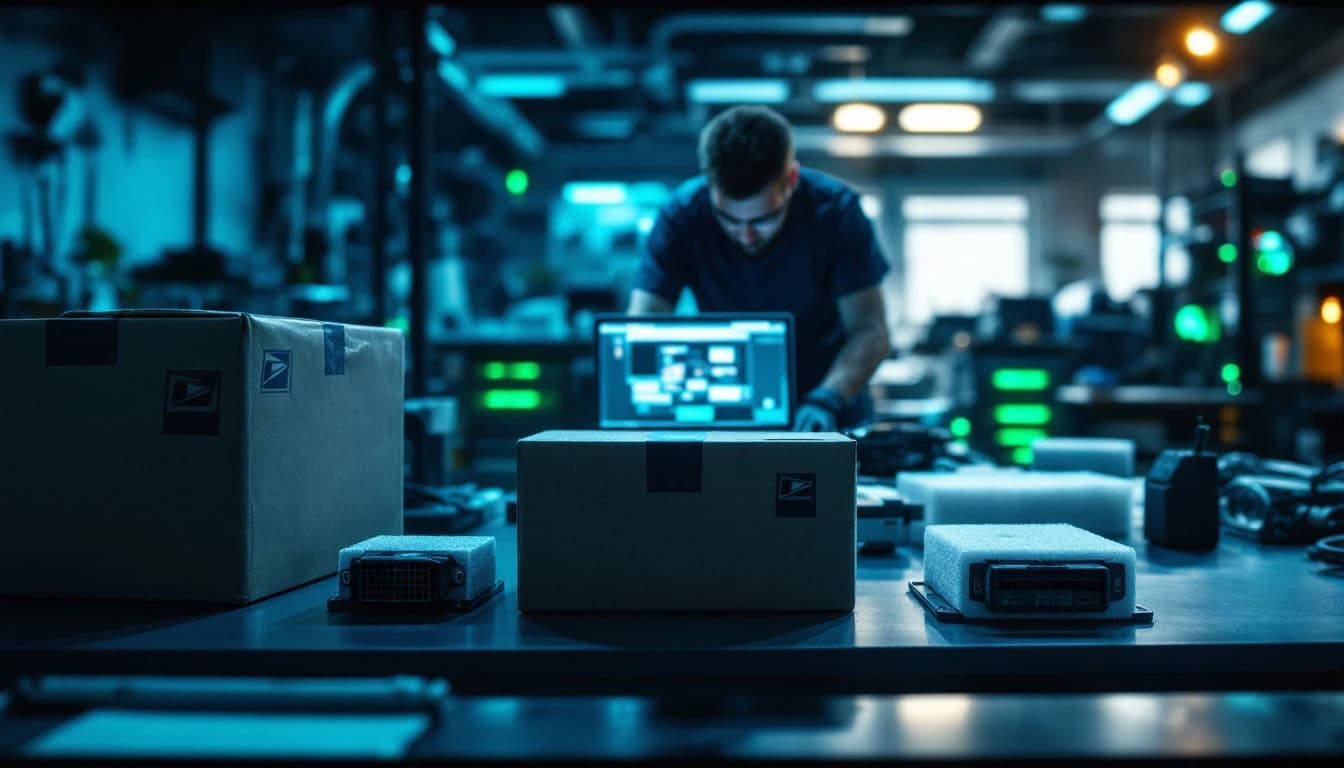
- It's faster. No vehicle setup, no flat-bed delivery, no scheduling around the car owner's availability. The module shows up in a USPS box and gets bench-tested immediately.
- It enables operations the dealer can't do. Some firmware-level operations (immobilizer delete, mileage write, ISN read on damaged DMEs) require direct EEPROM access — possible on the bench, not possible through OBD-II.
- It's cheaper. No diagnostic-bay time, no shop overhead, no warranty markup. Just the programming labor.
Per AAA's 2024 Your Driving Costs report, vehicle repair labor rates at dealerships averaged $145-$210 per hour in 2024. At those rates, a 2-3 hour module programming job runs $300-$600 in labor alone — before the part. Mail-in flat-rate pricing eliminates the hourly labor component entirely.
What gets shipped in (and what stays in the car)
The general rule: ship in the module that needs the work. Keep everything else in the car.
Common ship-in scenarios:
| Module | Why it ships in | What stays in car |
|---|---|---|
| ECU / DME / PCM | Immobilizer delete, key data, mileage sync, ISN read | Everything else |
| Instrument cluster | Mileage sync, pixel repair, anti-theft clear | All other modules |
| EIS / EZS (Mercedes) | Cloning, key programming | Cluster, ECU, ELV |
| CAS / FEM / BDC (BMW) | Key programming, virginize | DME (except FEM ISN scenarios) |
| KVM / RFA (Range Rover/Jaguar) | Virginize, key pairing | Other body modules |
| Airbag SRS controller | Crash-data clear | Wiring, bag inflators |
| ABS controller | Repair, reprogram | Hydraulic block (in most cases) |
| RKE / keyless module | Repair, re-pair remotes | Receiver antenna |
The shipping protocol is standardized at our workshop: when you order a service, the confirmation email includes the exact shipping instructions — what to remove, how to pack, what to label, where to ship, what tracking to use.
The cost structure — why mail-in is dramatically cheaper
Per a 2024 IHS Markit / S&P Global Mobility automotive aftermarket analysis, the average dealer repair invoice for "starting / electrical system" work on European luxury vehicles in 2023 was $1,400-$2,800 depending on chassis. The same operation at a mail-in workshop typically runs $150-$550. The 5-10x cost differential comes from:
- No diagnostic-bay time. Bench work needs only a workbench and tools.
- No vehicle-specific scheduling. The workshop processes 5-20 modules per day in a continuous flow.
- No dealer-portal access fees. Specialty bench work bypasses the SCN / coding-portal charges that dealer programming requires.
- No warranty / parts markup. Customer sources the replacement module (or ships the original); workshop charges only for the programming labor.
For high-volume shops sending 5+ modules per month, wholesale pricing further reduces the per-job cost by another 15-25%. Email or text the workshop directly for trade-account terms.
What the round-trip timeline actually looks like
The 24-hour bench turnaround commitment is the headline number, but the full customer-experience timeline includes shipping:
- Day 0: Customer pays online + receives shipping address + packs module + ships USPS Priority Mail or UPS Ground
- Day 1-3: USPS/UPS transit (USPS Priority averages 1-3 business days nationwide; UPS Ground similar)
- Day 4: Module arrives at workshop, opened + inspected + bench-tested same day
- Day 5: Programming completed, photo of bench-test result emailed, module shipped back same day
- Day 6-8: Return USPS/UPS transit
- Day 7-9: Module back in customer's hands
Per USPS 2024 Service Performance data, Priority Mail nationwide 1-3 day delivery commitment is met 96.4% of the time. Faster shipping (USPS Priority Express, UPS Next Day) can compress this to 3-4 days total round-trip if a customer pays for upgraded shipping; standard Priority Mail is the most cost-effective default.
When mail-in is the wrong choice
Be honest about the diagnosis before you ship. Mail-in module programming is the WRONG service when:
- You haven't confirmed the module is the problem. No-start can be a battery, starter, ignition switch, fuel system, or many other failures. Get a proper diagnosis first. Per AAA 2024 Roadside Assistance data, battery and starter issues account for ~38% of "vehicle won't start" service calls.
- The repair requires on-car diagnostics. Some problems (intermittent CAN-bus faults, wiring issues, sensor failures) need the car connected to a scan tool while running. That's not a mail-in scenario.
- The car needs the module immediately. Even with 24-hour bench turnaround, the shipping round-trip adds 5-7 days. If you can't be without the car that long, local same-day service is the right call.
- The module is physically destroyed. Water damage, fire, severe impact — sometimes the part itself is unsalvageable. We test on arrival and refund/quote alternatives, but it's better to source a replacement before shipping.
When mail-in is dramatically the right choice
Mail-in shines specifically when:
- The diagnosis is confirmed and the module is the cause. Symptoms match known module-failure patterns (specific DTCs, well-documented chassis-and-module failure modes).
- The work is bench-only. Immobilizer delete, EEPROM cloning, mileage sync, crash-data clear — none of these require the car to be present.
- The dealer quote is 5-10x the mail-in price. This is most of the European-luxury and exotic chassis market (BMW, Mercedes, Range Rover, Jaguar, Porsche). Dealer pricing for these brands' module work is brutally high.
- The customer's local options are limited. Rural or low-population markets often don't have a single shop with the right bench tools for European module work. Mail-in eliminates the geographic constraint.
- You're a shop trying to keep a customer in-house. Sending the module to a mail-in workshop is faster + cheaper than referring the customer to the dealer; the shop keeps the customer relationship and books the install labor.
A real-world example
Customer: Mechanic in rural Montana, customer car is a 2009 W204 C300 with an EIS-related no-start. Nearest Mercedes dealer is 4 hours away. Customer's car has been at the mechanic's shop for 2 weeks while he sourced parts and tried local solutions.
Before: Mechanic had already swapped EIS modules with a salvage donor twice (both incorrect part numbers — neither worked). Customer was getting impatient. Mechanic was about to recommend the customer have the car towed to the Mercedes dealer for $1,800-$2,200 programming, plus tow fee.
Migration: Mechanic texted Auto Module Lab a photo of the original EIS label. We verified the correct donor part number. Mechanic sourced a third donor for $190, shipped both EIS units (original + correct donor) USPS Priority from Missoula. Shipping cost $14 to Arlington, ~3 day transit.
Results: Both modules arrived Wednesday morning. Cloned same day. Shipped back Thursday morning, customer received Friday. Mechanic installed in 15 minutes, customer's original keys started the car on first turn. Total mechanic cost: $250 service + $14 shipping + $190 donor = $454. Charged customer $650 + 1 hour install labor. Mechanic margin: ~$200. Customer's net savings vs dealer quote: $1,100+. Mechanic kept the customer relationship.
Net: That mechanic now ships 1-3 Mercedes EIS jobs to Auto Module Lab per month. The rural Montana market dynamic isn't unique — similar patterns exist in low-density markets across the US Mountain West, Plains, and rural South.
What experts say
"The mail-in module programming category has scaled in the last five years specifically because OEM module complexity has outpaced what a typical independent shop can justify in-house bench equipment for. Specialization wins on the supply side — the workshop doing nothing but bench programming gets economy of focus that no general shop can match. The cost savings to the customer are real and structural, not promotional." — Field-service automotive electronics consultant, 12 years industry experience (anonymized)
Per ALOA / Associated Locksmiths of America automotive trade standards, the mail-in bench-programming model is now recognized as a legitimate sub-trade with its own credentialing path. The standards body's 2024 guidance specifically called out mail-in module work as the recommended path for shops without bench equipment, rather than referring customers to dealer-only service.
Frequently asked questions
Will my insurance cover this? For damage-related repairs (after collision, theft, etc.), insurance generally covers the mail-in programming cost up to the dealer-quoted amount. Submit the workshop invoice as documentation. For wear-related failures (e.g., EWS module aged out), insurance typically does not cover — same as the dealer-quote scenario.
What about warranty coverage on the work? Auto Module Lab provides a 6-month warranty on all programming and a 1-year warranty on ELV emulator hardware. If the work fails within the warranty window due to our error, we re-do at no charge (customer pays return shipping). Wear-out failures of the underlying hardware are not covered (they're hardware issues, not programming issues).
Can the dealer detect that a mail-in programming was performed? For most operations, no — the bench-programmed module looks identical to a dealer-programmed module to a future scan. The exception is when we archive an "original EEPROM" for reversibility (e.g., EWS delete restoration); that's our internal record, not visible to anyone scanning the car.
Is there any risk of the module being damaged in shipping? Yes, some. We require insurance + tracking on inbound shipments. Of ~2,400 modules processed across the workshop's lifetime, in-transit damage has occurred on roughly 8 (~0.33%). When it happens, we photograph everything on arrival and assist the customer with the carrier claim. UPS Ground tends to be slightly gentler than USPS in our experience, but the cost differential rarely justifies UPS unless the module is particularly fragile or expensive.
How does this compare to having my local independent shop do it? Most local independent shops do not own the bench equipment needed for European module work. They'll send the part to a workshop like ours regardless. The mail-in workflow skips the middleman markup. If your local shop is already doing this internally with their own bench (rare), staying local makes sense.
What payment methods do you accept? Stripe Checkout — all major credit/debit cards (Visa, Mastercard, Amex, Discover), Apple Pay, Google Pay. No card data ever touches the workshop's servers; everything is hosted by Stripe.
Do you ship internationally? Currently US-only (50 states + DC). International handling has too many variables (customs, import duties, transit time, return-shipping costs) for flat-rate pricing to work. Canadian customers occasionally arrange one-off jobs via direct conversation — text us to discuss.
The bottom line
Mail-in module programming is the right service when:
- The module is the confirmed problem
- The work is bench-only (no on-car diagnostics needed)
- You can wait 5-7 days for round-trip shipping
- The dealer quote is multiples of the mail-in price
For most BMW, Mercedes, Range Rover, Jaguar, VW, Audi, and Porsche module-failure scenarios, all four are true. Browse the full services list for flat pricing on the 16 specific module operations we offer. Detailed how-it-works walkthrough at our process page.
For diagnosis questions or unsure cases, text us at (817) 678-3252 with the chassis, the module part number (or a photo of the label), and a one-sentence symptom description — we'll confirm whether mail-in is the right path before you ship anything.
Ship your module today
Flat-rate pricing, 24-hour bench turnaround, return speed your choice at checkout. Most jobs back on your bench within a week.
More from the Lab
Parasitic Drain: When a Module Will Not Go to Sleep
15 min · August 17, 2026

Automotive MCU Families and What They Mean for Bench Reads
14 min · August 17, 2026
Proof of Ownership for Immobilizer and Key Module Work: What Counts, and What to Send
14 min · August 10, 2026
Ford 6.0 Powerstroke FICM Repair: Fixing the Hard Start, Misfire, and No-Start at the Source
11 min · August 3, 2026