
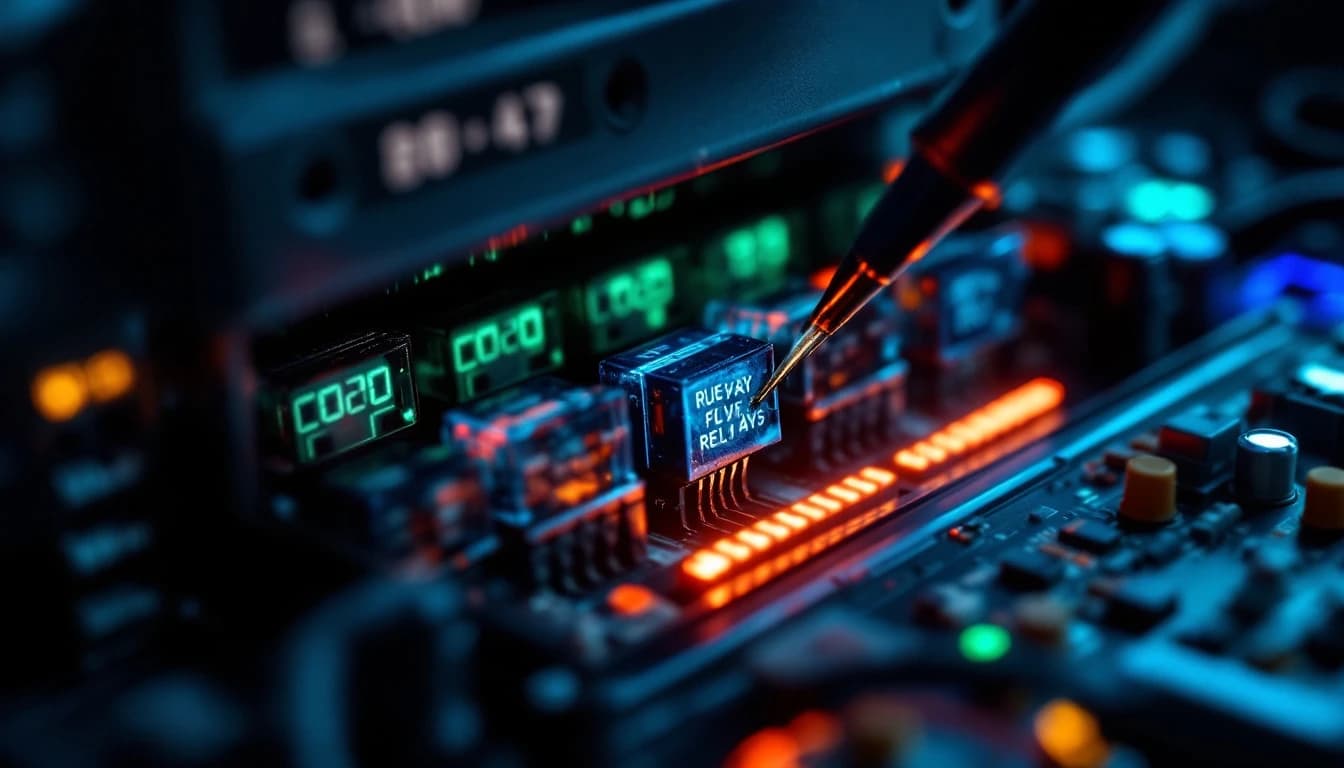
TIPM Failure Symptoms on Chrysler, Dodge & Jeep: Dead Fuel Pump, No-Start, Random Gremlins
What a TIPM actually is
Open the hood of most 2007-and-up Chrysler, Dodge, Jeep or Ram vehicles and you will find a black box near the battery that looks like an ordinary fuse and relay box. It is not ordinary. That box is the TIPM, the Totally Integrated Power Module, and it is one of the most important, and most misunderstood, modules on the vehicle.
The TIPM combines two jobs that used to be separate. It is the power distribution center, the fuse box that feeds circuits all over the car, and it is also a computer, a control module that talks on the vehicle network and decides when to switch power to major systems like the fuel pump, cooling fans, headlights, wipers, horn, and door locks. Instead of a simple mechanical relay clicking on when you turn a switch, many of those circuits are now commanded by the TIPM's internal board and its integrated relays.
That integration is elegant when it works and maddening when it does not. Because the TIPM sits at the center of so many circuits, a single internal failure can show up as a problem somewhere completely different, and owners end up replacing fuel pumps, batteries, and switches that were never actually bad. Stellantis, the parent company of the Chrysler, Dodge, Jeep and Ram brands, documents its vehicles at stellantis.com, and the TIPM design has been a fixture across the lineup for well over a decade.
The symptoms that point to a TIPM
TIPM failures are notorious precisely because the symptoms are so varied. Here are the classic ones.
Dead fuel pump, sudden no-start or stall
The single most common TIPM complaint is a fuel pump that stops getting power. The fuel pump relay is integrated into many TIPMs, and when that relay or its control circuit fails, the pump does not run. The car cranks but will not start, or it stalls and will not restart. A frequent field diagnostic clue is that tapping or bypassing the fuel pump circuit temporarily revives the car, which points straight at the TIPM rather than the pump itself.
Fuel pump that runs constantly and drains the battery
The opposite failure is just as common: the fuel pump relay sticks on, so the pump keeps running with the key off. Owners notice a humming noise from the tank after parking, or they come out to a dead battery morning after morning. This "fuel pump won't shut off" pattern is a hallmark TIPM fault.
Random electrical gremlins
Because the TIPM controls so many circuits, a failing board can produce genuinely bizarre behavior: wipers that turn on by themselves, a horn that beeps at random, headlights or interior lights flickering, door locks cycling, or the vehicle refusing to shift out of park. These "gremlin" symptoms are frustrating because they come and go, and they rarely point an untrained eye at the power module.
Intermittent no-crank and dashboard chaos
Some TIPM failures show up as an intermittent no-crank, where the starter sometimes does nothing, alongside multiple warning lights and implausible fault codes that do not agree with each other. When several unrelated systems misbehave at once, the common denominator is often the module feeding them all.
These failure patterns are well documented in the field. The National Highway Traffic Safety Administration has recorded a large volume of owner complaints and investigations tied to power-distribution and stalling concerns on affected Chrysler-family vehicles, and enthusiast and repair coverage from outlets like MotorTrend and Car and Driver has repeatedly flagged TIPM-related stalling and no-start behavior as a known pain point on these platforms. When a symptom shows up on hundreds of thousands of similar vehicles, it stops being a fluke and becomes a pattern worth diagnosing directly.
Why owners chase the wrong parts first
The reason TIPM problems cost people so much money is that the symptoms mimic other failures. A dead fuel pump circuit feels exactly like a dead fuel pump, so owners drop the tank and replace a perfectly good pump. A constant battery drain feels like a bad battery or alternator, so those get replaced. Random gremlins feel like wiring faults, so hours get spent chasing harnesses.
One independent Mopar-focused technician summed up the pattern this way:
"I cannot count how many customers roll in with a brand-new fuel pump, a new battery, and a stack of receipts, still stranded, because the real problem was the TIPM the whole time. Once you learn the symptom set, it is obvious. But the car does everything it can to make you blame the part downstream instead of the module switching the power. Test the TIPM first when the symptoms are all over the map, and you save the customer a fortune." — Independent Chrysler/Dodge/Jeep driveability technician, 16+ years on Mopar electronics (anonymized)
This is why understanding the symptom set matters. If you can recognize that a dead-or-constant fuel pump plus random electrical gremlins points at the power module, you stop throwing parts at the car. Our Dodge, Ram and Jeep no-start diagnosis guide covers how the TIPM interacts with the PCM and the SKIM immobilizer when a Mopar will not start, which is useful when the symptoms overlap.
Common failure points inside the TIPM
Most TIPM failures trace back to a handful of internal issues:
- Integrated relay failure. The fuel pump relay and other high-current relays are soldered into the board on many TIPMs. Their contacts wear, arc, and eventually stick open (dead circuit) or closed (constant power). This is the classic fuel-pump-relay failure.
- Solder joint and board fatigue. Heat cycling over years cracks solder joints and stresses the board, producing intermittent, temperature-dependent faults, the kind that come and go with weather.
- Water intrusion and corrosion. The TIPM lives under the hood; moisture that gets past a seal corrodes contacts and traces.
- Internal control circuit faults. The logic that commands the relays can itself fail, so the relay is fine but is never told to switch.
Because these are board-level and relay-level failures, many TIPMs can be repaired rather than thrown away, which is the whole point of a bench service.
Repair your original vs replace with a new TIPM
When a TIPM fails, you have two paths, and the cost difference is large.
| Bench repair (your original TIPM) | Dealer replacement (new TIPM) | |
|---|---|---|
| What happens | Failed relays / board faults repaired on your unit | Brand-new module installed and programmed to VIN |
| Your configuration | Preserved, it is your original module | New unit must be programmed to your car |
| Programming needed | None, it is your unit | Yes, VIN and configuration programming |
| Typical cost | From $299 (mail-in bench repair) | Often many hundreds to four figures, part plus programming |
| Turnaround | Mail-in bench, fast once it arrives | Depends on part availability and shop schedule |
| Best when | Common relay/board failure on a repairable unit | Module is physically destroyed |
A new TIPM is not plug-and-play. Like most modern control modules, a replacement has to be programmed to your VIN and configuration, which is why the dealer bill includes both a pricey part and programming labor. Cost-tracking resources like Kelley Blue Book and repair-cost coverage generally place full module replacement well above the cost of a targeted repair, which is exactly why bench repair of the original unit is so attractive when the failure is a repairable relay or board fault. For a broader view of module repair economics, our module and ECU programming cost guide puts TIPM repair in context with the rest of the catalog.
The mail-in bench repair workflow
The TIPM repair is a mail-in bench service, so you ship the module rather than bring the vehicle anywhere. Here is how it runs:
- Verify first. Text or email your VIN, the TIPM part number off the label, a description of your symptoms (dead fuel pump, constant pump, gremlins, no-start), and a photo of the module. A technician confirms your exact TIPM is one that can be repaired before you ship anything.
- Remove and ship the TIPM. Disconnect the battery, remove the module, and ship it to PO Box 120241, Arlington TX 76012 if you ship USPS — or 1168 W Pioneer Parkway, Arlington TX 76013 if you ship UPS or FedEx (UPS and FedEx cannot deliver to a PO Box), packed well.
- Bench diagnosis. On arrival the TIPM is tested on the bench to confirm the failed relays, joints, or circuits.
- Repair. The failed internal relays and board-level faults are repaired on your original unit, so your configuration is preserved and no VIN programming is needed.
- Bench test. The repaired module is tested before it leaves the shop.
- Return with tracking. It ships back via the return option you pick at checkout (Standard $14.95, UPS 2-Day $29.95, or UPS overnight $74.95). Return shipping is paid by the customer. You reinstall it and reconnect the battery.
Because the repair is done on your original module, there is no immobilizer or VIN re-programming step, which is one more reason it is faster and cheaper than a replacement. This is the workflow behind our TIPM repair service for Chrysler, Dodge and Jeep.
What the repair does not fix
To keep expectations honest:
- It does not repair a physically destroyed or severely burned module. If the board is beyond repair, replacement is the path.
- It does not fix an actually failed fuel pump. If your pump is truly dead, that is a separate mechanical repair; the TIPM repair addresses the power switching, not the pump motor.
- It does not diagnose wiring faults outside the module. If a harness is chafed or a connector is corroded, that is separate.
- It does not replace the need to verify fitment. A technician confirms your specific TIPM part number is repairable before you ship.
Reliability studies such as those from J.D. Power consistently rank electrical and electronic problems among the more common owner complaints across the industry, and a module that switches power to a dozen circuits is a prime example of why. Fixing the TIPM correctly removes an entire cluster of those complaints at once.
A quick self-check before you condemn a part
Before you spend money on a fuel pump or a battery, a few observations point strongly at the TIPM. If the fuel pump will not prime but the car starts after you tap the module or move the fuel-pump relay into a different slot, the pump is almost certainly fine and the TIPM relay is the culprit. If the pump keeps humming with the key out of the ignition, that is a stuck relay inside the module, not a pump problem. If two or more unrelated systems misbehave at once, wipers and door locks and a no-crank, for example, the common power source feeding all of them is the suspect rather than each individual circuit. And if the symptoms change with temperature or vibration, coming and going as the engine bay heats up, that pattern fits a cracked solder joint on the TIPM board rather than a hard failure in a downstream component. None of these replace a proper bench test, but together they are why an experienced technician reaches for the power module first when the symptom list is scattered across the whole vehicle instead of pointing cleanly at one system. Recognizing that pattern early is the single biggest thing that saves an owner from a pile of receipts for parts that were never bad.
Frequently asked questions
What are the most common signs of a failing TIPM? The most common signs of a failing TIPM are a dead fuel pump that causes a no-start or stall, a fuel pump that runs constantly and drains the battery, and random electrical gremlins like wipers, horn, lights or door locks operating on their own. Because the TIPM switches power to many circuits, one internal failure can show up as symptoms all over the vehicle, which is why owners often misdiagnose it as a bad pump or battery.
Can a bad TIPM cause a no-start? Yes, a bad TIPM is a very common cause of a no-start on Chrysler, Dodge, Jeep and Ram vehicles because the fuel pump relay is often integrated into the module. When that relay or its control circuit fails, the fuel pump gets no power, so the engine cranks but will not start. A classic clue is that tapping or bypassing the fuel pump circuit temporarily revives the car, pointing to the TIPM rather than the pump.
Is it cheaper to repair or replace a TIPM? Repairing your original TIPM is usually far cheaper than replacing it, because a new module has to be purchased and then programmed to your VIN and configuration, which adds both part cost and programming labor. A bench repair starts at $299 and fixes the failed internal relays and board faults on your existing unit, so no VIN programming is needed and your original configuration is preserved.
Does a replacement TIPM need to be programmed? Yes, a replacement TIPM must be programmed to your VIN and vehicle configuration before it will work correctly, which is why a dealer replacement bill includes both an expensive part and programming labor. Repairing your original module avoids this entirely, since your unit already carries the correct configuration and only the failed relays or board faults are addressed.
Why does my fuel pump keep running after I turn the car off? A fuel pump that keeps running after the key is off is a hallmark TIPM failure caused by the fuel pump relay sticking closed, so power is never cut to the pump. This drains the battery overnight and can leave you stranded with a dead battery in the morning. Repairing the stuck relay in the TIPM restores normal shut-off behavior without replacing the whole module.
Can I fix a TIPM myself? Repairing a TIPM yourself is difficult because the failure is usually at the integrated relay or circuit-board level, which requires bench diagnosis, the right replacement relays, and proper soldering to fix without creating new faults. Swapping in a used TIPM is also not plug-and-play because a replacement needs VIN programming. A mail-in bench repair of your original unit is the reliable path for most owners.
How do I know if my exact TIPM can be repaired? You confirm whether your exact TIPM can be repaired by sending your VIN, the TIPM part number off the label, a photo of the module, and a description of the symptoms so a technician can check it against known-repairable units before you ship. Most common relay and board failures are repairable; a physically destroyed or severely burned module may need replacement instead.
The bottom line
The TIPM is both the fuse box and a computer on Chrysler, Dodge, Jeep and Ram vehicles, and its central role is exactly why its failures are so confusing. A dead or constant fuel pump, intermittent no-starts, and random electrical gremlins are the classic symptom set, and recognizing them saves owners from replacing pumps, batteries, and switches that were never bad. Inside, the failures are usually integrated relays, tired solder joints, corrosion, or control-circuit faults, most of which are repairable.
Repairing your original TIPM on the bench starts at $299 and preserves your configuration with no VIN programming, which is why it is typically far cheaper than a dealer replacement that has to be bought and programmed. To get started, see the TIPM repair service for Chrysler, Dodge and Jeep and text us your VIN, TIPM part number, and symptoms, plus a photo of the module. A technician confirms your exact TIPM is repairable before anything ships, plus customer-paid return shipping chosen at checkout (from $14.95).
Ship your module today
Flat-rate pricing, 24-hour bench turnaround, return speed your choice at checkout. Most jobs back on your bench within a week.
More from the Lab
Chrysler, Dodge & Jeep PCM Replacement: Why a Used PCM Won't Start (SKIM / Sentry Key)
11 min · July 13, 2026
Dodge, Ram, Jeep, or Chrysler Won't Start? TIPM vs PCM vs WIN/SKIM — A Symptom-Based Diagnosis Guide
11 min · July 9, 2026
TIPM Repair Chrysler Dodge Jeep Ram 2007-2018: Mail-In 2026
12 min · June 18, 2026
Mopar Stock OEM Re-Programming Back to Factory: Mail-In 2026
12 min · June 18, 2026