
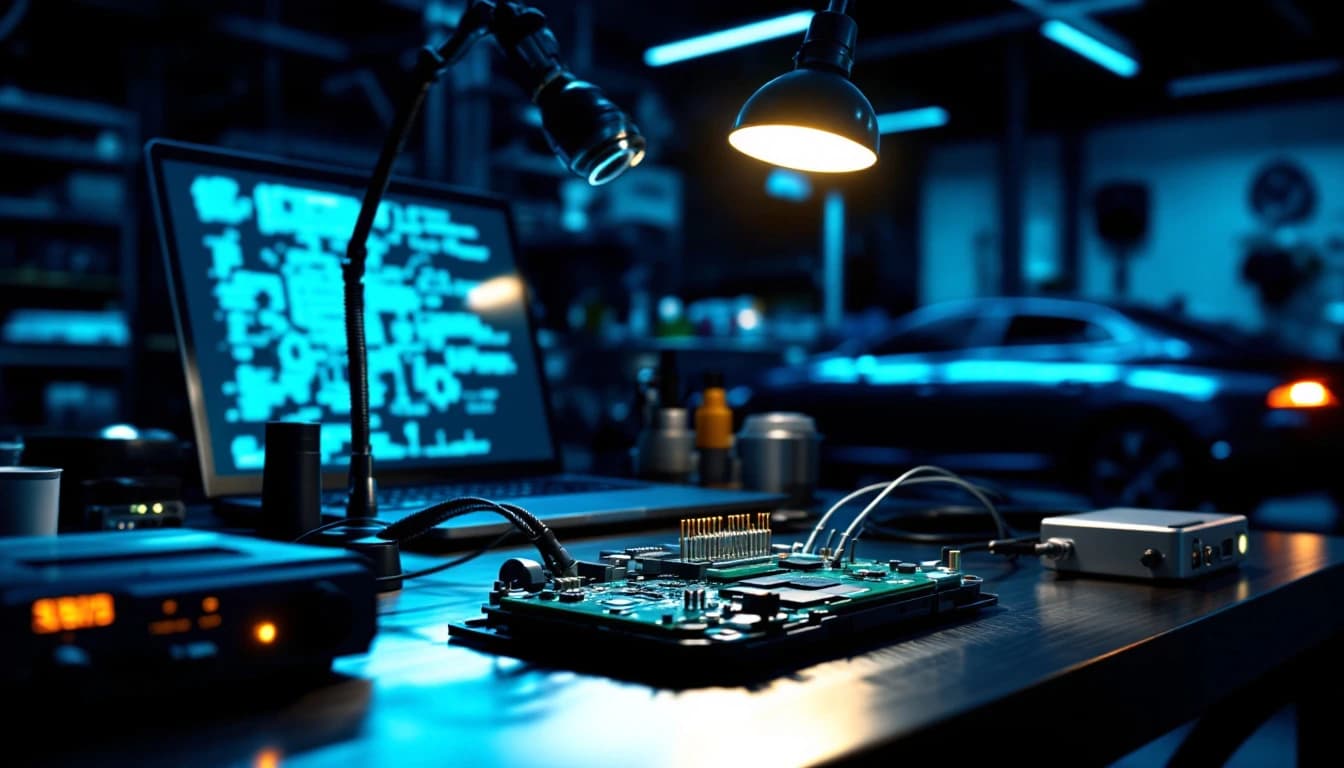
Mercedes SIM271DE2.0 ECU Clone & Renew: How to Make a Used Engine Computer Actually Start Your C-Class, E-Class, or SLK
The $80 eBay ECU that will never start your Mercedes
Here is the scenario that fills our inbox. A 2012 C250 dies — no communication with the engine computer, or a crank-no-start that every scan tool traces back to a dead ECM. The dealer quotes a brand-new engine control unit, SCN-coded to the VIN, and the number lands somewhere north of a thousand dollars before diagnosis, labor, and the tow to get the car there. Then the owner finds the exact same part on eBay, pulled from a wrecked donor car, for eighty bucks.
They bolt it in. The engine cranks strong. It never fires. Not once.
Nothing is broken. The used computer is working exactly as designed — it is refusing to start a car it was never married to. Every Mercedes of this era protects the engine computer with FBS drive authorization, the same electronic-immobilizer architecture the Insurance Institute for Highway Safety credits with driving vehicle theft rates down as it spread through the fleet. The system is spectacularly good at its job. The problem is that its job includes refusing you, the legitimate owner, when you install a second-hand module.
This guide covers what the SIM271DE2.0 actually is, which cars use it, why the used-ECU swap fails, and how bench cloning or a renew-to-virgin turns that $80 donor into a plug-and-play repair for a flat $250 — with the factory security system fully intact.
What the SIM271DE2.0 is, and which Mercedes have one
The SIM271DE2.0 is an engine control unit built by Continental, the German mega-supplier that most drivers know for tires but that also ranks among the largest automotive-electronics manufacturers on earth, with annual sales on the order of €40 billion. Mercedes paired this ECU with the M271 EVO engine — the 1.8-liter turbocharged, direct-injected CGI four-cylinder that replaced the earlier supercharged Kompressor unit.
The DE in the name is the tell: Direkteinspritzung, direct injection. (Its predecessor, the SIM271KE2.0, ran the supercharged port-injection Kompressor engines — a different unit that is not interchangeable.) If your Mercedes is one of these, roughly 2009 through 2015 depending on model and market, there is a strong chance a SIM271DE2.0 is running the engine:
- C-Class W204 — C180, C200, and C250 CGI sedans, wagons, and coupes. The W204 was a massive seller; Daimler built roughly 2.4 million of the generation worldwide per Mercedes-Benz's own press materials, and the 1.8T four-cylinder cars made up a huge share outside the AMG and V6 trims.
- E-Class W212 and C207/A207 — E200 and E250 CGI sedans, coupes, and cabriolets.
- SLK R172 — SLK200 and SLK250 roadsters from roughly 2011 on.
These cars are now deep into the second- and third-owner phase of their lives. S&P Global Mobility puts the average age of a vehicle on U.S. roads at more than 12.5 years and still climbing — which lands the entire W204 generation squarely in the years where an engine-computer failure meets an ownership budget that does not stretch to four-figure dealer electronics. That collision is exactly why the used-ECU-plus-cloning path exists.
Why a used Mercedes ECU cranks but never starts
Mercedes calls its immobilizer architecture FBS — Fahrberechtigungssystem, literally "drive authorization system." From the mid-1990s onward, every generation tightened the cryptographic handshake between the key, the EIS (Electronic Ignition Switch), and the major drivetrain modules. On FBS3 cars — which covers this entire M271 EVO era — the engine ECU is personalized to the car at the factory: it stores secret key data unique to that specific vehicle, and on every start it exchanges a cryptographic challenge with the EIS before it will enable injection and ignition.
Install a used ECU and the handshake fails instantly. The donor computer is still faithfully carrying the donor car's secrets. Your EIS asks its challenge, gets an answer computed from the wrong keys, and the ECU sits there — powered up, communicating, perfectly healthy, and completely unwilling to run the engine. Crank, no start, no fault beyond a start-enable or drive-authorization error.
Owners burn a lot of money learning this. It is the same trap we documented across every brand in our used ECU swap vs cloning guide and the broader VIN-locked module explainer: modern control modules are not interchangeable parts, they are identity-bearing computers. Mercedes is simply one of the strictest implementations. There is no OBD trick, no fuse pull, no battery disconnect that talks a foreign SIM271DE2.0 into cooperating. The identity data itself has to change — and that is bench work.
As one independent Mercedes drivability specialist put it:
"Every month someone tows in a W204 with a 'bad' used ECU they want warrantied. The ECU is fine — it's still married to a car sitting in a salvage yard in another state. I tell them the same thing every time: on a Benz you don't replace an engine computer, you replace the hardware and keep the identity. Clone the original onto the donor and the car genuinely cannot tell anything happened. Skip that step and you own two computers and zero running cars." — Independent Mercedes-Benz drivability and electronics specialist, 20+ years, Texas (anonymized)
How these ECUs die in the first place
The SIM271DE2.0 is a robust unit, but this generation is now old enough that we see a steady stream of them on the bench, usually for one of these reasons:
- Water and corrosion damage. The ECU lives in the engine bay's electronics box; a degraded seal or a blocked drain lets moisture in, and the board corrodes until communication gets flaky or stops entirely.
- Voltage events. Jump-starts done backwards, welding on the car without disconnecting the module, alternator faults, or a charger left on a marginal battery can kill drivers on the board.
- Internal component aging. Failed voltage regulators and driver stages simply wear out — the car develops misfire codes, injector-circuit faults, intermittent no-communication, or dies while driving.
- Failed repair attempts. A module that has been opened and reflowed by an electronics shop, then reinstalled with no start — we see plenty of those, and the identity data usually survives even when the repair did not.
The failure pattern matters because it decides which bench path your car needs. A dying ECU that still powers up and responds is a cloning candidate — and you should clone it while it still responds. An ECU that is completely dead, or missing entirely because the car was bought as a project, needs the renew path instead. Estimate aggregators like RepairPal put typical engine-control-module replacement in the $1,000–$1,500 range before any dealer coding — on a 12-year-old C250, cloning an $80 donor for $250 is often the difference between fixing the car and scrapping it.
Path one: the clone — plug and play, no coding at all
If your original SIM271DE2.0 powers up and responds to a diagnostic session — even if it is misbehaving, corroded, or intermittent — we can almost always read it. The clone service works like this on the bench:
- Both units are read first. Your original and the donor are each connected on the bench with a regulated power supply, and their contents are read and backed up before anything is written. Nothing destructive happens to either unit.
- The complete identity moves across. The original's drive-authorization data, immobilizer secrets, VIN, variant coding, and calibration are written onto the donor hardware. This is a full identity transplant, not a partial edit.
- The donor is verified. After writing, the donor is read back, checksummed, and communication-tested before it ships back to you.
The result is the closest thing to a factory repair that exists: healthy used hardware carrying your car's exact original identity. It installs plug and play. No dealer visit, no SCN coding session, no key relearn — your existing keys keep working because, as far as the EIS is concerned, the original ECU never left. The FBS immobilizer stays fully active, which matters for insurance and theft protection; the National Insurance Crime Bureau still logs on the order of a million vehicle thefts a year in the U.S., and a working immobilizer is your car's single best defense in that statistic.
Path two: the renew — when the original is dead or gone
When the original ECU does not power up at all, will not respond on the bench, or simply is not there (project car, stripped salvage purchase, module lost by a previous shop), there is nothing to read — so there is nothing to clone. The donor has to be prepared a different way: a renew, sometimes called virginizing or resetting to new mode.
On the bench, the donor's identity and drive-authorization data are reset to the state of a brand-new, never-married unit. A virgin FBS3 ECU behaves like a fresh part from the parts counter: at installation it can be married to your car's EIS and adopt your vehicle's drive authorization, instead of clinging to the donor car's.
Two practical notes on this path, and we flag both before you ever ship:
- Dead-original jobs sometimes need the EIS and a working key shipped in. Depending on the situation, the cleanest way to guarantee a plug-and-play result is to code the renewed donor to your drive-authorization system right on the bench — which requires your EIS and one working key in the box. A technician tells you up front whether your job needs this.
- Variant coding may still apply. A renewed donor keeps the engine calibration already on it. If your donor came from a matching car — same engine, same transmission type, same market — that is usually the end of the story. If the variant differs, a shop or dealer SCN coding session at install may still be required, and we tell you before work begins rather than after.
If your EIS itself is part of the problem — a common companion failure on these cars — that is its own repair family: see our EIS cloning and EIS key programming services, and the pre-2014 vs post-2014 FBS4 explainer for why this whole bench economy only exists on the earlier system. And if the car also refuses to release the steering lock, read the ELV failure cost analysis — a seized electronic steering lock produces a no-start that gets misdiagnosed as an ECU fault more often than you would think.
Sourcing the donor: five minutes of checking saves two weeks of shipping
You supply the donor ECU, and the donor market is good — these engines shipped in enormous volume, so salvage supply is deep and cheap. A few rules keep the project on rails:
- Match the Mercedes part number. The A-number on the donor's label should match your original's as closely as possible. Same part number is ideal; nearby revisions are often compatible, but that is our call to make, not a gamble to take.
- Confirm it is a DE2.0, not a KE2.0. The supercharged-era SIM271KE2.0 looks similar in listings and does not interchange. If the donor car was a Kompressor, keep scrolling.
- Prefer a donor from a running-when-wrecked car. Rear-end collision donors are ideal. Avoid flood cars and listings with corroded connectors in the photos — you are buying this module for its healthy hardware.
- Send us photos before you buy. This is the part that costs nothing: text or email your VIN plus the label photo of your original and the listing photos of the donor, and a technician confirms the pair is compatible before you spend a dime or ship a box.
That verify-first step is standard on every order. Fewer than five minutes of part-number checking eliminates essentially all of the round-trip disappointment in this repair.
The honest cost comparison
| Path | Typical all-in cost | Starts the car? | Notes |
|---|---|---|---|
| New dealer ECM, SCN-coded | $1,000–$1,500+ plus labor and tow (RepairPal range) | Yes | New hardware, but the car goes to the dealer and the invoice goes north fast |
| Used ECU bolted in as-is | $50–$150 for the part | No — cranks, never fires | FBS drive authorization rejects it, every time |
| Used ECU + bench clone | Part + $250 flat + return shipping | Yes — plug and play | Original identity preserved, keys untouched, immobilizer intact |
| Used ECU + renew (dead original) | Part + $250 flat + return shipping | Yes — married at install | EIS + working key shipped in when a technician calls for it |
The clone and renew paths are the same flat price because they are the same class of bench work. Return shipping is chosen at checkout — Standard $14.95, UPS 2-Day $29.95, or UPS overnight $74.95 — and inbound shipping to the lab is on you, with whatever carrier you like.
How the mail-in actually works
- Verify first. Text or email your VIN, a photo of your original ECU's label (if you have it), and the donor's label or listing photos. A technician confirms compatibility and tells you exactly what to ship — original + donor for a clone; donor alone, or donor + EIS + a working key, for a renew.
- Order and ship. Place the order online, pack the modules in a box with padding, and ship to the lab in Arlington, Texas. Proof of ownership — title, registration, or bill of sale — rides along, as it does for any immobilizer-related work.
- Bench work. Read, back up, clone or renew, verify, and communication-test with a regulated bench supply. Turnaround once your modules arrive is fast — this is a same-bench, same-day class of job in most cases.
- Reinstall and drive. A cloned donor goes in exactly like the original came out. A renewed donor marries to the car at first key-on, or arrives pre-coded when the EIS came in with it.
Frequently asked questions
My original ECU still runs the car but has intermittent faults. Should I wait until it dies?
No — this is the one scenario where acting early genuinely saves money. An ECU that still responds can be cloned; a dead one cannot. Cloning your failing original onto a healthy donor while the identity data is still readable keeps the whole job in plug-and-play territory.
Do my keys still work after a clone?
Yes. The donor carries your original's complete identity, so the EIS, your keys, and every other module see the exact same ECU they have always known. Nothing is relearned, nothing is re-coded.
Is this an immobilizer delete?
No. Both paths keep the factory FBS drive-authorization system fully active. The car demands a valid key exactly the way it did before — it simply gets its engine computer back. Nothing we do here weakens the theft protection the IIHS credits immobilizers for.
Can you supply the donor ECU?
No — you source the donor (eBay, salvage yards, parts recyclers all work), and we verify your pick by part number before you buy or ship. Supply on these units is deep because the M271 EVO cars sold in the millions.
My car is a C300, E350, GLK, or a diesel. Does this apply?
Not this exact service — those run different ECM families from different suppliers. Send your VIN and label photo anyway; we handle other Mercedes engine computers case-by-case and will point you at the right path or quote.
What if my EIS is bad too?
Then fix both, and tell us up front — combined EIS-plus-ECU jobs are common on these cars. Start with the EIS cloning service or the ELV emulator service if the steering lock is the failure, and a technician will map the whole repair before you ship anything.
Is a renewed ECU legal to install?
Yes — renewing a used module so it can be legitimately married to your own car is standard repair practice, the same operation a new part undergoes at the dealer. Proof of ownership is required on every immobilizer-related order, and mileage and emissions data are never manipulated.
The bottom line
A Continental SIM271DE2.0 failure does not have to end a good W204, W212, or R172 — and it absolutely does not require four figures at a dealer parts counter. The donor hardware is plentiful and cheap; the only real obstacle is identity, and identity is a bench problem with a $250 flat-rate answer. Verify the part numbers with us first, ship the modules, and get back a computer your Mercedes cannot tell from the original.
Ready to fix it? Start with the Mercedes SIM271DE2.0 ECU Clone & Renew service — or text the lab your VIN and label photos and a technician will confirm your donor before you spend anything.
Ship your module today
Flat-rate pricing, 24-hour bench turnaround, return speed your choice at checkout. Most jobs back on your bench within a week.
More from the Lab
Why a Used ECU From eBay or the Junkyard Will Not Start Your Car — and How Bench Cloning Makes It Truly Plug-and-Play
11 min · July 9, 2026
Your Programmed Module Came Back and the Car Still Will Not Start — A Systematic Troubleshooting Guide
15 min · July 26, 2026
How ECU Cloning Actually Works: EEPROM, Flash Memory, and Immobilizer Data Explained
12 min · July 20, 2026
Ford EEC-V PCM Cloning: Exactly Which Models and Years Are Covered (1996–2004), and What "Where Supported" Really Means
12 min · July 16, 2026