
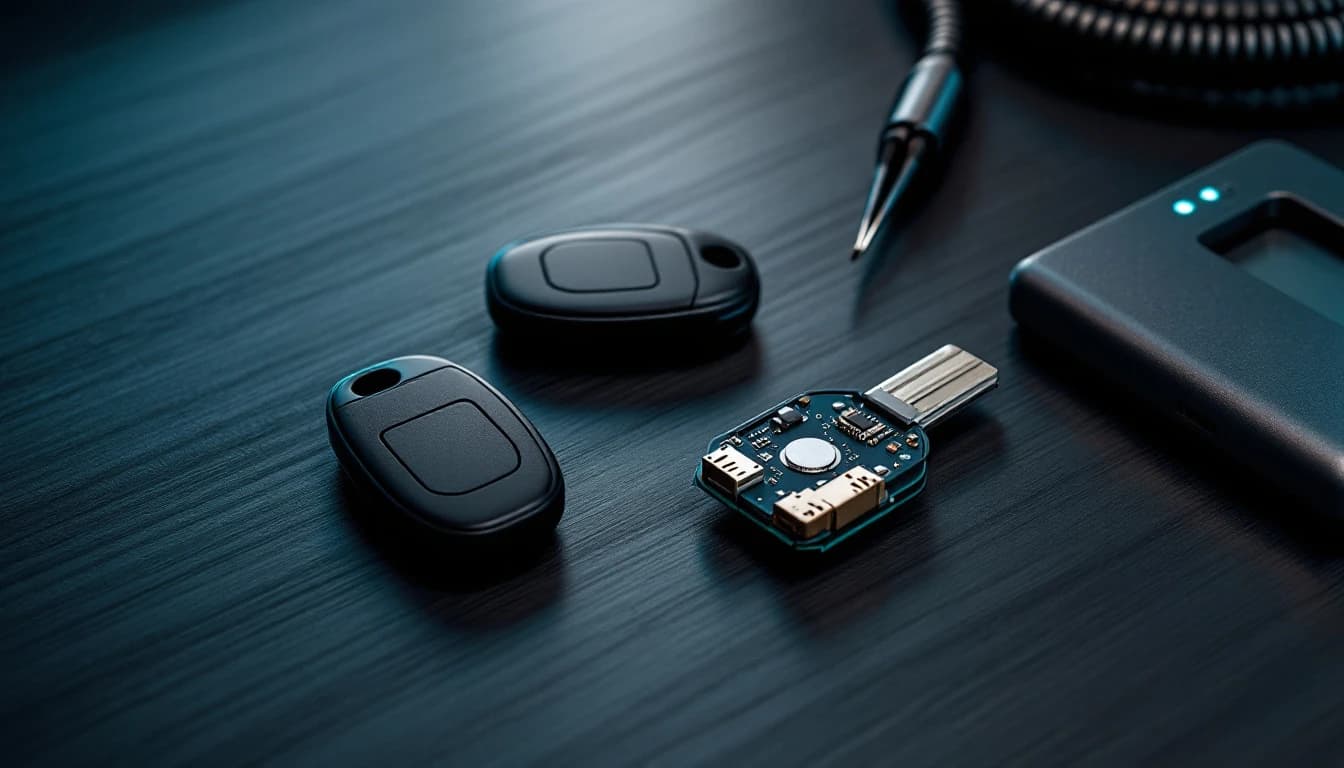
Toyota and Lexus All Keys Lost: What Push-to-Start Smart Key Recovery Really Costs (Mail-In Bench Guide)
Who this is for
Every week, somewhere in the country, a push-to-start Toyota or Lexus becomes a very well-built paperweight. The only smart key went through a washing machine, into a lake, off with a repossessed trailer, or vanished with the previous owner of an auction purchase. The car is healthy. The battery is charged. And nothing you do will make it start, because the one electronic credential the vehicle trusted no longer exists.
This guide is for that situation — all keys lost (AKL) on a push-to-start Toyota or Lexus — and specifically for the people who want to solve it without towing the car anywhere:
- Owners of roughly 2010-2017 push-to-start Toyota and Lexus vehicles with zero working smart keys
- Rebuilders and auction buyers who received a running car and no keys
- Independent shops and used-car dealers who need an AKL solution that does not involve a flatbed to the dealership
- Anyone quoted a four-figure dealer bill for a "new certification computer and keys" who wants to understand the cheaper path first
The short version: on supported systems, all-keys-lost is a bench problem, not a vehicle problem. The immobilizer decision lives in one module. You ship us that module, we solve it on the bench for a flat $250, and the car starts when the module goes back in. The Toyota / Lexus smart-key all-keys-lost key generation service is the exact service this article explains. Proof of ownership is required on every single order — more on that below, prominently, because it is not negotiable.
How the Toyota / Lexus smart-key immobilizer actually works
To understand why the bench path works, you need the ten-thousand-foot view of the architecture. A push-to-start Toyota or Lexus does not have one "immobilizer chip" — it has a small committee of modules that vote on whether the engine is allowed to run.
The certification ECU (the ID box). This is the heart of the system and the module this entire article is about. Toyota calls it the certification ECU; technicians call it the ID box or smart-key ECU. It is a small, unassuming box — typically hidden behind the dash or glovebox — that stores the cryptographic identities of every registered smart key. When you walk up with a fob, the car and the fob perform a challenge-response handshake, and the certification ECU is the judge that says "this key is one of mine" or "never seen it."
The steering lock ECU. On many of these platforms, an electronic steering lock module must receive an unlock authorization tied to the same security conversation before the column releases and the car will proceed toward starting.
The engine ECU. Finally, the engine computer will not enable injection and spark until it receives a valid immobilizer release from the certification side. On Toyota and Lexus vehicles this engine-side pairing matters enough that we run separate bench services for it — the Toyota / Lexus certification ECU clone and the Lexus Denso ECU clone exist precisely because the engine computer and the immobilizer system are married to each other.
The design goal of this committee is theft resistance, and it works. The National Insurance Crime Bureau reported roughly one million vehicle thefts in the United States in a recent year, and modern immobilizer systems are one of the primary reasons late-model Toyota and Lexus products are dramatically harder to steal without a key than the vehicles of the 1990s. The same cryptography that stops a thief is exactly what stops you when the last registered key is gone.
Why all keys lost is so much harder than add-a-key
Here is the asymmetry that surprises most owners. If you still have one working smart key, adding a second is a routine registration procedure — the existing key vouches for the new one, the certification ECU accepts it, done. Locksmith tooling and even some dealer-adjacent procedures handle add-a-key all day.
With zero working keys, that door slams shut. There is no trusted credential left to open the registration session. The certification ECU sits there doing precisely its job: refusing everyone. On these platforms you cannot simply "reflash" your way in through the OBD port on many model years, and the vehicle will not grant a new key an audience without an existing key to sponsor it.
That leaves three realistic ways forward:
- The dealer path. Tow the vehicle to a dealership, which typically resolves AKL by replacing hardware — commonly the certification ECU, sometimes with associated components — and registering new keys to the fresh module.
- On-site specialist tooling. Some field techniques exist for some years, with wildly varying coverage and cost. This is not our lane and not this article.
- The bench path. Remove the certification ECU, ship it to a bench, and solve the problem at the level where it actually lives: the module's EEPROM.
We do the third one, by mail, from anywhere in the country.
What actually happens on the bench
The certification ECU stores its registered-key data in EEPROM — non-volatile memory inside the module. On the bench, with the module out of the car and on a regulated power supply, we can read that memory directly. From there, two outcomes are possible depending on the platform and what you need:
Smart key generation. Working from the immobilizer data read out of your module, we generate a working smart key — a new OEM smart-key blank, supplied by you with the module, is programmed so that your certification ECU recognizes it as a registered key. This is true key generation from the module's own data. It is fundamentally different from cloning, which copies an existing key — useless in AKL, because you have no key to copy.
Smart code reset. On some platforms the correct fix is to reset the smart code — returning the module's registration state so the vehicle can accept keys again and start. Think of it as clearing the guest list so the system can be re-taught, rather than forging an invitation for one guest.
Either way, the intelligence of the fix happens at the EEPROM level, on the bench, with your module in hand. Nothing about it requires the vehicle to be present, which is exactly why it ships in a padded box instead of on a flatbed.
"People hear all keys lost on a push-button Toyota and assume the whole car has to go to the dealer. It doesn't. The car's opinion about keys lives in one little box behind the dash. Get that box to someone who can read it properly and the problem is a bench job. I've sent modules across three states and had customers driving the week the box came back." — Master automotive locksmith and immobilizer specialist, 20+ years on Toyota and Lexus platforms (anonymized)
The dealer path, priced honestly
Nothing here is a knock on dealers — they follow the factory playbook, and the factory playbook for AKL is hardware replacement plus key registration. But the playbook is expensive, because you are paying for several stacked line items:
- The tow. A push-to-start car with no keys does not drive itself to the service lane.
- New hardware. A new certification ECU (and on some jobs, related components) at retail parts pricing.
- New OEM keys. Toyota and Lexus smart-key fobs are not cheap at parts-counter prices, and you typically buy two.
- Registration labor. Factory-tool time to marry the new module and new keys to the vehicle.
- The wait. Modules and keys are frequently special-order.
Stack those up and dealer AKL quotes on these platforms commonly land well over $1,000, and quotes in the $1,500-$2,500 range are routinely reported by owners depending on model, year, and region. Against a vehicle worth real money that math can still make sense — Kelley Blue Book has tracked average new-vehicle transaction prices hovering in the high-$40,000s, and clean used Toyota and Lexus products hold value famously well. But against a 2012 Camry or a 2014 RX with 140,000 miles, a $2,000 key bill is a genuinely painful percentage of the car.
The scale of the affected fleet is why this question comes up so often. Toyota sells at enormous volume — Car and Driver sales reporting has the company moving well over two million vehicles in the U.S. in a single recent year, with the RAV4 alone accounting for well over 400,000 units in a single sales year. Millions of 2010-2017 push-to-start Toyota and Lexus vehicles are on American roads right now, aging into exactly the ownership phase — third owners, auction lanes, lost-key incidents — where AKL happens. And because J.D. Power dependability rankings have placed Lexus and Toyota at or near the top year after year, these cars outlive their key fobs with ease. The car lasting 250,000 miles is the brand promise; the fob surviving three owners is not.
Dealer vs mail-in bench: the comparison
| Dealer AKL path | Mail-in bench path (this service) | |
|---|---|---|
| Vehicle must be towed | Yes — flatbed to the dealership | No — the vehicle stays put; only the module ships |
| What gets replaced | New certification ECU + new keys (typical) | Nothing — your original module is serviced |
| Typical cost | Commonly well over $1,000; $1,500-$2,500 quotes routinely reported | $250 flat + customer-paid return shipping from $14.95 |
| Keys afterward | New OEM keys registered by dealer | Working generated smart key (you supply a new OEM blank) or smart code reset |
| Coverage | Nearly all years, at a price | Roughly 2010-2017 push-to-start; 2018+ verified case-by-case |
| Ownership verification | Dealership process | Proof of ownership required before any work |
| Timeline | Parts order + tow + shop queue | Shipping both ways + bench time |
The honest reading of that table: the dealer path buys near-universal coverage at a steep price. The bench path is a fraction of the cost on the years it covers — which is why the first step of our process is verifying, by VIN and module label, that your vehicle is actually on the supported list before you spend a dollar on shipping.
Which module to pull, and how to identify it
The certification ECU / smart-key ECU is usually behind the lower dash or glovebox area on these platforms — a compact box with one or more connectors, identified by a Toyota / Denso part-number label. Exact location varies by model and year, which is one more reason the verify-first step exists.
Before anything ships, text us the following:
- Your VIN
- A clear photo of the module label (part number visible)
- Year, make, and model — for example, 2014 Lexus RX 350, push-to-start
- Whether you want a generated working key (you will include a new OEM smart-key blank for your vehicle in the box) or a smart code reset
A technician verifies fitment from the VIN and the module label before you ship. If your system is a 2018-or-newer / online-seed architecture that we cannot support, you find that out in a text message — not after a wasted shipping label. That is the whole point of verify-first.
Proof of ownership — required, always, no exceptions
This needs its own section, stated plainly: every key, immobilizer, and security-related order requires proof of ownership before any work is performed. Title, registration, or equivalent documentation matching the VIN of the vehicle the module came from.
This is not bureaucratic theater. Immobilizer systems exist because vehicle theft is a billion-dollar problem — the National Insurance Crime Bureau exists as an entire organization because of it — and a workshop that generates keys from immobilizer modules carries a responsibility not to become a tool for defeating that protection. A vehicle history check through a service like Carfax can also help auction buyers confirm what they bought before sending anything. Legitimate owners, rebuilders with proper paperwork, and shops working on customer vehicles clear this bar without friction. Anyone who cannot document ownership does not get service — full stop.
The professional locksmith industry formalizes this same standard: ALOA, the trade association whose certifications our technicians hold, builds ownership verification into its code of ethics for exactly this reason.
The mail-in workflow, start to finish
- Verify first. Text us the VIN, module label photo, and vehicle details. We confirm your push-to-start system is supported (roughly 2010-2017; 2018-and-newer online-seed systems verified case-by-case and honestly declined when not supported).
- Send proof of ownership. Title or registration matching the VIN. No work begins without it.
- Order and ship. Place the order — the bench service is $250 flat — and ship the certification / smart-key ECU to PO Box 120241, Arlington TX 76012 if you ship USPS — or 1168 W Pioneer Parkway, Arlington TX 76013 if you ship UPS or FedEx (UPS and FedEx cannot deliver to a PO Box). If you want a working generated key, include a new OEM smart-key blank for your vehicle in the same box. Anti-static bag, padded box, tracking number.
- Bench read. We power the module on a regulated bench supply and read the EEPROM, archiving the original data before any change is made.
- Generate or reset. We generate a working smart key from your module's own immobilizer data, or reset the smart code so the vehicle can start — whichever your platform and situation call for.
- Verification and return. The module is verified on the bench, then returns to you with tracking via the return-shipping tier you chose at checkout — customer-paid, from $14.95 standard, with faster tiers available.
- Reinstall and start. The module goes back in the car, the generated key is in your hand, and the engine runs.
Total elapsed time is shipping both ways plus bench time — for most customers, comparable to or faster than a dealership's special-order parts wait, without the tow bill.
The honest limits
Bench work earns trust by being straight about edges, so here are ours:
2018-and-newer systems are case-by-case. Later Toyota and Lexus security architectures move toward online-seed models where key authorization involves manufacturer server calculations. Some can be handled; many cannot. We verify by VIN and label and tell you the truth before you ship. Vehicle security architectures are also a moving target industry-wide — NHTSA has published cybersecurity best-practice guidance pushing automakers toward exactly this kind of hardened, server-anchored design — so expect the supported window to remain roughly 2010-2017 rather than silently expanding.
Registering additional keys later may require the vehicle. The bench service gets you a working key or a startable car. If you later want extra spare keys registered to the live, drivable vehicle, that registration may still require the vehicle present with on-site tooling — a bench cannot stand in for the car on every follow-up procedure. Plan on the bench solving AKL, and on sourcing spares locally once the car drives.
This is key generation at the module, not vehicle diagnostics. If the car has other problems — a dead steering lock ECU, wiring damage, a failing engine ECU — those are separate issues. Where the engine computer itself is the casualty, the Toyota / Lexus certification ECU clone and Lexus Denso ECU clone services cover the engine-side pairing on the bench.
Frequently asked questions
How much does all keys lost cost on a push-to-start Toyota or Lexus? Through the mail-in bench path, $250 flat plus customer-paid return shipping chosen at checkout from $14.95, plus the cost of a new OEM smart-key blank if you want a generated working key. The dealer alternative — tow, new certification ECU, new keys, registration labor — commonly lands well over $1,000, with $1,500-$2,500 quotes routinely reported on these platforms.
Which years and models are supported? Roughly 2010-2017 push-to-start Toyota and Lexus smart-key systems are the core coverage. 2018-and-newer vehicles and online-seed architectures are verified case-by-case and may not be supported — a technician confirms your exact system from the VIN and module label before you ship anything, so you never pay to find out.
What exactly do I mail in? The smart-key / certification ECU — the immobilizer ID box, typically located behind the dash or glovebox. If you want a working key generated, include a new OEM smart-key blank for your vehicle in the same package. Text us the VIN and a photo of the module label first and we will confirm you are pulling the right box.
Is this cloning my old key? No — it is true key generation, which is exactly why it works when every key is gone. Cloning copies an existing key and is impossible in a genuine all-keys-lost situation. We read the immobilizer data stored in your certification ECU's EEPROM and generate a new working key from that data, or reset the smart code so the vehicle starts.
Do I really have to prove I own the car? Yes, on every order, with no exceptions. Key and immobilizer work is only offered against documented proof of ownership — title, registration, or equivalent matching the VIN. This protects legitimate owners, keeps the service on the right side of the line that immobilizers exist to defend, and matches the ownership-verification ethics the professional locksmith industry requires.
Can you register more spare keys for me later? A working key or a startable car is what the bench delivers; additional spares later may require the vehicle on-site. Registering extra keys to a live, drivable car is a vehicle-present procedure on many of these platforms, so plan to have spares added locally once the car is back on the road — and then keep one in a drawer so you never meet this article again.
Why not just buy a used certification ECU with keys? Because the used-module route trades one problem for several: the donor module arrives married to the donor vehicle's engine ECU and keys, and making a mismatched set work is its own project that frequently dead-ends. Servicing your own original module keeps the vehicle's electronics consistent — the same reason plug-and-play used engine computers fail on immobilized cars.
The bottom line
All keys lost on a push-to-start Toyota or Lexus feels catastrophic because the car is engineered to make it feel that way — that is the immobilizer doing its job. But on roughly 2010-2017 smart-key systems, the entire problem is stored in one module's EEPROM, and that module fits in a padded box.
The math is simple. Dealer path: tow, new certification computer, new keys, registration — commonly well over $1,000 and routinely quoted far higher. Bench path: $250 flat, your original module, true key generation or a smart code reset, customer-paid return shipping from $14.95, and the vehicle never leaves your driveway. Proof of ownership is required on every order, fitment is verified by VIN and module label before you ship, and 2018-and-newer systems get an honest case-by-case answer instead of a promise.
Start at the Toyota / Lexus smart-key all-keys-lost service page, then text us your VIN and a photo of the module label. You will know whether your car is a $250 bench job before the box is ever taped shut.
Ship your module today
Flat-rate pricing, 24-hour bench turnaround, return speed your choice at checkout. Most jobs back on your bench within a week.
More from the Lab
Toyota & Lexus ECU Immobilizer Reset: Adding New Keys to Older Turn-Key Models Without a Dealer ECM
13 min · July 13, 2026
Toyota & Lexus Won't Start? Immobilizer, Smart Key, and Denso ECU Options
12 min · July 13, 2026

Toyota Lexus Certification ECU Clone: Smart Key Box (2026)
12 min · June 18, 2026
Toyota Lexus Denso ECU IMMO Off for Swaps & Builds (2026)
12 min · June 18, 2026