
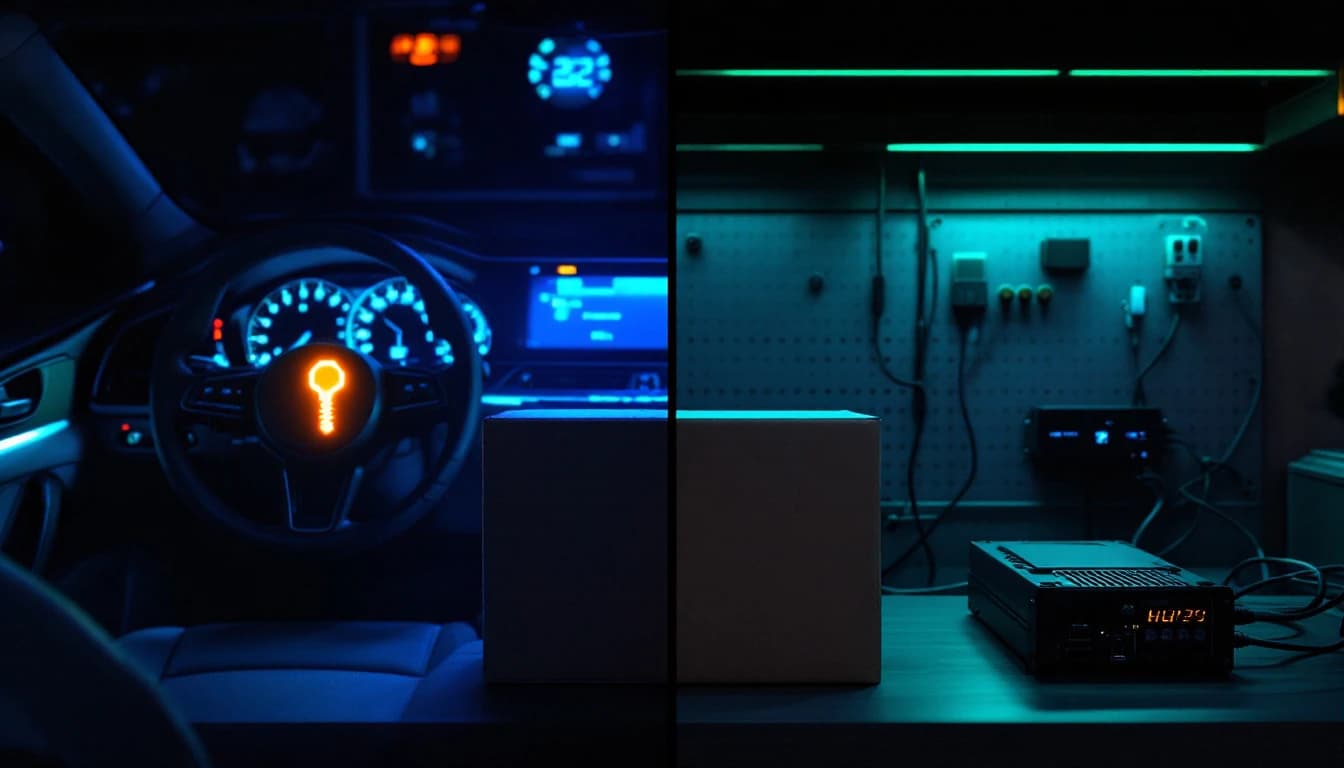
VW & Audi Immobilizer and No-Start by Platform: Immo 2 Through UDS/MQB
The symptom that brings VW and Audi owners here
The scenario is almost always the same. The engine cranks over strongly, the fuel pump primes, everything electrical looks healthy — but the engine catches for half a second and dies, or never fires at all, and the little immobilizer light (the key-and-car outline) is flashing in the cluster. Sometimes a scan tool reports the engine is running in a limp or "safe" mode. The owner assumes fuel pump, crank sensor, or a dead ECU. Nine times out of ten on these platforms, the mechanical parts are fine: the immobilizer has refused to release the engine because the security handshake between the key, the cluster, and the engine controller did not complete.
This is the immobilizer doing precisely what it was built to do. Engine immobilizers are one of the most effective anti-theft technologies ever fitted, and the data backs that up — the Insurance Institute for Highway Safety has documented measurable declines in theft rates for immobilizer-equipped vehicles, and immobilizers became effectively universal on European cars far earlier than on many other markets. Regulators drove that adoption: the National Highway Traffic Safety Administration administers the U.S. motor-vehicle theft-prevention standards that made anti-theft electronics mainstream. The context is a theft problem that remains enormous: the National Insurance Crime Bureau has tracked reported U.S. vehicle thefts running at or above one million per year in recent reporting, and the FBI Uniform Crime Reporting program consistently lists motor-vehicle theft among the highest-volume property crimes, with hundreds of thousands of vehicles stolen every year. A system that hard-stops a thief will, when a module or key fails or a used part is fitted, hard-stop the legitimate owner in exactly the same way.
The good news is that VW and Audi immobilizer behavior is highly predictable once you know which generation your platform uses. That is what this guide sorts out.
Where the immobilizer actually lives — and why it matters
Across VW and Audi history the immobilizer "secret" has migrated between modules, and that migration is the single most important thing to understand. The controllers involved are typically:
- The instrument cluster — on older systems this is the immobilizer master, holding the security code the key must satisfy.
- The engine ECU — the controller that ultimately allows or refuses fuel and ignition; it must agree with the immobilizer master.
- Kessy (Keyless Entry Start and Exit System) and the comfort/convenience modules — on newer keyless cars these join the security chain.
Why does this matter so much? Because a replacement part carries the identity of the car it came from. Fit a used cluster and it holds a stranger's security data. Fit a used ECU and it expects a different immobilizer master. Until those identities are reconciled — adapted, matched, or reset — the engine will not run. The location of the "secret" determines which module you actually have to work on, and it changes generation by generation.
Immo 2 and Immo 3 — the cluster is the master
The earliest systems commonly serviced on these platforms are Immo 2 and Immo 3, spanning roughly the mid-1990s into the mid-2000s depending on model. Here the instrument cluster is the immobilizer master. It stores the security code and the immobilizer identity, and it authorizes the engine ECU over a dedicated line (K-line on the earliest cars, later CAN).
On these generations the classic problems are:
- A failed cluster takes the immobilizer data with it, and a replacement doesn't hold your car's code.
- A replaced ECU doesn't match the cluster's expectations, so the two won't complete the handshake.
- Lost or damaged keys need to be re-coded to the cluster.
Because the cluster is the master, the fix usually centers on the cluster or on matching a controller back to it — reading the security data, adapting the ECU to the cluster, or programming keys to the cluster. On many of these cars the engine controller is a Bosch ME7 (gasoline) or an EDC family diesel unit, which is exactly where the bench immo-off services below come in. A VW/Audi cluster key programming or key-and-immo adaptation lets a replacement cluster and a set of keys agree with the rest of the car.
Immo 4 — component protection arrives
Immo 4 (broadly mid-2000s onward) is the generation where things get materially harder, because it introduces component protection. Instead of the cluster simply holding a code, the immobilizer identity is spread across multiple controllers — cluster, engine ECU, and on keyless cars the Kessy module — and those controllers are cryptographically bound to the car. Component protection means a module doesn't just need the right immobilizer code; it needs to be authorized as a component of this specific vehicle.
This is the era where the "just swap in a used ECU" approach falls apart most dramatically. On an Immo 4 car:
- A used engine ECU carries the donor vehicle's component-protection status and immobilizer data, so your car rejects it.
- Simply matching the immobilizer code is not enough — component protection has to be reset or the module adapted so it is authorized for your VIN.
- Kessy and comfort modules can also carry protection status that has to be reconciled.
The bench answer for many Immo 4 gasoline cars running the Bosch ME7 ECU is a VW/Audi ME7 immo-off service — a flat $250 bench job that turns off the immobilizer requirement in the ECU calibration so it runs independently of the cluster handshake, which is invaluable when the original cluster is gone, the immo data is unrecoverable, or a used ECU has to be pressed into service. Where the goal is instead to keep the security system intact and simply put the right VIN and immobilizer data into a controller, the VW/Audi immo-delete with VIN program service ($250) writes the correct identity so the module belongs to your car. For a full walkthrough of the ME7 procedure, when it's the right call, and what it does and doesn't touch, see our detailed VW/Audi ME7 immo-off guide.
Diesel: EDC16 TDI and the immo-delete path
VW and Audi TDI diesels of the Immo 3/Immo 4 era commonly run Bosch EDC engine controllers, with the EDC16 being one of the most frequently serviced. Diesel immobilizer handling follows the same logic as gasoline — the ECU must satisfy the immobilizer master — but the calibration and the delete procedure are specific to the EDC family.
The most common EDC16 no-start cases we see:
- A used EDC16 ECU fitted to replace a failed one, still carrying the donor car's immo data.
- An orphaned engine — an engine and ECU pulled for a swap or a project where the original cluster and immobilizer are no longer present.
- A cluster or immobilizer failure on the original car leaving the diesel ECU unable to complete the handshake.
The bench fix is the VW/Audi EDC16 TDI immo-delete at $250, which removes the immobilizer requirement from the EDC16 calibration so the diesel runs without waiting on the cluster handshake — the standard solution for a used or orphaned TDI ECU. Our VW/Audi EDC16 TDI immo-delete guide covers the diesel specifics in depth, including the difference between deleting immo and preserving other calibration content. As with all this work, it is offered for legitimate repair, restoration, off-road, racing, or orphaned-platform use where legally permitted, and software does not repair mechanical damage.
Immo 5, UDS, and MQB — the modern, harder platforms
The newest generation raises the bar again. Immo 5 and the UDS (Unified Diagnostic Services) communication era, culminating in the MQB platform (VW Group's modular transverse matrix that underpins a very wide range of 2013-and-newer models across the Volkswagen and Audi lineups), use stronger cryptography and deeper component protection than anything before. UDS is a standardized diagnostic and security protocol defined under SAE International and ISO standards, and on these platforms the security algorithms guarding the immobilizer are substantially more resistant to the read-and-copy methods that worked on earlier cars.
Practically, this means:
- The old trick of reading immo data from one module and writing it to another is far harder or blocked; the modules verify each other cryptographically.
- Component protection on MQB is thorough — clusters, engine controllers, and comfort/Kessy modules all participate, and each has to be authorized for the vehicle.
- Work that took minutes on an Immo 2 cluster can require specialized procedures and, in some cases, is simply not feasible on the bench for certain module and software combinations.
For supported gasoline controllers in this era the VW/Audi UDS immo-off service ($350) turns off the immobilizer requirement in the newer UDS-protocol ECUs — the price reflects the additional complexity versus the older ME7 work. Because feasibility on the newest software levels varies, this is the service where up-front verification matters most: we confirm the exact ECU, its software level, and whether the immo-off is supported before you ship anything. Our VW/Audi UDS immo-off guide explains what is and isn't feasible on these platforms and how the verification step works.
Which VW/Audi immobilizer do I have? A comparison
The table below is a starting map. Model years overlap because VW Group phased systems in by platform, not by calendar — always confirm by the actual ECU and cluster part numbers, which is exactly what our intake step does.
| Immobilizer era | Rough years | Where the security lives | Used-part behavior | Typical bench service |
|---|---|---|---|---|
| Immo 2 / Immo 3 | ~1995–2005 | Instrument cluster (master) | Used cluster holds wrong code; ECU must match cluster | Cluster key programming / immo-VIN adaptation ($250) |
| Immo 4 (gasoline ME7) | ~2004–2010 | Cluster + ECU + Kessy, component protection | Used ECU rejected until adapted / immo-off | ME7 immo-off ($250) or immo-delete + VIN ($250) |
| Immo 3/4 diesel (EDC16 TDI) | ~2003–2010 | Cluster + EDC16 ECU | Used/orphaned diesel ECU won't start until immo removed | EDC16 TDI immo-delete ($250) |
| Immo 5 / UDS / MQB | ~2011–present | Cluster + ECU + Kessy, cryptographic CP | Cryptographically bound; read-and-copy largely blocked | UDS immo-off ($350), where supported |
The most reliable diagnostic move is not the year — it is the part number. Two cars of the same model year can carry different immobilizer generations depending on build date and market. That is why we verify from the VIN and the module labels before accepting an order, and why we can tell you up front whether your exact controller is serviceable.
"The number one call I get is 'I put a used ECU in my Golf and now it won't start.' On the older ME7 cars that's an easy immo-off on the bench and it's running that afternoon. On an MQB car it's a completely different conversation, because those modules are locked to each other cryptographically — you can't just copy the data across like you could ten years ago. Knowing which platform you're on before you buy a used part saves people a lot of money and a lot of grief." — Independent European-marque diagnostics and ECU specialist, 16+ years on VW/Audi immobilizer systems (anonymized)
Where a used ECU fails — and how to avoid the trap
Because "buy a used ECU" is the single most common way owners end up with a no-start, it is worth being explicit about the failure points by era:
- Immo 2/3: the used ECU expects a different cluster. It has to be adapted to your cluster, or your immobilizer data written into it. Feasible and usually inexpensive.
- Immo 4: component protection means matching the immo code isn't enough — the module must be authorized for your VIN. An immo-off or a proper immo-delete-plus-VIN is the reliable path.
- EDC16 TDI diesel: same story on the diesel side — the used or orphaned ECU needs the immobilizer removed or adapted before it will run.
- Immo 5/UDS/MQB: cryptographic binding makes used-part swaps genuinely difficult; success depends heavily on the exact software level, and some combinations aren't bench-serviceable at all. Verify before you buy the part.
The single most valuable habit is to confirm serviceability before purchasing a used controller. A twenty-dollar verification conversation prevents a several-hundred-dollar mistake on a module that can't be adapted to your car.
The mail-in bench workflow
Every one of these services is a mail-in bench job — you ship a module, not a vehicle. The sequence:
- Verify first. Text us your VIN, the ECU or cluster part / software number off the label, a clear photo of that label, and the symptom (cranks-no-start, immo light flashing, what part was replaced). We confirm your immobilizer generation and whether the procedure is supported. Nothing ships until we confirm.
- Proof of ownership. All immobilizer, security, and key work requires documented proof of ownership — title, registration, or equivalent. This is required on every order, without exception, and you are responsible for legal compliance for your vehicle and use.
- Remove and ship the module. Once verified, pull the correct controller and ship it to PO Box 120241, Arlington TX 76012 if you ship USPS — or 1168 W Pioneer Parkway, Arlington TX 76013 if you ship UPS or FedEx (UPS and FedEx cannot deliver to a PO Box), packed in an anti-static bag inside a padded box.
- Bench read and archive. We power the module on a regulated bench supply, read its existing data, and archive it before making any change.
- Perform the procedure. ME7 immo-off, EDC16 TDI immo-delete, UDS immo-off, immo-delete with VIN program, or cluster key programming — matched to your verified platform.
- Test and return. We verify the module communicates on the bench, then ship it back with tracking via the flat-rate return option you chose at checkout (from $14.95). Return shipping is paid by the customer on every order.
A regulated bench supply is also a safer place to write a controller than a car with a marginal battery, where a voltage sag mid-write is a classic way to brick an ECU.
What these services do not do
- They do not repair a mechanically failed fuel pump, crank sensor, wiring fault, or a genuinely dead ECU. If the controller has an internal hardware failure, immo-off can't revive it — that's a repair or replacement question first.
- They do not supply or cut physical keys; a locksmith may still be needed to add keys after the module work.
- They do not waive proof of ownership. Security work is performed only for the documented owner.
- They do not guarantee an unsupported MQB software level is serviceable — which is exactly why verification comes first.
This work is offered for legitimate repair, restoration, off-road, racing, orphaned-platform, or already-mechanically-serviced applications where legally permitted. Software does not repair mechanical damage, and the customer is solely responsible for compliance with applicable local, state, and federal law.
Frequently asked questions
Why does my VW or Audi crank but not start with the immobilizer light flashing? A strong crank with no start and a flashing immobilizer light almost always means the security handshake between the key, cluster, and engine ECU failed, not that the engine is mechanically broken. The fix depends on your immobilizer generation — from adapting a cluster on older Immo 2/3 cars to an ME7 or UDS immo-off on newer ones — so identify the platform before replacing fuel or sensor parts.
Can I put a used ECU in my VW or Audi? You can, but on nearly every VW/Audi platform a used ECU will cause a no-start until its immobilizer data is reconciled with your car, because the module still carries the donor vehicle's identity. On older ME7 cars a bench immo-off ($250) solves it easily; on Immo 4 the module needs immo-off or a VIN adaptation; and on MQB the cryptographic binding can make used swaps difficult, so confirm serviceability before you buy the part.
What is component protection on VW and Audi? Component protection is a security layer introduced with Immo 4 that cryptographically binds modules — cluster, engine ECU, and Kessy — to a specific vehicle, so a replacement part must be authorized for your VIN rather than merely holding the right immobilizer code. It is the reason a used ECU or cluster that "should fit" still won't let the car start until it is properly adapted or the immobilizer requirement is removed on the bench.
What is the difference between ME7 immo-off and UDS immo-off? ME7 immo-off ($250) turns off the immobilizer requirement in the older Bosch ME7 gasoline ECUs used on Immo 4-era cars, while UDS immo-off ($350) does the equivalent on the newer UDS-protocol controllers found on Immo 5 and MQB platforms. The UDS work costs more because the newer cryptography and component protection make the procedure substantially more complex, and feasibility varies by exact software level, so we verify support before you ship.
Do you handle diesel TDI immobilizer problems? Yes — VW and Audi TDI diesels running the Bosch EDC16 controller are a common bench job, and the EDC16 TDI immo-delete ($250) removes the immobilizer requirement so a used or orphaned diesel ECU will run without the cluster handshake. It follows the same logic as the gasoline immo-off but uses a procedure specific to the EDC diesel calibration.
Do I need proof of ownership for immobilizer work? Yes — proof of ownership such as a title or registration is required for all immobilizer, security, and key-related work, on every order, without exception. It protects vehicle owners against theft-enabling misuse and is a standard, non-negotiable step before any security procedure is performed.
The bottom line
A VW or Audi that cranks but won't start with the immobilizer light flashing is usually a security refusal, not a mechanical failure — and the right fix is entirely a function of your platform. Immo 2/3 keeps the code in the cluster, so replacements center on cluster and key programming with VIN adaptation. Immo 4 adds component protection, which is why a used ME7 ECU needs an ME7 immo-off ($250) or a proper immo-delete with VIN. EDC16 TDI diesels follow the same path with a diesel-specific delete ($250). And Immo 5, UDS, and MQB raise the cryptographic bar high enough that a UDS immo-off ($350) is feasible only on supported software levels — making up-front verification essential.
Know where your immobilizer lives, confirm your controller by part number rather than model year, and check serviceability before you buy any used module. Every job requires proof of ownership, software never repairs mechanical damage, and you are responsible for legal compliance. Text us your VIN and a photo of the ECU or cluster label and we'll confirm your immobilizer generation and the exact fix before anything ships.
Ship your module today
Flat-rate pricing, 24-hour bench turnaround, return speed your choice at checkout. Most jobs back on your bench within a week.
More from the Lab
VW / Audi P1570 Explained: Immobilizer Blocked ECU, Used-ECU Swaps, and the Two Real Fixes
15 min · July 26, 2026
Honda & Acura Won't Start, Green Key Light Blinking? Immobilizer and ECU Options
13 min · July 13, 2026

VW & Audi Immobilizer Delete Cost and Turnaround: ME7, MED17, EDC16, and UDS
12 min · July 13, 2026
VW Audi UDS Cluster IMMO-OFF Guide (2011-2016) 2026
12 min · June 18, 2026