

VW / Audi MED17 / ME17 IMMO Delete + VIN Guide (2026)
Who this is for
This guide is for the builder, swap shop, or hobbyist who has a Bosch MED17 or ME17 engine controller that needs to run free of the car it was born in. The most common situation is an engine swap: you pulled a complete 2.0 TSI or a VR6 out of a donor car, dropped it into a project chassis, and now the ECU refuses to start the engine because it cannot find the original immobilizer, cluster, or key. The same problem shows up on standalone and dyno builds, on off-road and motorsport projects, and on used-ECU repairs where the replacement controller carries a different VIN and a different key pairing than the car it now lives in.
If you drive or build a Golf, GTI, Jetta, Passat, Tiguan or CC, or an Audi A3, A4, A5 or Q5 from roughly 2009 onward, the gasoline engine almost certainly runs a Bosch MED17 or ME17 controller. Auto Module Lab is a nationwide mail-in shop in Arlington, Texas. The bench work is identical regardless of which state your project lives in, and the immobilizer delete is permanent once it is done.
What MED17 and ME17 actually are
MED17 is the Bosch Motronic family for direct-injection gasoline engines; the "ED" denotes the direct-injection variant, and ME17 is the closely related port or mixed-injection sibling. Bosch is the largest tier-one automotive supplier in the world and reports engine control units numbering in the hundreds of millions across its production history, so this controller family is everywhere across the Volkswagen Group lineup and well beyond it.
Inside, these controllers run an Infineon TriCore microcontroller and store the immobilizer relationship as data: a component protection record that ties the ECU to the instrument cluster, the immobilizer box, and the key set of one specific car. When the engine starts, the ECU and cluster perform a security handshake before fueling continues. The handshake is built on the kind of seed-key security access defined in the ISO 14229 Unified Diagnostic Services standard. If the handshake fails, the controller cuts fuel and spark and the engine will not run. That is the entire point of the factory immobilizer, and it works: studies by the Insurance Institute for Highway Safety credit electronic immobilizers with measurable reductions in theft rates since they became common.
For a car still wearing all of its original modules, that pairing is invisible and trouble-free. For a swapped, standalone, or used controller, the same pairing is the thing standing between you and a running engine.
Where MED17 and ME17 show up
| Platform | Typical years | Engine | Controller family |
|---|---|---|---|
| VW Golf / GTI (MK6, MK7) | 2010-2021 | 2.0 TSI, 1.4 TSI | MED17.5 |
| VW Jetta / Passat / CC | 2009-2019 | 1.8 / 2.0 TSI | MED17.5 / ME17.5 |
| VW Tiguan | 2009-2021 | 2.0 TSI | MED17.5 |
| Audi A3 / A4 / A5 | 2009-2020 | 1.8 / 2.0 TFSI | MED17.1 / MED17.5 |
| Audi Q5 | 2009-2020 | 2.0 / 3.0 TFSI | MED17.1 |
Model-year overlap is normal across the VW Group, and the only certain way to identify the exact controller is the Bosch number and software version printed on the ECU label. We confirm that on the bench before any work begins.
How the immobilizer lock works, in plain terms
Think of the MED17 or ME17 as carrying three separate things: the engine calibration, the immobilizer pairing data, and the VIN. The calibration is what runs the engine. The immobilizer pairing is a record that says "I belong to cluster X, immobilizer box Y, and key set Z." The VIN is a stored vehicle identity. At every start, the controller checks the immobilizer pairing against whatever cluster and immobilizer hardware it can see. No match, no fuel.
An IMMO delete edits the immobilizer logic inside the controller so it no longer demands that handshake. After the delete, the ECU treats the immobilizer check as already satisfied and fuels the engine on its own. It is not a wiring trick or an external bypass box; the change lives in the controller's own flash, so it travels with the ECU and cannot be undone by a dead battery or a cleared fault. When you also need the stored VIN to match the chassis, for emissions inspection records or for a clean module relationship in a non-original car, we can correct that VIN on the same bench pass.
"The dead giveaway on a swapped MED17 is start-then-stall, the engine catches for a heartbeat and the controller cuts fuel the instant the component-protection handshake fails. That tells me the ECU is healthy and just locked to the car it came out of. A clean delete in the flash beats fighting VW Group component protection with a generic tool every time."
— Master automotive locksmith, 15+ years on VW and Audi immobilizer systems (anonymized)
Failure modes and symptoms you will recognize
A swapped or mismatched controller produces a recognizable set of symptoms:
- Starts then immediately stalls. The engine fires for a fraction of a second, then the controller kills fuel because the immobilizer handshake failed. This is the classic immobilizer signature.
- Cranks but never fires. With no compatible cluster present at all, the controller may withhold fuel entirely.
- Immobilizer or key warning lamp. The dash shows an immobilizer icon, a key symbol, or a security message, sometimes flashing.
- Component protection fault stored. A scan tool reports a component protection or immobilizer adaptation fault tying the ECU to a car it no longer lives in.
- No-start after an ECU swap. A known-good used controller from another car simply will not run the engine in your chassis.
If you are seeing a start-then-stall or a component protection fault on a swapped MED17 or ME17, the controller is healthy and locked, not broken.
The exact mail-in process
We built the workflow to be boring and predictable, which is what you want when your controller is in the mail.
- Order online. Choose the VW / Audi IMMO delete and VIN program service at 250 dollars and pay. You receive an order confirmation and a packing slip immediately.
- Remove the ECU and ship it. Disconnect the battery, unplug the controller, remove it, and mail it to: Auto Module Lab, PO Box 120241, Arlington TX 76012 if you ship USPS — or 1009 Oakwood Ln # 120241, Arlington TX 76012 if you ship UPS or FedEx (UPS and FedEx cannot deliver to a PO Box). Include the packing slip with your order number, and tell us the VIN you want stored if you need the VIN corrected.
- 24-hour bench turnaround. Once your controller is in hand, the IMMO delete and any VIN correction are completed within one business day on the bench. We verify the controller before it leaves.
- Flat-rate return shipping. We ship the controller back to you via the return tier you chose at checkout (from 24.95 dollars). You reinstall it and the engine starts without the cluster and key handshake.
That is the entire loop: pay, pick a flat-rate return tier, ship, 24-hour bench work. No appointment, no tow, no dealer.
What to ship
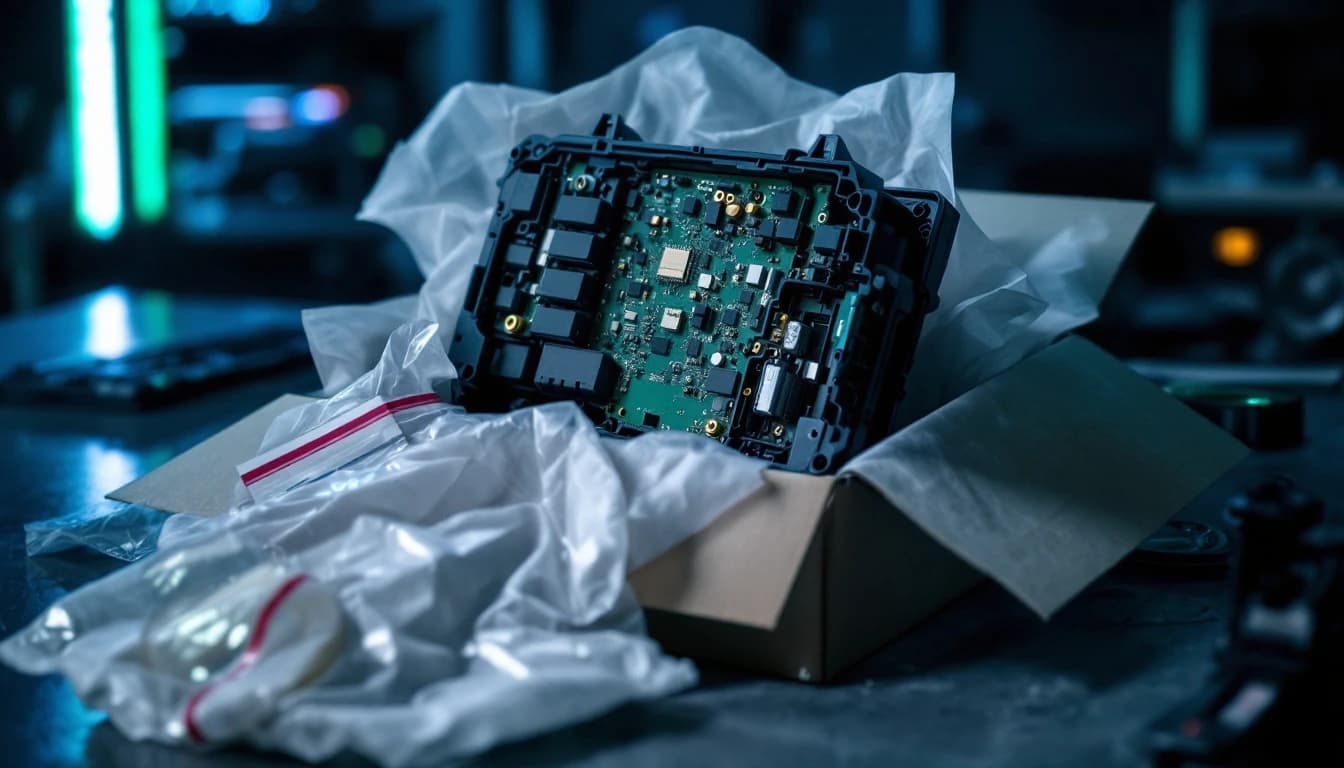
For the IMMO delete, send the engine controller only. You do not need to send keys, the cluster, or the immobilizer box. Pack it the way you would want to receive an electronic part:
- The MED17 or ME17 ECU, removed from its bracket if it lifts off easily.
- The packing slip with your order number.
- The target VIN written clearly, if you want VIN correction.
- Snug padding so the connector pins cannot shift in transit.
- A rigid box, not a padded envelope. These controllers have exposed connector pins that bend.
We read what we need from the controller itself, so no calibration files or paperwork are required beyond the order number and, if applicable, the VIN.
What this service does NOT fix
Honesty here saves everyone a wasted shipment. An IMMO delete is exactly that, and nothing more.
- It is not an emissions defeat. We do not delete catalytic converters, defeat the EVAP or EGR systems, disable oxygen sensor monitors, or remove any federally required emissions control. Tampering with emissions equipment violates the Clean Air Act, which the EPA enforces with civil penalties. The IMMO delete is for engine swaps, standalone, off-road, motorsport, and repair where legally permitted; emissions compliance remains your responsibility.
- It is not a performance tune. Removing the immobilizer requirement does not add power or change any fuel, boost, or timing map. Tuning is a separate job.
- It is not a repair for dead hardware. A controller with water damage, blown injector drivers, or a dead processor is a hardware failure. An IMMO delete will not revive dead electronics.
- It is not a fix for a no-crank. If the starter never turns, the problem is electrical or mechanical, not the immobilizer. IMMO delete only helps when the controller is otherwise able to run the engine.
- It does not transfer your keys. The point of the delete is to make keys irrelevant to starting. If you specifically need keys cut and programmed to a working immobilizer system, that is a different service.
If your situation is one of these, tell us before you ship and we will point you to the right service.
Price versus the dealer and the alternatives
There is no dealer counterpart to "delete the immobilizer for my swap," because the dealer's job is to keep the car paired to its original modules. The realistic alternatives are sending the controller out for a bench delete, buying a complete matched module set, or fighting component protection with a generic tool. The numbers favor a straightforward bench IMMO delete.
| Path | Typical cost | Turnaround | Notes |
|---|---|---|---|
| Auto Module Lab mail-in IMMO delete + VIN | 250 dollars | 24-hour bench + shipping | Flat-rate return shipping from 24.95 dollars, keeps your original ECU |
| Buy a full matched module set (ECU + cluster + immo + keys) | 600-1,500+ dollars | Variable | Must all match, often still needs adaptation |
| Dealer component-protection adaptation | Not offered for swaps | n/a | Dealers will not adapt a swapped or salvage ECU |
| Generic IMMO tool attempt | Tool cost + time | DIY | Often blocked by component protection on MED17 |
Keeping your own controller matters more than the price line suggests. The MED17 or ME17 you already have is matched to your engine's exact fueling, injector, and turbo calibration. Buying a random module set instead means matching four or more parts to each other and to the car, and the modern VW Group component protection system is built to resist exactly that. The vehicle electronics behind this complexity keep growing: industry analysis from McKinsey notes that modern vehicles carry dozens of electronic control units, with premium models exceeding 100. Deleting the immobilizer on the one controller you already own is the efficient answer.
Frequently asked questions
Will the IMMO delete change how my engine runs?
No. The delete edits only the immobilizer logic. Your fuel, boost, and timing calibration are untouched, so the engine runs exactly as it did, except it no longer needs the original cluster and key handshake to start.
Do I need to send my cluster, keys, or immobilizer box?
No. For the MED17 and ME17 IMMO delete we only need the engine controller. Everything else stays with your project.
Can you correct the VIN at the same time?
Yes. If you give us the target VIN, we can write it into the controller on the same bench pass so it matches your chassis. This is useful for module relationships and inspection records in a non-original car.
How do I know whether I have MED17 or ME17?
You usually cannot tell from the dash. The Bosch number and software version on the controller label are the reliable indicators, and we confirm the exact variant on the bench before any work. Both are within our service.
Is deleting the immobilizer legal?
Modifying a controller you own for an engine swap, a standalone or off-road build, or a repair is a legitimate use of your own property. What you must not do is defeat emissions controls on a street-registered vehicle or disable anti-theft systems on a car you do not own. We only provide IMMO delete for swap, standalone, motorsport, and repair purposes where legally permitted.
What if the delete does not take on my controller?
We verify the controller starts the engine logic without the immobilizer handshake before it leaves our bench. In the rare case a controller cannot be processed because of a hardware fault, we tell you and we do not charge for work we could not deliver.
The bottom line
Bosch MED17 and ME17 controllers are paired to one specific car by design, and that pairing is exactly why a swapped or used ECU starts then stalls, or never fires, in a new chassis. A bench IMMO delete removes that requirement on the controller you already own, and an optional VIN correction makes the stored identity match your build. It is a clean, defined service: not a tune, not an emissions defeat, not a hardware repair, just an immobilizer delete for legitimate swap and repair work.
If you are ready, start with the VW / Audi IMMO delete and VIN program service. You can review the full services list, see exactly how the mail-in process works, or read more about founder Adrian Torres and the bench experience behind every delete. Ship to PO Box 120241, Arlington TX 76012 if you ship USPS — or 1009 Oakwood Ln # 120241, Arlington TX 76012 if you ship UPS or FedEx (UPS and FedEx cannot deliver to a PO Box), and expect a 24-hour bench turnaround, with flat-rate return shipping chosen at checkout (from 24.95 dollars).
Ship your module today
Flat-rate pricing, 24-hour bench turnaround, return speed your choice at checkout. Most jobs back on your bench within a week.
More from the Lab
VW / Audi EDC16 TDI Diesel IMMO Delete Guide (2026)
12 min · June 18, 2026
VW / Audi ME7 IMMO Off Guide for Older Gasoline (2026)
12 min · June 18, 2026
Bosch ME7 EEPROM IMMO OFF for VW / Audi / SEAT / Skoda (2026)
13 min · July 27, 2026
VW Audi Cluster Key Programming 2006-2017 (2026 Guide)
12 min · June 18, 2026