
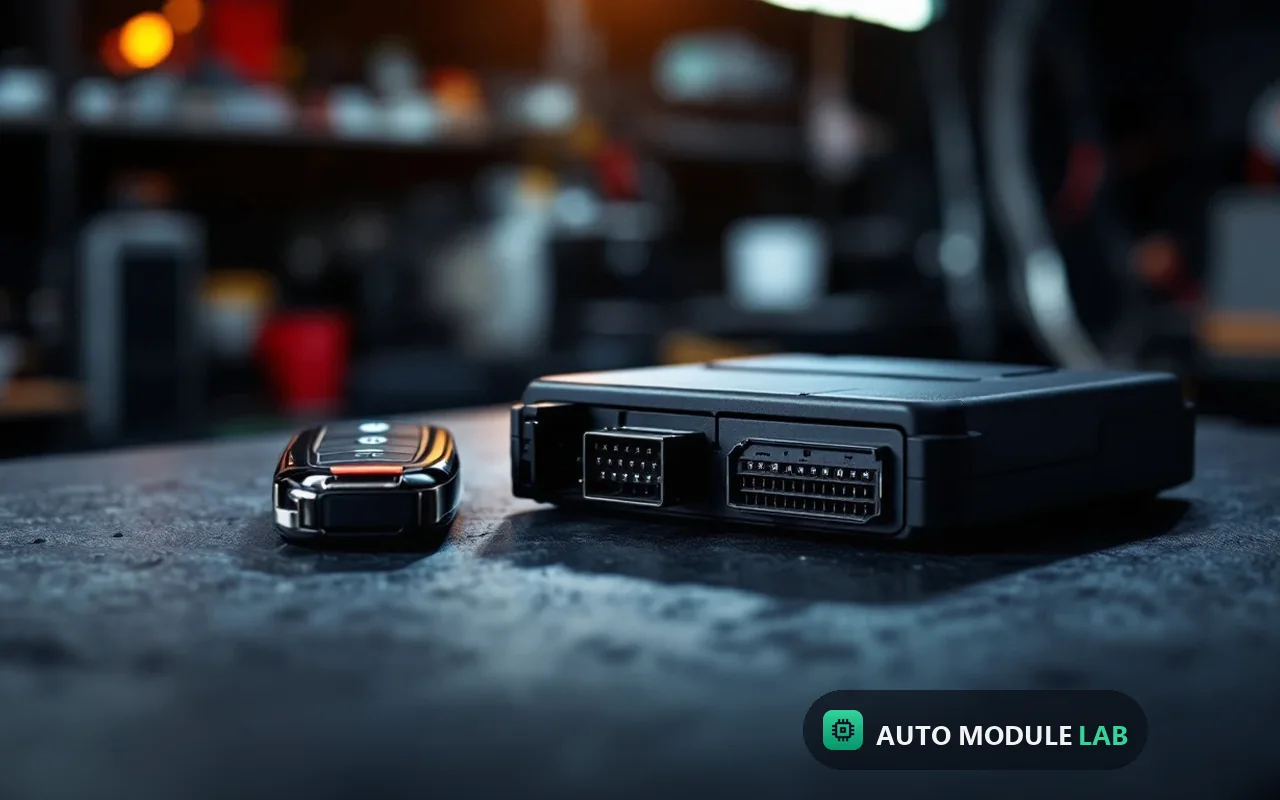
BMW FEM / BDC Key Programming Explained: What the Body Domain Controller Is, Why It Replaced CAS, and How Mail-In Bench Work Beats the Dealer
Who this is for
You are in the right place if any of these describe your situation:
- You own a 2013+ F-chassis BMW and just lost your only key — and the dealer quoted a price (and a wait) that made you sit down
- You want a spare key made and every locksmith you call says "we don't do FEM cars"
- You installed a used or replacement FEM/BDC module and now the car will not start
- You are an independent shop or locksmith who takes in BMW work but does not carry the bench tooling for FEM/BDC, and you want a reliable send-out
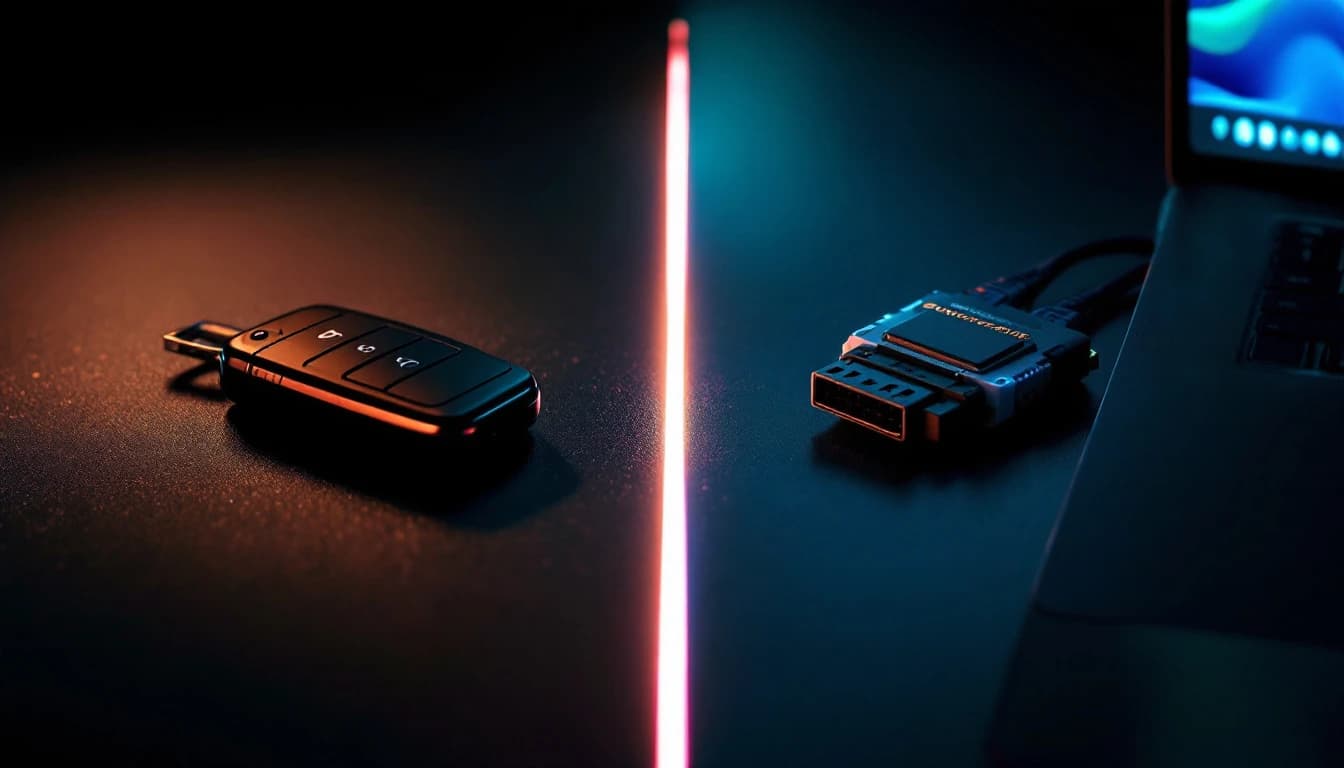
The short version: on 2013+ F-chassis cars, BMW moved key management out of the CAS module and into the FEM (Front Electronic Module) or BDC (Body Domain Controller), and locked that module cryptographically to the engine computer. Key programming became a two-module bench job. Our BMW FEM/BDC key programming service does exactly that job, mail-in, for a flat $150 — key blank, blade cut, ISN work, and transponder programming all included. Everything below explains what these modules actually are, why the work is genuinely harder than CAS, and how the mail-in path runs end to end.
What the FEM and BDC actually are
Every modern BMW has one module that acts as the gatekeeper for starting the car. It stores which keys are authorized, talks to the key by radio, and participates in the immobilizer handshake that decides whether the engine is allowed to run.
- On roughly 2006–2012 BMWs, that gatekeeper is the CAS — Car Access System — a dedicated access/security module that went through generations CAS2, CAS3, CAS3+, and CAS4. (We cover those cars separately with our BMW CAS key programming service, and the differences between generations get their own deep dive in our CAS3+ vs CAS4 guide.)
- On 2013+ F-chassis cars, BMW folded that role into a much larger body computer. In the compact and mid-size cars — F20/F21 1-Series, F22 2-Series, F30/F31/F34 3-Series, F32/F33/F36 4-Series, F87 M2 — that computer is the FEM, Front Electronic Module. In the bigger SUVs and the newer UKL-platform cars — F15 X5, F16 X6, F45 2-Series Active Tourer — it is the BDC, Body Domain Controller. The exact split varies by model and production date, which is why we verify from your VIN before anything ships.
Functionally, FEM and BDC are siblings: the BDC is the evolution of the FEM concept, and for key programming purposes the workflow is the same family. Both are "domain controllers" — instead of a dozen small modules each doing one body job, one powerful computer runs central locking, lighting, wipers, windows, the immobilizer, and the key memory. This consolidation trend is industry-wide; engineering bodies like SAE International have documented for years how vehicle electrical architectures are collapsing dozens of discrete ECUs into a handful of domain and zonal controllers.
That consolidation is great for manufacturing. It has one big consequence for you: the module that holds your keys is now a huge, deeply integrated computer — not a small access box a locksmith can casually swap or reflash in a parking lot.
Why BMW replaced CAS — the security arms race
BMW did not redesign key security for fun. Vehicle theft is a numbers game, and the numbers are serious: NHTSA reporting put U.S. vehicle thefts at roughly one million in a recent year. The long-term counterweight has been the electronic immobilizer — and the data on it is striking. Research summarized by the Insurance Institute for Highway Safety and its Highway Loss Data Institute shows theft losses fell by well over half in the decades after immobilizers spread through the fleet, which is precisely why manufacturers keep hardening them.
By the early 2010s, the CAS3 generation had been thoroughly studied by the aftermarket and, inevitably, by thieves. Tools existed that could add a key to a CAS car quickly through the OBD port — convenient for locksmiths, and exactly the attack surface BMW wanted to close. The FEM/BDC generation answered with:
- Stronger, individualized encryption. Key data in the FEM/BDC is protected so that simply reading the module's memory is not enough; critical secrets are tied to that specific module.
- A locked pairing with the engine computer. The FEM/BDC and the DME share an ISN — an Individual Serial Number — and the car only starts when the two agree. More on this below, because it is the single fact that shapes the whole repair.
- No easy OBD path for all-keys-lost. With no working key present, the module generally has to come out of the car and onto a bench, where its processor and memory can be worked with directly and safely.
The result: a 2015 F30 is dramatically harder to steal with electronic tools than a 2008 E90 — and, by the same mechanism, dramatically harder to make a key for. Security and serviceability are the same coin, opposite faces.
Why so many locksmiths decline FEM/BDC jobs
Call five mobile locksmiths about a lost key on a 2016 F30 and there is a good chance three of them pass. This is not laziness. AAA alone responds to roughly four million lockout-related roadside calls a year per AAA — keys are a huge business — but FEM/BDC work sits outside what a typical mobile operation can do profitably:
The bench requirement. An all-keys-lost FEM/BDC job typically requires removing the module, connecting to it directly on a bench, performing a controlled sequence that involves working with the module's processor and, on many variants, physically handling a memory chip. That is electronics work, done at a workstation with a regulated power supply — not something you do on a fender in a driveway.
The two-module problem. Because the FEM/BDC is ISN-locked to the DME, doing the job correctly means having both modules' data in agreement. A locksmith who only ever touches the FEM can leave a car that takes the new key but still will not start.
The brick risk. Interrupt the wrong step — voltage sag, a bad clip on a memory chip, a wrong dump written back — and the module is damaged. On a domain controller that runs half the car's body functions, that is an expensive mistake, and it is the reason careful shops either invest fully in the platform or send the work out.
"FEM was the point where I stopped doing BMW all-keys-lost in the field. On CAS cars I could work at the curb. On an F30 you're pulling a body computer, opening it on a bench, and if your power supply hiccups mid-procedure you've turned a key job into a module replacement. I send them out now — it's cheaper than owning the one failure a year that eats the profit from the other twenty jobs." — Independent European-vehicle locksmith, 12+ years on BMW platforms (anonymized)
This is exactly the niche mail-in bench work fills. The module is coming out of the car either way; the only question is whether it travels across town to someone doing their third-ever FEM, or overnight to a bench that runs them every week.
The ISN — why your DME ships in the same box
The single most common question about our FEM/BDC service: why do you need the engine computer for a key job?
Because on these cars, the key is only half the security chain. The FEM/BDC stores an ISN — Individual Serial Number — that must match the ISN in the DME (the engine control computer). At every start, the two modules compare notes; if the values disagree, the engine will crank and refuse to run, working key or not. The two modules are, in effect, cryptographically married.
For key programming, we must read the DME's ISN and ensure the FEM/BDC carries the matching value before pairing the new transponder. That is why the service page is explicit: ship the FEM/BDC AND the DME from the same vehicle, in the same box. Shipping the FEM alone is not enough, and the $150 price already covers benching both modules.
The same ISN logic explains two neighboring failures people confuse with key problems:
- Used FEM/BDC installed, car will not start. The donor module carries the donor car's ISN and key data. We handle this in the same service — used FEM/BDC virginization plus DME pairing is one of the listed scenarios.
- Used DME installed, car will not start. Mirror image: the donor engine computer's ISN does not match your FEM/BDC. That is a different bench job — our BMW F-Series used DME programming service ($399) reads the ISN from your CAS/FEM/BDC and writes it to the donor DME so it installs plug-and-play.
If you are not sure which side of the marriage is your problem, text us the symptoms and part labels first — routing you to the right service before anything ships is free.
All-keys-lost vs adding a spare
All keys lost is the emergency case and the one this service was built around. No working key exists, so nothing can be done in the car — the FEM/BDC and DME come out, the key data is rebuilt on the bench, and a fresh key is cut and programmed. Our mail-in service fully supports all-keys-lost: you get back both modules and a cut, programmed key with the transponder paired and verified.
Adding a spare while you still have a working key is the case everyone should handle before it becomes the first case. The bench process is similar (we still need the FEM/BDC and DME), but nothing about your situation is an emergency — and a spare key is dramatically cheaper than an all-keys-lost event at a dealership later. Independent cost-of-ownership reporting from outlets like Car and Driver and J.D. Power has repeatedly flagged luxury-brand key replacement as a several-hundred-dollar line item once dealer programming time is included — against that backdrop, a $150 flat bench job that includes the key blank, cutting, and programming is the cheap insurance.
Worth stating plainly: keys are anti-theft credentials, so proof of ownership is required on every FEM/BDC order — registration or title matching the VIN, plus matching ID. Legitimate owners and shops have this on hand; it is the same standard held across the locksmith industry.
CAS vs FEM/BDC at a glance
BMW owners often do not know which system their car has — and the two services are different jobs at the same price. The dividing line is roughly the 2013 model year on F-chassis cars, with early F-chassis (2011–2012) still carrying CAS4.
| CAS (2006–2012) | FEM / BDC (2013+ F-chassis) | |
|---|---|---|
| Module | Car Access System — dedicated access module | Front Electronic Module / Body Domain Controller — full body computer |
| Generations | CAS2, CAS3, CAS3+, CAS4, CAS4+ | FEM (1/2/3/4 Series), BDC (F15 X5, F16 X6, F45, later F-chassis) |
| Typical chassis | E60, E65, E70, E87, E90, E92, early F-chassis w/ CAS4 | F20, F22, F30, F32, F36, F87, F15, F16, F45 |
| What you ship | CAS module only — DME stays in the car | FEM/BDC AND DME together — ISN-locked pair |
| All-keys-lost | Supported | Supported |
| Our price | $150 flat — CAS service | $150 flat — FEM/BDC service |
| G-chassis (G20, G30…) | — | Not covered — BDC2 uses stronger encryption; contact us first, case by case |
Fastest way to be sure which you have: send us your VIN. We verify the platform before you remove anything.
The mail-in workflow, step by step
- Verify first. Text us your VIN and, ideally, a photo of the module labels. We confirm FEM vs BDC vs CAS and that your car is in scope before you spend anything.
- Order on the FEM/BDC key programming page and choose your return-shipping speed at checkout — Standard $24.95 (3–5 days), UPS 2-Day $54.95, or UPS overnight $94.95.
- Pull both modules. The FEM/BDC lives in the passenger-side kick panel / A-pillar area on most of these cars; the DME is in the engine bay electronics box. Disconnect the battery first, photograph connectors as you go, and never force a locked connector lever.
- Ship the FEM/BDC, the DME, a printed order confirmation, your VIN, proof of ownership, and your contact details to PO Box 120241, Arlington TX 76012 if you ship USPS — or 1009 Oakwood Ln # 120241, Arlington TX 76012 if you ship UPS or FedEx (UPS and FedEx cannot deliver to a PO Box). Pack both modules padded, connectors protected, in one box.
- Bench work. We read the DME's ISN, prepare the FEM/BDC key data, cut the key blade to your VIN, and pair the transponder — on a regulated bench supply, with the data archived before any write.
- Return with tracking, 24 hours after both parts arrive: FEM/BDC and DME back, ISN matched, plus a cut and programmed key, covered by a 6-month warranty on the programming work.
- Reinstall and drive. Plug both modules back in and start the car.
The population that needs this is only growing. BMW Group has delivered well over two million vehicles in a single recent year, the F-chassis generation sold in huge numbers through the 2010s, and with the average U.S. vehicle now roughly twelve and a half years old per S&P Global Mobility, the 2013–2018 cars this article covers are exactly the ones living out of warranty, on second and third owners, with one key in the drawer.
Frequently asked questions
How do I know if my BMW has FEM, BDC, or CAS? Rule of thumb: 2006–2012 is CAS territory; 2013+ F-chassis is FEM/BDC. Early F-chassis cars from 2011–2012 still use CAS4. The definitive answer comes from your VIN — text it to us and we will confirm which service (and which module) applies before you remove anything.
Why do you need the DME for a key job? The FEM/BDC and DME share an ISN and are cryptographically paired — the car only starts when they agree. Programming a key correctly requires reading the DME's ISN and making sure the FEM/BDC matches, so both modules ship together. The $150 covers benching both.
All my keys are lost. Is that a problem? No — all-keys-lost is the core scenario this service supports. We rebuild the key data on the bench and return a cut, programmed key with your modules. You will need proof of ownership (registration or title matching the VIN, plus ID).
Can you program a used FEM/BDC I bought to replace a failed one? Yes — used FEM/BDC virginization and DME pairing is a listed scenario for this service. The donor gets matched to your DME's ISN and your new key is paired to it.
What if my DME is dead? A failed DME cannot be ISN-read electronically. In some cases we can recover the ISN from a dump or a known-good donor — contact us before ordering if your DME does not power up or communicate.
Does this cover G-chassis cars like the G20 3-Series or G30 5-Series? No. G-chassis uses BDC2 with stronger encryption and is outside this service. Contact us first — some cases can be helped case by case.
Is the $150 for the programming only, or the key too? Both. Key blank, blade cut to your VIN, ISN work on the bench, and transponder programming are all included, with a 6-month warranty on the programming work. Return shipping is chosen and paid at checkout, from $24.95.
The bottom line
The FEM and BDC are BMW's answer to a real problem — vehicle theft — and the data says immobilizer hardening works. The cost of that win lands on owners at exactly one moment: when a key is lost or a module is replaced, and the job turns out to be a two-module bench procedure that dealers price like dealer work and many locksmiths will not touch at all.
Mail-in bench service is the escape hatch. Ship the FEM/BDC and DME from your 2013+ F-chassis BMW to the Arlington workshop, and for $150 flat you get back both modules ISN-matched plus a cut, programmed, warrantied key — all-keys-lost included, 24-hour bench turnaround, return shipping chosen at checkout from $24.95, proof of ownership required. If your car is older, the CAS service covers 2006–2012 at the same price; if your no-start traces to a swapped engine computer instead, the used DME programming service is the right tool; and the full menu is on the services hub.
Start with the free step: text us your VIN, and we will tell you exactly which module your BMW has and which service actually fixes your problem — before anything ships.
Ship your module today
Flat-rate pricing, 24-hour bench turnaround, return speed your choice at checkout. Most jobs back on your bench within a week.
More from the Lab
BMW FEM/BDC Bricked During Key Programming: Why It Happens, and How Data Recovery (or Replacement Adaptation) Saves the Car
13 min · July 28, 2026
BMW All-Keys-Lost Cost by System: EWS, CAS, and FEM/BDC Explained
11 min · July 13, 2026
BMW Key & Module Programming by Chassis: CAS, FEM/BDC, DME, FRM Explained (E, F, G Series)
12 min · July 10, 2026
Ford PATS Delete vs Key Programming: Which One for All-Keys-Lost or an Engine Swap?
11 min · July 13, 2026