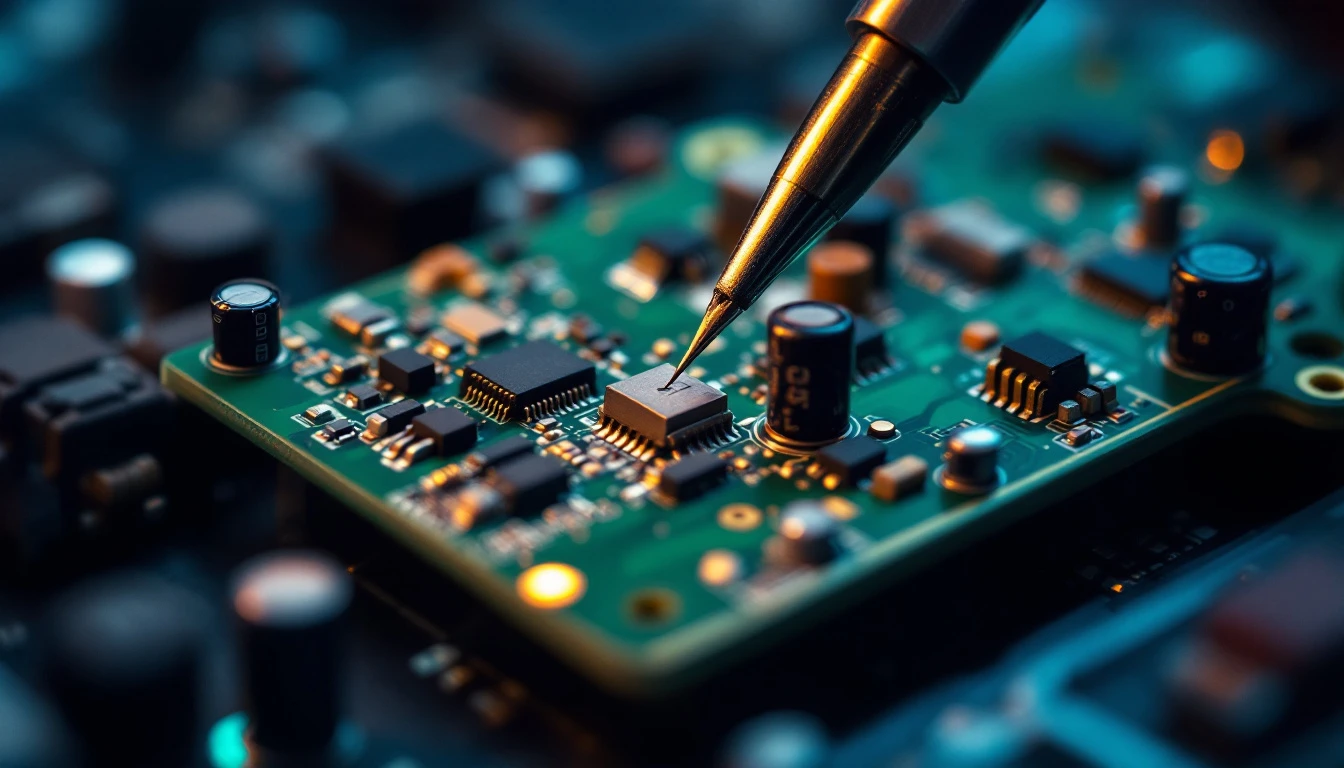
Board-Level ECU Repair: What Is Repairable vs Scrap
What people actually mean by "ECU repair"
Search for vehicle ECU repair and you will find two completely different businesses answering the same question. One sells you a replacement module and calls the swap a repair. The other opens the case, puts the circuit board under a stereo microscope, and fixes the specific component that failed.
This article is about the second one — genuine board-level repair — and about the honest boundary where it stops. Some faults inside a control module are routine bench work with a long service life afterward. Others mean the board is scrap, and no amount of skill or money brings it back. Knowing which is which before you ship anything is the difference between a diagnostic fee that saves you four figures and a month of wasted turnaround.
Board-level repair is not exotic. It is ordinary electronics work applied to a part that happens to live in a car, and the trade has published standards for it. The IPC standards body, whose rework and repair documents are the reference the electronics industry works to, maintains the IPC family of assembly and rework standards that define what an acceptable solder joint, a replaced component, and a repaired pad look like. A shop that cannot describe its work in those terms is guessing.
What is actually inside the box
Before you can reason about failures, you need a mental picture of the board. Strip the case off almost any modern automotive control module — engine, transmission, body, ABS, cluster, keyless entry — and you find the same functional blocks:
- A microcontroller. The processor that runs everything. It contains the CPU core and, in most automotive parts, on-die flash and EEPROM. This is where the calibration, the VIN, the immobilizer secrets, and the adaptation data live.
- External memory. A separate serial EEPROM (often a small 8-pin part) and sometimes an external flash chip. On a lot of modules this is where the security data and mileage counters actually sit.
- A power supply section. Linear or switching voltage regulators dropping vehicle voltage to 5V, 3.3V, and often 1.8V rails, plus bulk and decoupling capacitors, inductors, and reverse-polarity protection.
- A CAN or LIN transceiver. The physical-layer chip that turns processor logic levels into the differential bus signal the rest of the car speaks.
- Output drivers. Power transistors, MOSFETs, and driver ICs that switch real current to injectors, coils, solenoids, motors, relays, and lamps. These carry the load and take the abuse.
- Input conditioning. Resistor networks, filter capacitors, op-amps, and protection diodes that turn sensor signals into something the processor can read.
- The connector and the board itself. A multilayer printed circuit board with plated through-holes (vias) tying the layers together, and a sealed header with dozens to hundreds of pins.
That last point matters more than people expect. A modern vehicle is an electronics platform with wheels. Analysts have put the electronics share of a new vehicle's total cost at roughly a third or more and climbing, and industry research from firms such as Deloitte has tracked that content growth for over a decade. A premium vehicle can carry well over a hundred networked control units, according to supplier material from Bosch. When there are that many boxes on a car, the odds that one of them fails during a normal ownership cycle are not small.
And ownership cycles are getting longer. The Bureau of Transportation Statistics tracks the average age of light vehicles in operation in the United States at roughly twelve and a half years and rising. A twelve-year-old control module has been through several thousand heat cycles. That is the single most important fact in this entire article, because thermal cycling is what kills solder.
Owners feel this in the ownership data. For several consecutive years, electronics-related complaints — infotainment, connectivity, and control-module driveability faults — have been the most-reported problem category in the annual dependability research published by J.D. Power. Vehicle electrical systems are also a recurring theme in safety recall activity tracked by NHTSA, which maintains the public recall and complaint database. None of that means modules are junk. It means there are simply far more of them than there used to be, and the ones that fail fail in a small number of predictable ways.
The failures that ARE repairable
1. Cracked and fatigued solder joints
This is the number one repairable fault in automotive electronics, and it is a direct consequence of physics rather than of any manufacturing defect.
Every time the engine bay heats up and cools down, the board, the components, and the solder joining them expand and contract at different rates. The solder absorbs that mismatch as strain. Do it a few thousand times and microcracks form in the joint, usually starting at the fillet edge. Eventually the crack propagates far enough that the connection becomes intermittent — works cold, drops out hot, or vice versa.
The classic symptoms are maddeningly familiar: a module that works in the morning and not in the afternoon, a fault that clears when you tap the case, a cluster that flickers, a light that comes on only after a long drive. Heavy parts with big thermal mass — power transistors, large electrolytics, relays, connector pins, inductors — crack first because they put the most leverage on their joints.
The repair is straightforward for a competent technician: identify the affected joints under magnification, clean off the old solder, and reflow or fully replace it with fresh solder and proper flux. Done correctly, the repaired joint is better than the factory one because it is a full, properly wetted fillet rather than a cost-optimized minimum. This is a genuinely permanent fix, and it is why so many BMW footwell modules, GM clusters, and older ABS units come back to life on the bench.
2. Dried-out electrolytic capacitors
Aluminum electrolytic capacitors contain a liquid electrolyte, and liquid evaporates. Capacitor manufacturers publish life curves that follow the Arrhenius rule of thumb — roughly, service life doubles for every 10 degrees Celsius the part runs cooler, which is why datasheets from suppliers like Vishay quote endurance in hours at a stated temperature rather than in years.
Put a capacitor rated for a couple of thousand hours at 105 degrees Celsius inside a hot module and it will eventually dry out. As it does, its capacitance falls and its equivalent series resistance climbs. The power supply gets noisy, rails sag under load, and the processor starts doing things it should never do: random resets, comms dropouts, corrupted writes.
Symptoms of failed capacitors are the ones people describe as "the module went crazy." Replacing them is a routine bench job. The important detail is that you replace them with correctly rated parts — same or higher voltage, correct temperature grade, low-ESR where the design demands it — not with whatever fits the footprint. A bulging or vented can is obvious; a quietly dried-out one is not, and only shows up on an ESR meter or under load.
3. Blown output drivers — the classic
If a module has one failure mode that defines it, this is it. Output drivers switch real current into inductive loads: fuel injectors, ignition coils, transmission solenoids, ABS pump motors, blower motors, window and door motors, fuel pumps.
Inductive loads fight back. Every time you shut off current to a coil, it produces a voltage spike in the opposite direction. Automotive electrical environments are hostile enough that entire standards exist to describe the transients a module has to survive — the electrical-transient and EMC work published through SAE International defines the load-dump and switching pulses every vehicle driver stage is designed against. Designs handle ordinary events fine. It is the abnormal ones that kill drivers. Designs handle that with clamping diodes and internal protection, but a shorted injector, a chafed harness, a seized motor, or a jump-start done backwards can push a driver past what it can absorb. The transistor or MOSFET fails, usually shorted, and often takes a trace or a series resistor with it.
The recognizable signature is a dead circuit that nothing external explains. One injector that never fires while the other seven do. One solenoid that never actuates. A blower that runs only on high. A fuel pump relay circuit that stays dead with a good relay. Very often the driver failed because of something outside the module — and this is the part people skip: if you repair the driver and do not fix the short that killed it, you will kill the new one too. Any honest repair report tells you what the driver was driving and why it probably failed.
Driver replacement is very repairable when the failed part is still obtainable and the board damage is local. It stops being repairable when the failure vaporized a section of copper or when the driver is integrated into a custom multi-channel ASIC that no distributor sells.
4. Voltage regulator and power supply failures
The regulator is the single point of failure for everything downstream. When a 5V regulator drifts, oscillates, or dies, the module either goes completely silent or behaves erratically. Overvoltage events — a failing alternator, a bad jump start, a shorted load dumping into the supply — kill regulators regularly.
Regulators are inexpensive, well documented, and generally easy to source. This is one of the most satisfying repairs on the bench: a completely dead module that comes back with a two-dollar part. The catch is that whatever killed the regulator may have also punched through to the processor. That is what a powered bench test is for.
5. Corroded vias, lifted pads, and trace damage
Moisture is the other great enemy. Modules mounted low, near the cowl, in a door, under a seat, or in a footwell live where water goes. Once moisture gets past the seal, it wicks into the plated through-holes and starts eating the copper. Salt from winter roads accelerates it dramatically.
Early corrosion is repairable: neutralize and clean the board, remove corrosion products, and rebuild the affected via or trace with a repair wire, which is exactly the kind of work the IPC rework standards describe. Lifted pads — where a pad has separated from the laminate, usually because someone previously applied too much heat with the wrong iron — are also repairable by bonding a replacement pad and reattaching the trace.
The point at which corrosion stops being repairable is when it has traveled into the inner layers of a multilayer board. Inner-layer traces cannot be inspected or rebuilt. If a board shows green crust on both sides and blistered laminate, the honest answer is that it is finished.
6. Cracked ceramic components
Multilayer ceramic capacitors are brittle. Board flex during assembly, a drop, or a mechanical impact can crack one internally with no visible sign at all. A cracked MLCC often fails short, which pulls a rail down and mimics a dozen other problems. Finding one takes methodical work: thermal imaging on a powered board makes the shorted part glow, which is far faster than removing capacitors one at a time.
Cracked ceramics are cheap and easy to replace once identified. Finding them is the skill.
7. Connector and pin damage
Bent pins, backed-out terminals, burned pins from a high-resistance connection, and pins broken off inside the header are common and usually repairable. A burned pin often points at a load problem in the harness, not the module.
8. BGA processors and reballing
Ball grid array packages sit on a grid of solder balls under the chip where you cannot see or probe them. Those balls crack from thermal cycling exactly like any other joint. Reballing — removing the chip, cleaning the pads, applying fresh balls, and reflowing it with a proper profile — is real, established work, but it requires a controlled hot-air or infrared rework station, a good thermal profile, and stencils.
It is repairable. It is not a soldering-iron job, and a shop that offers it should be able to describe its reflow profile. If the underlying problem is a cracked die rather than cracked balls, no amount of reballing helps.
The failures that usually mean scrap
Now the part nobody likes.
Damaged secured microcontrollers. This is the big one. If the microcontroller holding the security data — the immobilizer secrets, the component protection, the ISN, the VIN marriage — is physically destroyed, and that data exists nowhere else, the module is finished as that car's module. Some processors use mask ROM or one-time-programmable regions that cannot be re-read once the die is damaged. Some store secrets in a secured area with read-out protection that is not designed to survive damage. You cannot reconstruct data that no longer exists.
This is why we take a data image first, before any thermal work, on any module where that is possible. Restoring a board and discovering the security data was lost during the repair is the worst outcome in this business.
Water damage that reached the processor. A module recovered from a flooded vehicle can sometimes be saved if it was unpowered and the water never got under the chips. If corrosion has traveled under a BGA or into a package, cleaning cannot reach it, and the part will fail again within weeks or months. Being honest about that up front is more valuable than a repair that lasts one season.
Delaminated or burned boards. Sustained overheating causes the laminate to char and separate. Once the substrate itself has failed, there is nothing to solder to.
Unobtainable custom silicon. Many automotive modules use application-specific chips made only for that manufacturer. If one of those has failed and no donor board is available, the repair path is a donor unit, not a component swap.
"The hardest conversation I have is telling somebody their board is not coming back. People want to hear that skill can beat physics. Cracked solder, dead caps, blown drivers, corroded vias — those I will fix all day and they stay fixed. But if the security processor is cooked and the data is gone, I cannot invent it. The most valuable thing I can sell that customer is an honest hour of evaluation and a straight answer, before they spend money chasing it." — Independent automotive electronics technician, 20+ years in board-level module repair (anonymized)
Repair is not programming — and this is what costs people money
Here is the distinction that generates more confusion than anything else on this site.
Repair fixes the hardware. It makes the electronics work again — power supply stable, drivers switching, processor booting, bus communicating.
Programming puts the correct data on the hardware. Calibration, VIN, configuration, security marriage, adaptation values.
They are different operations, and a repaired board very often still needs the second one. If the repair involved replacing the processor or a memory chip, the data has to be restored to the new part. If the fix was a donor board, that donor arrives carrying somebody else's VIN and security data. Even a clean, no-memory-touched repair can leave adaptations that need relearning after the module is reinstalled.
| Board-level repair | Programming | |
|---|---|---|
| What it addresses | Physical hardware faults | Data, identity, and configuration |
| Typical work | Reflow solder, replace caps, drivers, regulators, rebuild vias | Flash calibration, write VIN, code options, restore security data |
| Fixes intermittent no-comms | Yes, when caused by a cracked joint | No |
| Fixes wrong VIN or refused immobilizer | No | Yes |
| Needed after the other | Often needs programming afterward | Useless on hardware that is electrically dead |
| How you tell | Module is dead, erratic, or a circuit does not switch | Module powers up and talks but the car rejects it |
The practical rule: if the module will not power up or talk at all, start with hardware. If it powers up and communicates but the vehicle refuses it, the problem is data. Our module repair vs replacement vs reprogramming guide walks that decision tree in more detail, and if you have already been told the part cannot be programmed, the dealer said they cannot program my module guide covers what that usually actually means.
How a technician actually evaluates a board
A proper evaluation is a sequence, not a glance.
- Intake and documentation. Record the part number, hardware and software revisions, the vehicle it came from, and the reported symptom. Photograph the module before opening it.
- Open and inspect under magnification. A stereo microscope at 10x to 40x. Look for corrosion, discoloration, cracked joints, bulged or vented capacitors, burned components, board flex marks, and evidence of previous repair attempts. Previous repairs matter enormously — lifted pads and bridged joints from someone else's iron change the plan.
- Take a data image where possible. Before anything gets hot, read the EEPROM and flash if they are accessible. This is insurance.
- Powered bench test on a current-limited supply. Bring the board up on a regulated supply with a current limit set low. A short shows itself immediately as a current spike, and the limit prevents you from making the damage worse.
- Thermal imaging. With the board powered, a thermal camera finds shorted parts in seconds that would take hours to locate by probing.
- Component-level probing. Check supply rails against the design values. Scope the oscillator, the reset line, and the CAN differential pair. Test suspect semiconductors in and out of circuit.
- Decision and quote. Repairable, repairable-but-needs-programming, or not economically repairable — stated plainly, with photographs. If the answer comes back as replacement rather than repair, our auto ECU programming cost guide sets out what the programming half of that job runs by module type.
That is exactly what a bench evaluation is for. It is a flat $150, it is credited toward the repair if you go ahead, and if the module turns out to be unrepairable we refund $95 of it and tell you why. Turnaround on the evaluation itself is typically 24 hours from arrival. Return shipping is a flat-rate tier you pick at checkout, starting at $29.95.
Where the flat-rate repairs fit
Some module families fail the same way often enough that they do not need an open-ended evaluation. Those are flat-rate services:
- ABS module repair — $499, for the pump-driver and solder-fatigue failures that put ABS and traction lights on.
- BMW FRM footwell module repair — $175, the well-known FRM3 corruption and lighting failure.
- Keyless entry module repair — $125, receiver modules that stopped hearing fobs.
- Instrument cluster repair with mileage sync — $200, including synchronizing the cluster to the vehicle's true mileage.
Anything that does not fit one of those goes through the bench evaluation instead. Auto Module Lab is nationwide mail-in only — you ship the module to the Arlington, Texas workshop and it ships back to you. We do not do on-site or mobile work. For any key, immobilizer, or security-related job, proof of ownership is required before we start.
Frequently asked questions
Is board-level ECU repair actually permanent, or does the same fault come back?
A correctly executed board-level repair is permanent for the fault it addressed. A properly reflowed solder joint or a correctly specified replacement capacitor typically outlives the original factory part, because the repair is done deliberately rather than at production speed. What does come back is a repair that ignored root cause — replacing a blown injector driver without finding the shorted injector that killed it guarantees a repeat failure.
How do I know whether my module needs repair or programming?
Use the power-and-communication test. If the module is completely dead, resets randomly, or one specific output circuit does nothing while everything else works, that points at hardware and a repair. If the module powers up, communicates on the bus, and the scan tool sees it, but the vehicle rejects it or throws a VIN or security mismatch, that is a data problem and needs programming. Many jobs need both, in that order.
Can you fix a module that got wet?
Sometimes, and it depends heavily on whether it was powered when it got wet and how long ago. A module that was unpowered, dried, and sent in promptly has decent odds — clean the corrosion, rebuild any damaged vias and traces, replace affected parts. A module that sat wet and powered, or that has corrosion under a BGA package, usually cannot be saved reliably. We will tell you which one you have after the evaluation rather than guessing over a message.
What is BGA reballing and does my module need it?
Reballing is removing a ball grid array chip, cleaning its pads, applying fresh solder balls, and reflowing it under a controlled thermal profile. It is the fix for cracked solder balls under a processor, which show up as intermittent or total no-communication faults. Most modules never need it — plain solder fatigue on visible joints is far more common — and it requires proper rework equipment, not a soldering iron.
Why can a damaged microcontroller make a module unrepairable when everything else is fine?
Because the security and identity data lives inside it, and on many automotive processors that data cannot be read out once the die is damaged. Component protection, immobilizer secrets, and VIN marriage exist in a secured region specifically so they cannot be copied. If that region is destroyed and no backup image exists, the hardware could be perfect and the module still would not work in that car.
Do I have to remove the module myself before shipping it?
Yes. Auto Module Lab is mail-in only, so you or your shop removes the module and ships it in. Pack it in an anti-static bag inside a padded box. If you ship USPS, send it to PO Box 120241, Arlington, TX 76012. If you ship UPS or FedEx, send it to 1009 Oakwood Ln # 120241, Arlington, TX 76012, because UPS and FedEx cannot deliver to a PO Box.
Is it cheaper to repair or just buy a used module?
Repair usually wins on total cost once you account for programming. A used module carries the donor vehicle's VIN and security data, so it typically needs to be virginized or programmed before your car accepts it, and that cost is on top of the part. Your original module already has the correct identity, which is exactly what makes repairing it attractive when the fault is a repairable one.
The bottom line
Vehicle ECU repair at the board level is real, well-established electronics work with published industry standards behind it. Cracked and fatigued solder joints, dried-out electrolytic capacitors, blown injector and solenoid drivers, failed voltage regulators, corroded vias, lifted pads, cracked ceramics, damaged connector pins, and cracked BGA solder balls are all genuinely repairable, and repaired properly they stay fixed.
The limits are equally real. A destroyed secured microcontroller with unrecoverable security data, corrosion that reached under the packages, a delaminated board, or a failed custom ASIC with no donor available all mean the module is finished — and a shop that will not say so is not doing you a favor.
Keep the two operations straight. Repair fixes the hardware; programming puts the right data on it; a repaired board frequently needs both. And when you do not know which category your module falls into, that is exactly what a bench evaluation is for — $150 flat, credited toward the repair if you proceed, with photographs of the board and a straight answer either way. Text us the module part number and the symptom and we will tell you before you ship whether it is a flat-rate job or an evaluation.
Ship it for the duramax e35 ecm repair (2006-2007) — $499.95 flat
Typical 3-5 Business Day Bench Turnaround, return speed your choice at checkout. Prepaid inbound label by email the minute you order.