

Gateway Module Programming: ZGW, CGW, J533 and SGW
The car that reads as dead but is not
Here is the pattern that brings people to this article. A vehicle comes in with something ordinary — a dead battery, a no-crank, a warning light — and the scan tool cannot see anything. Not one module. Or it sees the engine controller and nothing else. Every fault code in the car is a lost-communication code, and the list is long enough that no single failed module explains it.
The instinct is to start pulling modules and testing them. That instinct is usually wrong, and it is expensive. Before a single module comes out of a vehicle in that condition, somebody needs to answer a narrower question: is the car actually broken in a dozen places, or is one module refusing to pass messages between the networks?
That module is the central gateway, and it is the single most under-diagnosed part in a modern vehicle. It is also the part most likely to be replaced with a used unit and then blamed for a problem it did not cause, because a gateway that has not been configured behaves in ways that look exactly like a broken car.
What a gateway module actually does
Strip away the brand names and a gateway does three jobs.
It routes messages between physically separate networks. A modern vehicle does not run on one bus. It runs on several, deliberately segregated by speed and criticality. Powertrain and chassis modules sit on a high-speed CAN segment. Comfort, body and door modules sit on a slower body CAN or on LIN sub-networks hanging off a body module. Chassis-critical functions on some German platforms run on FlexRay. Cameras, driver assistance and infotainment increasingly run on automotive Ethernet. Those buses use different physical layers and different data rates, and they cannot simply be spliced together. The gateway is the translator that sits in the middle and copies the messages that need to cross from one segment to another.
The reason for that architecture is bandwidth and isolation. Standard high-speed CAN, as specified in the vehicle network standards published through SAE International, commonly runs at 500 kilobits per second, with 250 kbit/s typical for slower body segments. FlexRay was defined at roughly 10 megabits per second and automotive Ethernet links commonly run at 100 megabits per second per pair — well over one hundred times the throughput of the body CAN they coexist with. You cannot put a camera stream and a door lock request on the same wire pair, so you segregate them, and then you need something to bridge them.
It holds the vehicle configuration. The gateway is where a lot of platforms store the installed-module list — the record of which controllers this specific VIN is supposed to have. Diagnostic sessions read that list to decide what to interrogate. Modules use it, directly or indirectly, to decide who they should be talking to. Get that list wrong and the car will hunt for equipment it does not have and ignore equipment it does.
It gates diagnostic access. Everything a scan tool asks the car goes through the gateway. On newer platforms it does more than forward the request — it decides whether the requester is allowed to send it at all. Stellantis made that explicit with the security gateway, but the direction of travel is industry-wide, and it is directly connected to the vehicle cybersecurity guidance published by the National Highway Traffic Safety Administration, which treats network segmentation and controlled diagnostic access as basic defensive architecture rather than an optional extra.
That third job is why a gateway fault reads as total silence. When the translator stops working, the scan tool is not talking to a broken car. It is talking to a wall.
The brand names for the same idea
If you work across makes, the naming is the first source of confusion. The function is broadly the same; the acronym, the location and the tooling are not.
| Platform | Common name | What it typically bridges | What it needs after replacement |
|---|---|---|---|
| BMW | ZGW (Zentrales Gateway Modul) | Body CAN, powertrain CAN, FlexRay on later chassis, Ethernet on F/G platforms | VIN and vehicle order data, then a full coding pass against the car build |
| Mercedes-Benz | CGW (Central Gateway) | Interior CAN, chassis CAN, engine CAN, diagnostic CAN | Variant coding and SCN-style online configuration on many model years |
| VW / Audi / Skoda / Seat | J533 Gateway (control module 19) | Powertrain CAN, comfort CAN, infotainment CAN, diagnostic line | Installation list rewrite, coding, and adaptation to the car build |
| Stellantis (Chrysler, Dodge, Jeep, Ram) | SGW (Security Gateway) | Diagnostic access control ahead of the vehicle buses | Authorized credentialed access, not a bypass |
| GM | Serial data gateway function | GMLAN / high-speed CAN segments, often folded into a body or comms module | SPS-style programming with vehicle configuration from the build record |
One table is enough to make the point: every one of these needs to be told what car it is in. None of them are a bolt-in part. That is the difference between a gateway and, say, a window motor, and it is the reason this article exists.
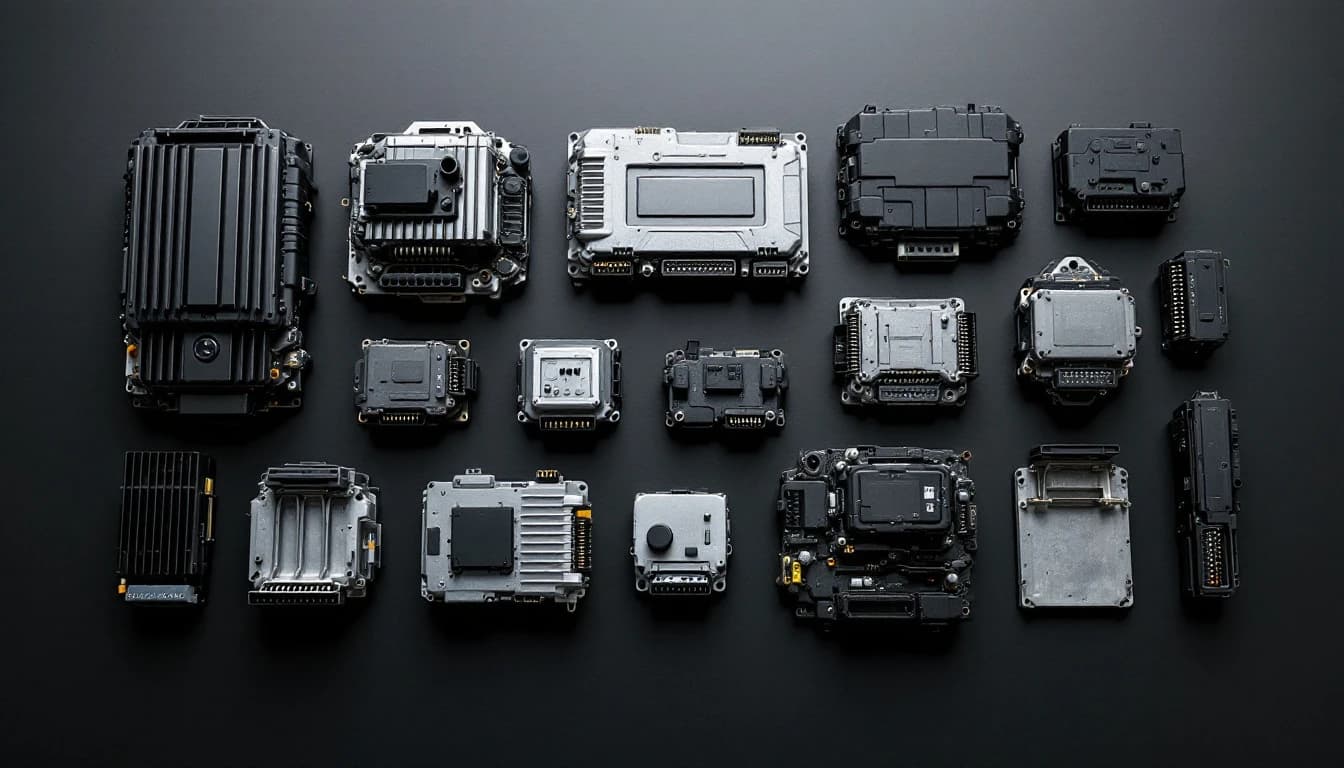
For a fuller picture of how the gateway sits alongside everything else in the vehicle, our breakdown of every control module in a modern car by system maps the whole architecture — engine, body, chassis, restraint, comfort and infotainment — and shows where the network boundaries actually fall.
Failure mode one: the gateway dies and the car goes quiet
A gateway can fail like any other module. The usual suspects are unremarkable: a failed voltage regulator on the board, cracked solder on a connector pin under thermal cycling, corrosion after a water leak into a footwell or A-pillar where many gateways live, and damage from a jump-start polarity mistake or a load dump.
What makes the symptom set distinctive is the breadth. When the gateway stops forwarding, you tend to see:
- A scan tool that connects to the vehicle but enumerates almost nothing
- Lost-communication codes stored in every module that can still be reached, all pointing at different addresses
- Multiple unrelated warning lights at once — ABS, airbag, traction, charging — with no mechanical fault behind any of them
- Comfort functions that still work locally but not across systems, because a module can drive its own outputs without hearing from the rest of the car
- Intermittent behaviour that tracks with temperature or with a bump in the road, which is the classic signature of a cracked joint
That last one is important. A gateway with a marginal solder joint does not fail cleanly. It drops messages, comes back, and drops them again, so the car is fine on Tuesday and unrecoverable on Thursday. Owners describe this as the car being haunted. It is not haunted. It is a mechanical crack in an electrical path.
The distinction between a genuine module failure and a network fault is exactly the ground covered in our guide to U0100 and U0140 lost communication codes, and it is worth reading before anything gets unbolted. The short version is that lost-communication codes describe a symptom, not a culprit, and the culprit is at least as often a wire, a splice or a gateway as it is the module named in the code.
Failure mode two: the replacement gateway lies about what is in the car
This is the failure that costs people the most money, because it happens after the repair.
A used gateway pulled from a donor vehicle carries the donor vehicle's configuration. That includes the installed-module list. Bolt it into a different car and the gateway now believes the vehicle has whatever the donor had. The consequences are specific and confusing:
- Modules the donor had but this car does not are reported as missing — permanent lost-communication codes for equipment that was never fitted
- Modules this car has but the donor did not are reported as unexpected — the diagnostic session may not even list them, so a perfectly healthy controller becomes invisible
- Feature behaviour follows the donor's build: lighting, remote start, drive-mode logic and trailer functions can all inherit settings from a truck you have never seen
- Immobilizer and anti-theft interactions may refuse to line up, because the gateway is part of the chain that establishes which modules belong together
The technician then chases the codes. They test the module that reads as missing, find nothing wrong with it, replace it anyway, and the code comes back — because the code was never about that module. It was about a configuration record in a part that came out of a different car.
"The call I get most often is not about a gateway at all. It is a shop three modules deep into a parts cannon, and when I ask what changed first, the answer is a used gateway off a wrecker. The car was never broken in three places. It was told it should have three things it does not have." — Independent European driveability and network technician, 18+ years, anonymized
Telling a gateway fault from a wiring fault before you pull anything
This is the section to actually use. Do not remove a gateway on suspicion. Prove it first, because the two things that mimic a failed gateway most convincingly are a bus fault and a power or ground fault — and neither one is fixed by shipping a module anywhere.
Start with power and ground at the module. A gateway is not exotic here. It needs a clean supply, a clean ground, and often a switched wake input. Measure supply voltage with the circuit loaded, not just with a meter on an open pin, and voltage-drop the ground against battery negative. A gateway starved by a corroded ground behaves identically to a failed gateway, and it is a far more common finding. The same corrosion and charging problems that quietly kill modules are covered in our write-up on charging system and ground faults behind repeat module failures.
Then check the buses themselves, at rest. With the ignition off and the car settled, a healthy high-speed CAN pair typically measures in the neighbourhood of 60 ohms across CAN-High and CAN-Low, because two 120-ohm terminating resistors sit in parallel at opposite ends of the segment. Roughly 120 ohms suggests one terminator is missing or the bus is split. Near zero suggests a short between the lines. Open circuit suggests a broken segment. This one measurement, done at the diagnostic connector and then again at a mid-bus connector, separates a wiring problem from a module problem faster than any other test in the book.
Then look at the shape of the signal. A scope on the CAN pair tells you what a meter cannot: whether one module is dragging a line, whether the differential swing is collapsed, whether there is enough noise to corrupt frames. A gateway that has failed internally usually goes silent on one segment while the other segment continues to look normal — which is a very useful asymmetry, because a wiring fault rarely respects a network boundary that cleanly.
Then divide the network. Disconnect one module at a time, or unplug a segment at the gateway, and watch what returns. If pulling one branch restores communication on the rest of the car, the fault is in that branch — a shorted module dragging the bus down, not the gateway.
Then check the obvious external causes. Rodent damage to a harness produces spectacular multi-module symptoms and is visible to anyone willing to look; we have written separately about telling rodent-chewed wiring apart from module failure. Aftermarket accessories spliced into a bus are the other frequent offender.
Only when power, ground, bus resistance, signal quality and branch isolation all point at the same module is it time to remove it.
What a gateway needs after replacement
Assume nothing about a new or used gateway. Depending on the platform, some or all of the following has to happen before the car is right:
VIN write. The gateway has to carry the correct vehicle identification for this car, not the donor's. On several platforms a VIN mismatch anywhere in the chain will block programming of other modules later, which is how a gateway swap turns into a mysterious failure to program an unrelated controller months down the line. The mechanics of writing identity data are covered in our explainer on how module programming actually works.
Installed-module list rebuild. This is the step people skip. The list has to be rewritten to match the equipment actually fitted to this VIN. On VW and Audi platforms this is the installation list on control module 19; on BMW it falls out of coding the module against the vehicle order; on Mercedes it is part of the variant coding pass.
Coding and variant configuration. Region, market, lighting specification, equipment options, network topology variants. A gateway coded for one market can produce lighting and instrument behaviour that looks like a fault in another.
Software level alignment. Gateways ship with specific software levels, and the rest of the car expects a compatible one. A part number that superseded, or a unit from a later build, may need updating before the modules around it behave. Part-number and hardware-software compatibility is its own minefield, and we broke it down in module part numbers and hardware-software compatibility.
Security and access rights. On platforms with a dedicated security gateway, diagnostic write access is credentialed. That is a deliberate design decision, and it is the correct one — a bus that anyone can write to is a bus anyone can attack. The path forward is authorized access through the manufacturer's channel, whether that is Stellantis, BMW or Volkswagen service infrastructure, not a device that pretends the gate is not there. Independent access to that infrastructure is a live regulatory question — the Federal Trade Commission has reported to Congress on repair restrictions, and the Environmental Protection Agency requires emissions-related service information and tools to be made available to independent repairers — but the answer is credentialed access, not bypass.
Why a used gateway is not plug-and-play
Three reasons, in order of how often they bite.
Configuration. Covered above. The donor's data is in there, and it does not match your car.
Security binding. On platforms where the gateway participates in the anti-theft or component-protection chain, the module is not simply a router. It is a member of a set that has to agree with the other members. Component protection on the VW group platforms and the equivalent binding on other makes will lock a transplanted module into a reduced-function state until it is adapted, and adapting it is a credentialed operation. Because that binding touches immobilizer function, any work of this kind requires proof of ownership before it starts — that is not a formality we can waive.
Provenance. Gateways are cheap enough to be a common counterfeit and relabel target, and a relabeled module with the wrong internal hardware will accept a flash and then behave unpredictably. If you are buying a donor part, our checklist on what to check before you buy a used module and the write-up on counterfeit and relabeled modules are both worth ten minutes before you spend the money.
There is an industry-scale reason all of this keeps getting harder. Electronics and connected systems have consistently ranked among the most-reported problem categories in the annual quality studies published by J.D. Power, and reliability surveys from Consumer Reports repeatedly place in-car electronics among the most common trouble spots owners report. Cars now carry, on some luxury platforms, well over one hundred networked controllers. The gateway is the one that has to make sense of all of them.
Where a bench service fits
Being honest about scope matters more here than in most articles, because the gateway sits at the intersection of three things — a physical module, a configuration record, and credentialed vehicle access — and only the first two travel in a box.
What bench work handles well. A gateway with a genuine hardware fault is a repairable board like any other: power supply components, transceivers, connector-pin solder, corrosion damage, and in some cases recovery of the configuration data off a failed unit so it can be transferred to a sound one. Data recovery is often the highest-value part of the job, because the configuration is the expensive thing, not the plastic.
What bench work cannot do. It cannot perform the in-vehicle, online, credentialed configuration steps that some platforms require after installation. It cannot bypass a security gateway. It cannot resolve a wiring fault, a ground fault, or an aftermarket accessory that is holding a bus down. If the real problem is in the harness, no module we ship back will fix it.
Because gateway work is platform-specific and does not fit a single flat rate, it runs through our bench evaluation and custom job service at $150. We diagnose the module on the bench, photograph the board, and quote the actual repair; that $150 is credited toward the repair if you proceed, and if the module turns out to be unrepairable we tell you plainly and refund $95 of the evaluation fee. Related bench work that often accompanies a gateway problem — a BMW FEM/BDC at $150, which combines body gateway and immobilizer duties on 2013-and-newer F-chassis cars and requires the DME to ship alongside it, or a GM BCM standalone clone at $199 to move VIN, mileage, theft-system and option coding onto a replacement body module — is quoted from the same catalog. For a wider view of what these jobs cost across the industry, our module and ECU programming cost guide for 2026 lays out realistic ranges by module type and by route.
Everything here is mail-in. Ship USPS to PO Box 120241, Arlington, TX 76012, or ship UPS and FedEx to 1009 Oakwood Ln # 120241, Arlington, TX 76012 — UPS and FedEx cannot deliver to a USPS PO Box, so use the street form for those carriers. Work is performed at our Arlington bench, and return shipping starts at $24.95 for standard service, with faster tiers available, chosen at checkout. Text us your VIN, the module part number off the label, and a photo of the connector face before you ship anything, and we will tell you whether the job is one we can complete or one that has to finish in the vehicle.
Frequently asked questions
How do I know if my gateway module is bad? The distinctive signature is breadth without a mechanical cause: a scan tool that connects but enumerates few or no modules, lost-communication codes stored against many different addresses at once, and several unrelated warning lights with nothing actually wrong under them. Before concluding the gateway is at fault, verify power and ground at the module, measure roughly 60 ohms across the high-speed CAN pair at rest, and isolate branches one at a time. A wiring or ground fault produces the same symptom set and is more common.
Can I just buy a used gateway and plug it in? No. A used gateway carries the donor vehicle's VIN and installed-module list, so the car will report modules as missing or unexpected and may inherit the donor's feature configuration. At minimum it needs the VIN written, the module list rebuilt to match your build, and coding applied. On platforms with component protection or anti-theft binding it also needs credentialed adaptation, which requires proof of ownership.
Why does my scan tool see nothing at all? Because every diagnostic request reaches the modules through the gateway. If the gateway is not routing, the tool is not talking to a car full of broken modules — it is talking to a wall. That is why a single gateway fault can look like a dozen simultaneous failures, and why parts-cannon repairs on those codes almost always miss.
Is bypassing a Stellantis security gateway an option? Not with us. The security gateway exists to control who can write to the vehicle networks, which is sound design and aligns with published federal vehicle cybersecurity guidance. The correct route is credentialed, authorized diagnostic access through the manufacturer channel. We do not sell, fit, or advise on bypass hardware.
Does the gateway store mileage or immobilizer data? On some platforms it participates in the anti-theft and component-protection chain, and on others it holds configuration that other modules rely on. It is generally not the primary odometer store, but because it can touch immobilizer function, any gateway work involving security data requires proof of ownership before it begins. Where mileage is involved anywhere in our work, we synchronize to true mileage only.
Can you fix my gateway by mail? If the fault is in the module, usually yes — board-level repair and configuration data recovery are bench work. If the fault is in the harness, a ground, or an aftermarket accessory, shipping the module will not help, and part of what a bench evaluation buys you is an honest answer about which of those you have.
What should I send with the module? Send the VIN, the part number and software level from the label, a photo of the connector face, and a short description of what the car does — what the scan tool can and cannot see, and what changed immediately before the symptoms started. That last detail resolves more gateway cases than any measurement.
The bottom line
The gateway is the quiet module in the middle of the car, and it fails in two ways that look nothing alike. When it dies, the car reads as if a dozen modules died with it, and the temptation to start replacing those modules is the single most expensive mistake in this whole subject. When it is replaced without configuration, it tells the car a story about a different vehicle, and the resulting missing-module codes send technicians chasing controllers that were never faulty.
Both failures have the same defence: prove the network before you condemn a module. Power, ground, roughly 60 ohms across the CAN pair at rest, signal shape on a scope, and branch-by-branch isolation will separate a gateway fault from a wiring fault in an afternoon, and that afternoon is cheaper than any part.
When it really is the module, treat it as what it is — a controller carrying identity and configuration data, not a router you can swap. It needs the right VIN, the right installed-module list, the right coding, and on some platforms credentialed adaptation that finishes in the vehicle. Send us the VIN, the label and a photo of the connector face, and we will tell you before you ship whether the job ends on our bench or has to finish in the car.
Ship your module today
Flat-rate pricing, 24-hour bench turnaround, return speed your choice at checkout. Most jobs back on your bench within a week.
More from the Lab
Imported Vehicle Module Programming: Canada, Euro, JDM
12 min · August 17, 2026

U0100, U0140 and the Lost-Communication Codes: How to Tell a Dead Module From a Dead Network Before You Ship Anything
15 min · August 10, 2026
Every Control Module in a Modern Car, By System: What Each One Does, How It Fails, and What Can Be Mailed In
18 min · August 10, 2026

Budgeting Module and Electronics Costs Before You Bid: A Copart / IAA Auction Buyer Guide
16 min · August 4, 2026