
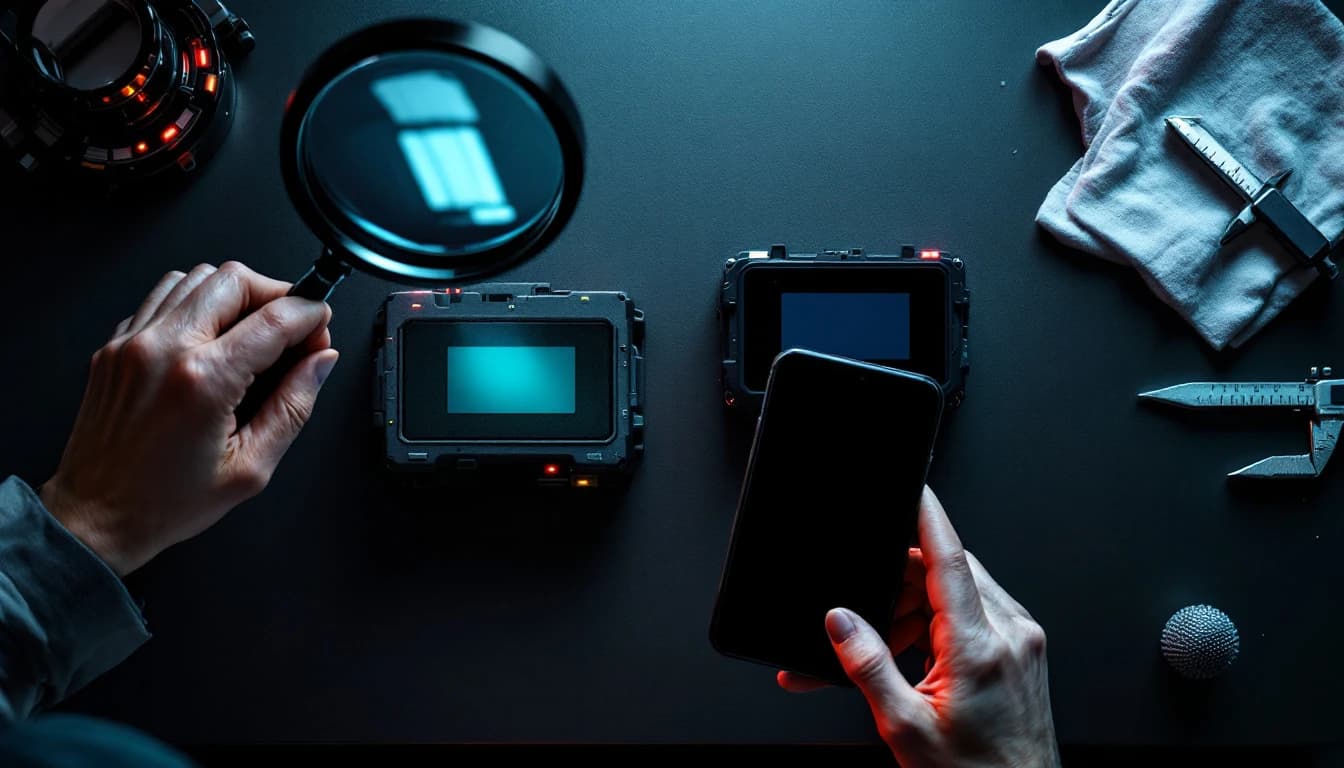
Buying a Used Donor Module: The Checklist That Decides Whether It Will Actually Clone
Why a donor checklist is worth more than a donor discount
There is an article that explains why a junkyard module will not simply plug in and run — VIN lock, immobilizer pairing, anti-theft handshakes, the whole architecture. If that is the question you arrived with, read why a used ECU swap fails plug-and-play first, because it answers the "why."
This article answers a completely different question, and it is the one that costs people real money: how do you buy the right physical unit in the first place?
Cloning solves the identity problem. It does not solve a hardware mismatch. If you send us a donor whose processor generation, memory layout, or hardware revision does not match your original, there is nothing to write to — the data has nowhere compatible to go. We tell you before we charge you, and then you are out the purchase price, the shipping, and a week. Every single time that happens, the root cause traces back to a listing that said "fits 2011-2014" and a buyer who trusted it.
So this is the checklist. Print it, keep it open in a browser tab while you shop, and treat any seller who will not answer these questions as a seller who does not know what they are selling.
Hardware part number vs software part number — the distinction that decides everything
Open any engine controller, transmission controller, or body module label and you will usually find at least two numbers, and often three or four. They mean entirely different things, and confusing them is the single most common donor-buying error we see.
The hardware part number identifies the physical unit — the circuit board revision, the processor family, the memory layout, the connector configuration, the driver stages. It is typically cast, laser-etched, or printed on a durable label attached to the housing. On a Bosch-built unit you will often also find a Bosch internal number (commonly a ten-digit number beginning with 0 26 or 0 28 on engine controllers) alongside the automaker's own number. This is the number that has to match for a clone to be possible.
The software, calibration, or strategy number identifies what is currently programmed inside the unit. It changes when a dealer reflashes the module for a service bulletin. It changes when a calibration is updated. On some platforms it is printed on a separate sticker that a technician is supposed to update after a reflash — which means it is frequently wrong on a used part, because nobody updated the sticker.
Here is why the distinction matters so much: a donor with the wrong software number is usually fine, because we overwrite the software anyway. A donor with the wrong hardware number is usually unusable, and no amount of programming fixes it.
That is exactly backwards from how most listings are written. Sellers routinely advertise the software number because it is the biggest, cleanest number on the label, and buyers match it because it looks authoritative. We have received donors that matched a customer's original on the calibration sticker and differed on the hardware casting — dead on arrival for cloning purposes.
When you contact a seller, ask for every number on the unit, and say it that way: "Please send me a photo showing all numbers on the label and any numbers stamped or cast into the housing itself." A seller who sends one number and says "that's the part number" has told you they have not looked.
Revision suffixes: why one letter can end the job
Automakers revise modules mid-production without changing the base number. The revision is carried in a suffix — a trailing letter, a dash number, a two-character code after the base string. A part number ending in a different final character is very often a different board.
Sometimes the suffix is cosmetic: a connector supplier change, a housing tweak, a conformal-coating revision. Sometimes it marks a processor change, a memory-size change, or a security-generation change. From the outside, these look identical. From the bench, one accepts your original's data and the other does not.
This is not sloppy record-keeping on the automaker's part — it is the normal consequence of how automotive electronics are specified. The engineering standards published by SAE International treat diagnostic behavior, network messaging, and security access as separately versioned layers, so a supplier can revise the hardware underneath a stable marketing designation without breaking anything the driver would ever notice. The buyer looking at a listing sees one number. The bench sees two units that share almost nothing that matters.
The honest answer is that you cannot tell which category a given suffix falls into by reading the number. We can, for the families we service, because we have read both revisions. That is why our standing advice is blunt: send us both part numbers — yours and the one in the listing — before you pay. It costs you a text message and it is the highest-value thirty seconds in the entire process.
This is especially true on the families where the security architecture changed mid-generation. GM's Gen IV controllers span a wide production window, and the difference between an early and late unit inside the same nominal family matters for a GM E38 / E67 / E92 ECM clone. BMW's F-series DME hardware went through multiple internal revisions while the marketing designation stayed constant, which is why BMW F-series used DME programming at $399 is priced as its own service rather than folded into the flat clone rate — the verification and coding work is genuinely heavier. Mercedes ME9.7 and MED17 units carry hardware and software identifiers that must be read together before a Mercedes ME9.7 / MED17 ECU clone is confirmed as feasible.
Date codes and production-range compatibility
Nearly every module carries a manufacture date code — sometimes an explicit month/year, sometimes a four-digit year-and-week code, sometimes a manufacturer-internal scheme. Read it. It is the cheapest compatibility signal on the label.
Two things it tells you:
1. Where the unit sits in a production run. If your original was built late in a model year and the donor was built very early in the prior model year, you are at elevated risk of straddling a revision boundary even when the base part numbers agree. A donor built within a similar window as your original is a safer buy, all else equal.
2. Whether the "low mileage" story is plausible. A module with a date code eight years older than the vehicle the seller claims it came from is a module with a story problem.
Date codes also matter for a practical reason nobody mentions in listings: electrolytic capacitors and solder joints age. A donor pulled from a vehicle that sat in a salvage yard through several summers is not the same electrical proposition as one pulled from a running trade-in last month, even if both test as "working." You are buying the hardware half of your repair. Buy the healthier hardware half.
Why "fits your year and model" listings mislead
Vehicle-fitment listings are built from parts catalogs that were designed to sell mechanical components. They work beautifully for brake rotors. They fail for electronics, for four reasons:
- Mid-year running changes. A single model year can contain two or three module revisions with no external change to the vehicle.
- Option content. Tow package, upgraded audio, adaptive cruise, keyless entry, different transmission, different emissions calibration — any of these can drive a different module part number on an otherwise identical-looking truck.
- Market and emissions variation. A federal-emissions unit and a California-emissions unit can carry different calibrations and, on some platforms, different hardware.
- Catalog aggregation. Many listings inherit fitment data from a supplier feed the seller has never verified. Nobody at the yard checked.
The fleet on the road makes this worse every year. Industry reporting covered at Car and Driver has put the average age of a U.S. light vehicle at more than 12.5 years — a record — which means the used-module market is increasingly made up of parts from vehicles that have been through a decade of running changes, dealer reflashes, and prior repairs. The catalog does not know any of that.
Treat fitment data as a filter that narrows your search, never as proof. The proof is the number on the label.
The exact photos to request from a seller
Ask for these five, before payment, every time. Any seller unwilling to walk to the shelf and take five photos is telling you something.
1. The complete label, in focus, straight on. Not at an angle, not cropped. You need every character of every number, including small print and any secondary supplier label. If the label is unreadable in the photo, it is unreadable, and that is a reason to pass.
2. Both connector faces, straight on. You are checking pin count, pin condition, and connector keying. Green or white crust on pins means moisture got in. Bent, pushed-back, or missing pins mean the unit was yanked or probed. Melted or discolored plastic around a pin means something drew far more current than it should have.
3. The full case from both sides, including all seams and mounting ears. You are checking for cracks, impact marks, broken mounting tabs, and — critically — evidence the case was opened.
4. Any staining, corrosion, or residue. A tide line on the housing, powdery white or green deposits, mud in a seam, or a rust bloom on a mounting ear all point to water exposure. A water-exposed module can pass a bench power-up and fail six weeks later.
5. The unit sitting next to something that proves it is the actual unit for sale. A handwritten card with the listing number, the date, or the seller's name in frame. This sounds paranoid. It costs the seller nothing and it eliminates the stock-photo problem entirely.
If you are also buying a module you will need to remove yourself, our remove, package, and ship your module guide covers the disconnection sequence and packing standard that keeps a good unit good in transit.
Red flags that should end the conversation
Some of these are absolute. Some are negotiable at the right price with the right return policy. None should be ignored.
Evidence the case was opened. Pry marks on the seam, mismatched or missing case screws, a bead of silicone or adhesive that does not match factory sealing, a housing that no longer sits flush. An opened case means someone was inside — repairing, harvesting a chip, or reading it. It may have been a competent repair. It may have been a failed one. You are not able to tell from a photo, and the downside is that the memory contents or board may already have been altered.
Resoldered pins or visible board rework. Shiny, blobby, or dull-gray solder around connector pins, flux residue, or a wire jumper visible through a vent. Connector-pin rework specifically is a bad sign because it usually means the unit already had a driver-stage or connector failure.
Missing, defaced, or replaced labels. A module with the label peeled off is a module whose identity you cannot verify — and it is also the classic signature of a part with a history someone wanted erased.
Theft-recovery provenance. A module pulled from a recovered stolen vehicle may be perfectly healthy, but it can also have been tampered with, and on security-relevant modules it raises an ownership-documentation question you do not want to inherit. Vehicle theft remains a large-volume problem — the National Insurance Crime Bureau has reported U.S. thefts exceeding one million vehicles in recent peak years — so a meaningful share of salvage inventory has that history. Ask.
Flood or water-damage provenance. This is the one that burns people quietly, because a flood module often works at first. After major U.S. flood events the NICB has repeatedly warned that hundreds of thousands of water-damaged vehicles re-enter the market, and vehicle-history services including Carfax publish flood-vehicle counts in the same order of magnitude. Corrosion inside a sealed module is progressive. Ask the seller directly whether the donor vehicle carried a flood, salvage, or total-loss brand.
"Tested good, no returns." These two phrases together are the tell. "Tested good" on a module almost always means the seller powered it up or saw the donor car run. It does not mean the unit is compatible with your vehicle, and "no returns" means the risk of that gap is entirely yours.
No answer on whether the unit was locked or coded. Covered next, because it deserves its own section.
Was the donor ever locked, coded, or security-paired?
Ask this explicitly: "Was this module ever coded, locked, or paired to the vehicle it came out of, and was it ever programmed by anyone after removal?"
The answers you want to hear, and what they mean:
- "It came out of a running car and has not been touched since." Best case. The unit still holds its original vehicle's data, which is exactly what we expect to overwrite.
- "A shop tried to program it for another car and it didn't take." Proceed carefully. A partial or failed write can leave a module in a state that needs recovery before it can be used, which is real bench time.
- "It's already programmed to your VIN." Stop. That is a different product with different risks, and it is not what a clone donor is. We compared the two paths directly in mail-in module programming vs eBay sellers.
- "I don't know." Acceptable from an honest yard, as long as the return policy is real.
There is one more wrinkle worth naming. On some platforms the module you are buying participates in a security chain rather than owning it outright — BMW's older EWS architecture is the classic teaching example, where the engine controller and the immobilizer are married to each other, as covered in our BMW EWS delete and bench programming guide. On those platforms, "what else came with it" can matter as much as the module itself. Similar logic applies at the extreme end of key and security work — see Range Rover all-keys-lost for what happens when the security chain, not the module, is the actual problem.
Because this is security data, one rule is not negotiable on our side: any work involving keys, immobilizer credentials, or security pairing requires proof of ownership matched to the vehicle, exactly as it would at a dealer.
What to match, and how strictly
| What is on the label | How strictly it must match | Why |
|---|---|---|
| Hardware / casting part number | Exact family match required | Defines board, processor, memory layout — nothing can be programmed around a mismatch |
| Revision suffix (trailing letter or dash code) | Verify before buying | Sometimes cosmetic, sometimes a processor or security-generation change; not readable from the number alone |
| Bosch / supplier internal number | Strongly preferred to match | Often the most precise hardware identifier on a European unit |
| Software / calibration / strategy number | Nice to have, not required | We overwrite it; stickers are frequently stale after a dealer reflash |
| Manufacture date code | Advisory, but read it | Flags revision-boundary risk and implausible seller stories |
| Vehicle year / make / model fitment | Never sufficient on its own | Mid-year changes, option content, and emissions variants break catalog fitment |
"The listings that scare me aren't the ones with a scratched case. They're the immaculate ones with a beautiful photo and one part number in the description. I've had customers buy three units in a row off the same fitment chart before somebody finally read the casting number and found out the car needed a revision that chart never knew existed." — Independent driveability and electronics technician, 17+ years (anonymized)
Return policies: what marketplace and salvage sales actually give you
Set expectations honestly here, because the gap between what buyers assume and what they get is wide.
Salvage yards and recyclers commonly sell electrical parts with a short warranty window measured in days, frequently as exchange-or-credit rather than cash refund, and very often with an explicit no warranty on electrical components carve-out. Some of the better recyclers do warranty electronics. Ask, in writing, before paying — and ask specifically whether the clock starts at purchase or at delivery, because a part in transit can eat most of a seven-day window.
Marketplace sellers vary enormously. Platform buyer protection generally covers "not as described" — which, usefully, includes a part number that does not match the listing. It generally does not cover "I bought the wrong part."
Federal consumer-protection framing helps less than people expect. The Federal Trade Commission administers the Used Car Rule requiring a Buyers Guide on used vehicles, and the FTC publishes broad guidance on auto repair and warranties — but a loose module sold as a used part is generally an as-is sale, and "as-is" means the compatibility risk lives with you.
Practical protection, in order of effectiveness:
- Confirm the part number match before you pay. This eliminates most of the risk for free.
- Pay with a method that has dispute rights. Documented not-as-described disputes are winnable when you have the seller's own label photo.
- Photograph the unit the moment it arrives, before it goes in a box to anyone. This is your evidence if it arrives different from the listing photos.
- Keep the listing. Screenshot it. Listings get edited and deleted.
How to describe your car so a supplier can match it correctly
When you contact a recycler or specialist, give all of this in one message. Suppliers match faster and more accurately with complete information, and a good one will tell you when your description rules out half their inventory.
- Full 17-character VIN. The VIN format has been standardized in the U.S. since the 1981 model year under rules administered by NHTSA, and it encodes plant, engine, restraint, and body information a good supplier can decode.
- Build date from the door-jamb sticker (month/year), not just the model year.
- Engine and transmission codes, exactly as they appear on the emissions label and the RPO/option sticker if your vehicle has one.
- Option content that touches electronics: tow package, auto stop-start, adaptive cruise, upgraded audio or amplifier, keyless/push-button start, four-wheel drive, upgraded cluster.
- Emissions market — federal or California — from the underhood emissions label.
- Your original module's complete label, photographed as described above.
- What failed and how, in one sentence. A supplier who knows your original was water-damaged will steer you away from another unit from the same storm region.
If you are unsure what your module even is, our module acronym glossary sorts ECU from ECM from PCM from TCM from BCM in plain language.
What to ship in for a clone
For a standard clone job you ship two modules: your original, which is the data source, and the part-number-matched donor, which receives the data. Label them clearly — a strip of masking tape reading ORIGINAL and DONOR is enough, and it removes any chance of a mix-up.
Include a note inside the box with your VIN, year/make/model/engine, both part numbers, and a one-line description of the symptom. Static-bag each unit, pad them so nothing shifts, and ship to 1168 W Pioneer Parkway, Arlington TX 76013. Auto Module Lab is a mail-in bench workshop serving the whole country — there is no vehicle drop-off and no on-site work; you send the part, not the car.
Return shipping is chosen and paid at checkout, with flat nationwide tiers starting at $14.95 for standard service, with 2-day and overnight options if you need the unit back faster.
Flat-rate clone families most commonly shipped in are the GM E38 / E67 / E92 ECM clone at $250, the Ford PCM clone with VIN transfer at $250, the Honda / Acura ECU clone at $250, and the Mercedes ME9.7 / MED17 ECU clone at $250. BMW F-series used DME work is $399 through BMW F-series used DME programming.
How the workshop verifies a donor before writing to it
Nothing gets written blind. The sequence on arrival:
- Visual and physical inspection. Case integrity, seam evidence, connector pin condition, corrosion, prior rework. This is the same inspection the seller photos were standing in for — now done in hand.
- Label and identifier capture. Every number on both units is recorded and compared: hardware number, supplier internal number, revision suffix, date code.
- Bench power-up on a regulated supply. A clean, current-limited bench supply is safer than a vehicle harness and reveals a shorted driver stage immediately instead of after installation.
- Read the original first, and archive it. Your original's memory is read and stored before anything else happens. If your original turns out to be unreadable, we find out at this step — before any money is spent on writing.
- Read the donor and compare structure. Memory layout, identifiers, and internal software family are compared against your original. This is where a mismatched revision reveals itself.
- Write, verify, and read back. Only after both units check out. The write is read back and verified before anything ships.
If you want that verification done as a standalone job — for example, you have a donor in hand and want to know whether it is worth building a repair around before you commit — that is what bench evaluation at $150 exists for. It is also the right service when you are not certain whether the module is even the failed component. The mechanics of what actually gets copied are covered in depth in how ECU cloning works.
When a donor turns out to be incompatible
It happens, and the process is boring on purpose.
You get told before you are charged for a clone that cannot be completed. We send you what we found: the numbers on both units, what differs, and — where we can — what specification you actually need to buy. That last part is the valuable one, because it converts a failed purchase into a precise shopping list instead of another guess.
You then have three paths. Source a correct donor using the specification we send and ship it in; your original is already read and archived, so the second attempt is faster. Ask whether an alternative service exists for your platform — on some families a renew-to-virgin write or a repair of your original is a better answer than any donor, which is exactly the situation described in our Mercedes SIM271DE2.0 clone and renew guide, where a unit can be returned to a virgin state and coded to the car instead of chasing a perfectly matched donor. Or have your original evaluated and repaired if the failure turns out to be recoverable, which happens more often than people expect on connector, driver-stage, and moisture failures.
Your donor and your original both come back to you either way. Nothing is kept.
One genuinely useful piece of framing: the module is often not the most expensive thing in this transaction — the wrong guess is. Vehicle-history and repair-cost guidance published at Carfax commonly puts dealer engine-computer replacement at around $1,000 or more once module and programming are combined, and on many older platforms the new module is discontinued entirely. Against that, a text message confirming a part number before purchase is free.
Frequently asked questions
How do I know if a used module will actually clone to my car? Match the hardware part number and revision suffix, not the vehicle fitment. Send us your original's complete label photo and the donor's part number before you pay, and we confirm compatibility at no charge — that single step prevents the large majority of failed donor purchases we see.
What is the difference between the hardware part number and the software number? The hardware number identifies the physical board, processor, and memory layout and must match; the software or calibration number identifies what is currently programmed inside and does not, because it gets overwritten during the clone. Sellers usually advertise the software number, which is why so many mismatched donors get bought.
Can I use a donor whose case has clearly been opened? Not safely, and we recommend passing on it. An opened case means someone was inside the unit — repairing it, reading it, or harvesting components — and you cannot tell from the outside whether that work succeeded, whether the memory contents were altered, or whether a failure was properly fixed.
Is a module from a flood or theft-recovery vehicle a real problem? Yes, on both counts, and you should ask before buying. Corrosion inside a sealed module from water exposure is progressive and can pass a bench test then fail weeks later, and the NICB has repeatedly warned that hundreds of thousands of water-damaged vehicles re-enter the market after major flood events.
What should I ship in, and where does it go? Ship both modules — your original as the data source and the matched donor as the recipient, each labeled and static-bagged — to 1168 W Pioneer Parkway, Arlington TX 76013, with a note inside carrying your VIN, vehicle details, both part numbers, and the symptom. Return shipping is chosen and paid at checkout starting at $14.95.
What happens if the donor I bought turns out to be wrong? You are told before being charged for a clone that cannot be completed, and we send you the specification you actually need so the next purchase is exact rather than another guess. Both units come back to you, and because your original has already been read and archived, the second attempt runs faster.
Do I need proof of ownership to have a donor cloned? Yes, whenever keys, immobilizer credentials, or security pairing are involved — the same standard a dealer applies. Cloning transfers your vehicle's security identity onto a replacement module, so ownership documentation matched to the vehicle is required before that work proceeds.
The bottom line
The used-module market is not dangerous because parts are bad. Most donors are electrically fine. It is dangerous because listings are written in the language of vehicles and modules live in the language of part numbers, and the translation between the two is where money disappears.
Buy on the hardware number and the revision suffix. Read the date code. Demand five photos — full label, both connector faces, the case from both sides, any staining, and the unit with something in frame proving it is the real one. Walk away from opened cases, resoldered pins, missing labels, and the words "tested good, no returns." Ask directly about flood, theft-recovery, and whether anyone has already tried to program it. Give your supplier the full VIN, build date, engine and transmission codes, option content, and emissions market — not just the model year.
Then send both part numbers before you pay. That confirmation is free, it takes a text message, and it is the difference between a $250 flat-rate clone on a GM, Ford, Honda/Acura, or Mercedes unit and a second donor purchase you did not need to make. If you would rather have the hardware assessed before committing to anything at all, bench evaluation at $150 is the honest first step — text us the numbers and we will tell you what you are actually holding.
Ship your module today
Flat-rate pricing, 24-hour bench turnaround, return speed your choice at checkout. Most jobs back on your bench within a week.
More from the Lab
Car Module Repair vs Replacement vs Reprogramming: How to Decide Before You Spend
14 min · July 26, 2026

Can a Mail-In Service Really Program a Module to My VIN Without the Dealer?
13 min · July 26, 2026
TCM Programming and Cloning: The Complete Transmission Control Module Replacement Guide
12 min · July 20, 2026
Transmission in Limp Mode or Shifting Harsh? TCM vs Mechatronic vs Mechanical — A Diagnosis Guide
14 min · July 20, 2026