
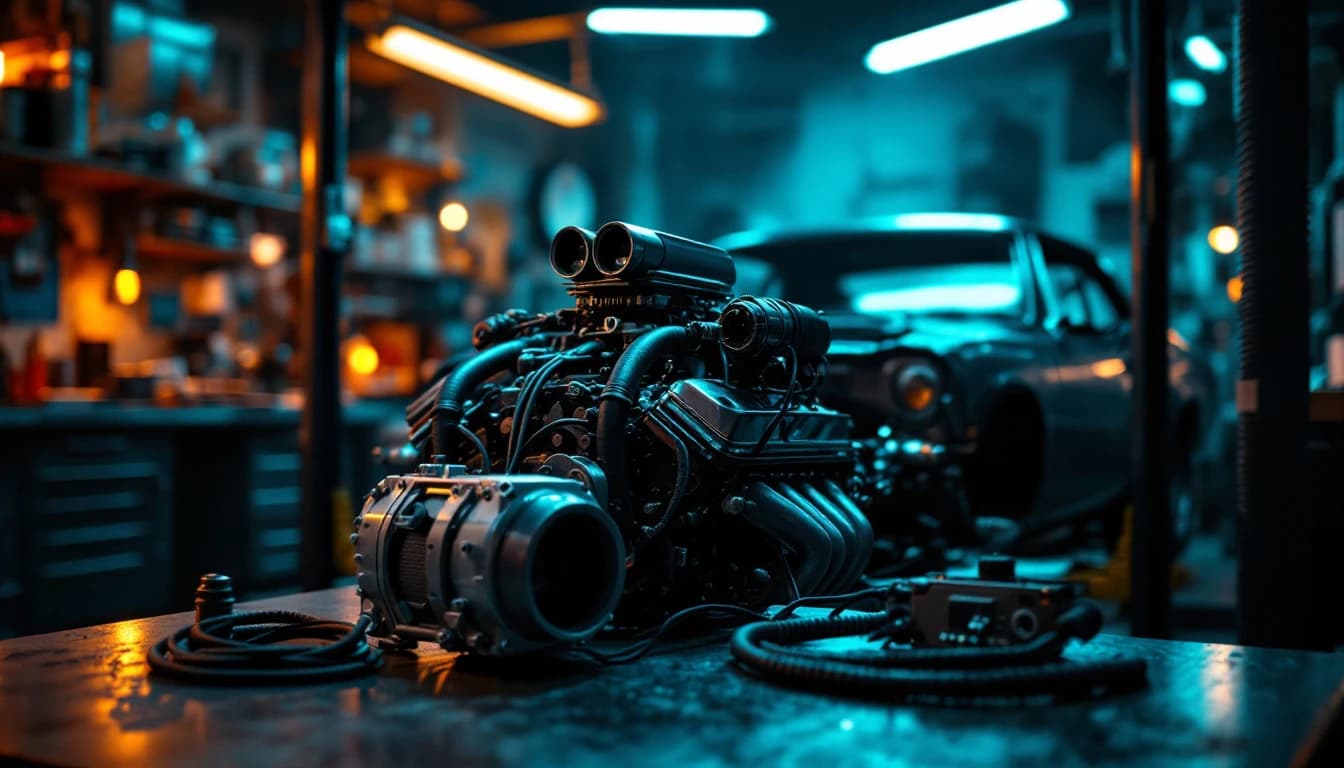
LS & LT Swap Won't Run? The GM ECU Immobilizer Is Why — and How Immo-Off Fixes It
The swap that cranks but won't run
It is one of the most demoralizing moments in an engine swap. The LS or LT is in, the harness is pinned out, the fuel is flowing, you have spark — and the engine cranks strong and refuses to fire, or fires for half a second and dies. You check the obvious things twice. Fuel pressure, good. Crank sensor, good. Grounds, good. And still nothing.
Nine times out of ten on a GM swap, nothing on that list is the problem. The problem is invisible and it lives inside the engine ECU: the anti-theft system. GM's engine computers are built to refuse to run outside the vehicle they were married to, and a swap is, by definition, outside that vehicle. The ECU is doing exactly what GM designed it to do — it just has no idea you are the legitimate owner building something new.
This guide explains why the GM immobilizer blocks a swap, which ECUs it affects, and how a bench immobilizer-off removes the requirement so the engine runs standalone. It is the swap-specific companion to our broader engine-swap ECU programming guide.
Why GM engine ECUs refuse to run outside their car
GM's anti-theft systems — VATS, Passlock, and the modern immobilizer built into the Global A and Global B architectures — exist to stop a stolen engine or a stolen car from running. It works: electronic immobilizers of this class are what the Insurance Institute for Highway Safety credits with driving vehicle theft rates down across the fleet, and the FBI's motor-vehicle-theft statistics show how much harder immobilizers made casual theft.
On a factory GM vehicle, the engine ECU expects a security handshake from the body control module or the vehicle's anti-theft system on every start. No valid handshake, the ECU disables fuel or spark, and the engine will not run. In your donor car that handshake happened invisibly a hundred thousand times. In your swap — an old Chevelle, a boat, a rock crawler, an early truck — there is no BCM sending it, so the ECU sits there waiting for a partner that will never answer. Crank, no run. It is the same anti-theft logic we walk through for factory cars in the GM security-light no-start guide, just experienced from the swap builder's side.
Which ECUs, and which builds
The immobilizer-off covers the modern GM engine ECU families that show up in LS and LT swaps and standalone builds:
- E98 (MPC5674) — common on later LS-based applications.
- E80 / E82 / E84 (MPC5676) — the Gen V LT family and related units.
- Related GM engine ECUs — verified by part number before work.
And the builds these serve are exactly the ones where an immobilizer makes no sense:
- An LS or LT swap into an older or non-GM chassis — a muscle car, an early pickup, a hot rod, a European or Japanese shell. There is no GM anti-theft to talk to, so the requirement has to go.
- A standalone, marine, or off-road build — an engine running on a stand, in a boat, in a buggy, with a minimal harness and no body electronics at all.
- An orphaned vehicle — a GM car where the anti-theft path is simply gone: a dead BCM, a missing key system, a salvage build.
A shop that does a steady stream of swaps summarized the customer conversation:
"The LS-swap guys all get everything right — engine, wiring, fuel — and then it won't run and they think they've cooked something. I ask one question: did the ECU come out of a car with GM anti-theft? If yes, that's your no-run. The ECU wants a handshake from a body module that isn't in your Chevelle. Immo-off the ECU on the bench and it runs standalone. It's the last mile of the swap and it's the one nobody plans for, every single time." — Independent engine-swap and standalone specialist, 15+ years (anonymized)
Immo-off is not a tune — and it is not emissions
Two clarifications that save confusion, because builders ask both.
It is not a tune. An immobilizer-off removes the anti-theft requirement so the ECU runs on its own. It does not change fueling, timing, idle, or fan control — that is a separate calibration job. If you also want the ECU tuned or unlocked for a tuner to write to, that is our Global A ECM unlock, a different operation for a different goal. Immo-off just gets the engine running; the tune is yours to do after.
It is not emissions. We do the anti-theft side only. We do not delete or disable the catalyst, EVAP, EGR, or any emissions equipment — selling emissions deletes for street vehicles is a Clean Air Act violation, and it is not something we offer. The immo-off is a security operation and nothing more. The EPA's engine and vehicle regulations are the reason that line is bright, and we keep it bright.
What the bench job includes
The immo-off is a genuine ECU edit, done properly:
- The immobilizer requirement is removed from the ECU so it no longer waits for the anti-theft handshake.
- The checksum is corrected so the edited file is valid and the ECU runs clean rather than throwing a fault or refusing the modified data.
- It is bench-verified before it ships back, and we tell you what your harness still needs to provide — power, ground, the right sensor inputs — so you are not chasing a non-immobilizer no-run afterward.
It is $250 flat, 24-hour turnaround once your ECU arrives.
What it is worth to a build
Swap builders count both money and dead weekends. A no-run you cannot diagnose eats both — days on forums, parts swapped on a guess, a running engine sitting silent because of a handshake that will never come. The Bureau of Labor Statistics tracks the shop-labor rates that pile up when a build stalls at a shop instead of your own garage. Against that, a $250 bench immo-off is cheap certainty: the ECU comes back running standalone, checksum-corrected, with a note on what the harness still owes it. It is the difference between a finished swap and a very expensive paperweight with a perfect engine in it.
What to ship
- Text us the ECU part number and a line about the build — LS or LT swap, standalone, marine, orphaned — so we can confirm coverage and set expectations.
- Order online — GM ECU immo-off $250 — and choose return shipping at checkout (Standard $24.95, UPS 2-Day $54.95, overnight $94.95).
- Pack the ECU, a note describing the build and what the harness is, proof of ownership, and your order confirmation. USPS: PO Box 120241, Arlington TX 76012. UPS/FedEx: 1009 Oakwood Ln # 120241, Arlington TX 76012.
- 24-hour bench turnaround. Immobilizer removed, checksum corrected, verified, shipped back.
- Install and run. The ECU no longer needs the anti-theft handshake; your engine runs standalone.
Ruling out the other no-run causes first
Before you conclude it is the immobilizer, it is worth confirming the swap basics, because an immo-off fixes the security no-run and nothing else. The immobilizer signature is specific: the engine cranks strong, has fuel and spark, and simply will not run or fires briefly and dies — with no mechanical fault you can find. That points at the anti-theft handshake.
If instead you have no spark at all, no fuel pressure, a dead crank or cam sensor signal, or a wiring fault, those are ordinary swap problems and an immo-off will not touch them. General swap and no-start references from outlets like Car and Driver and the broad hot-rod community walk through the usual suspects — power, ground, sensor inputs, harness pinout — worth eliminating first. The clean test is the one the swap specialists use: if the engine cranks with good fuel and spark and still will not run, and the ECU came out of a car with GM anti-theft, the immobilizer is your prime suspect. We would rather you confirm that before shipping than after.
What your harness still has to provide
An immobilizer-off removes one specific obstacle — the anti-theft requirement — but it does not build your harness for you, and it is worth being clear about that so you are not chasing a second no-run after the ECU comes back. The edited ECU still needs the fundamentals any standalone build needs: clean switched and constant power, solid grounds, the crank and cam signals, and the sensor inputs the calibration expects. On a swap into an older chassis, that usually means a standalone or swap-specific harness rather than the factory body harness the ECU grew up with.
The immo-off makes the ECU willing to run; the harness makes it able to. When your module ships back we note what it still expects, so you can check your harness against it. This is the same division of labor covered in our broader engine-swap ECU programming guide — the ECU work and the harness work are two halves of one swap, and getting the immobilizer out of the way is the half most builders do not see coming.
Buying a used ECU for a swap
Many swaps run a used ECU pulled from a donor car, and that is fine — the immo-off makes it run regardless of which vehicle it came from. The thing to get right is matching the ECU to your engine and its needs: an E98 for the right LS application, an E80/E82/E84 for the Gen V LT. Salvage yards, eBay, and the enthusiast market carry them in depth, because LS and LT swaps have become one of the most popular build paths in the hobby — a trend Hagerty has tracked as these engines became the default heart transplant for everything from muscle cars to imports.
Send us the ECU part number of your candidate before you buy if you want it confirmed for your build. Once it is in hand, the immo-off is what turns that donor-car ECU into one that will run in your project rather than sitting there waiting for a security system that no longer exists.
Why swappers keep the security off, and factory cars keep it on
There is a clean logic to when immo-off is the right call, and it comes down to what the vehicle is. On a factory GM car that is still a car — a daily driver with a working body module and key system — the anti-theft is protecting something, and you keep it. Stripping it there needlessly removes protection that insurers and buyers value, and vehicle-history services like Carfax reward clean, intact vehicles. That is why, for a factory car with a security no-start, the right fix is usually repairing the anti-theft path, not deleting it — the territory our GM security-light no-start guide covers.
A swap is the opposite situation. There is no daily-driver immobilizer to protect, because the ECU is now living in a chassis that never had a matching security system — an old muscle car, a boat, a buggy. The immobilizer is not guarding anything; it is just a locked door with no key on the other side. Removing that requirement is what makes the engine run, and it takes nothing away, because there was nothing there to take. That is why immo-off is a legitimate, standard operation for a build and a poor choice for a daily driver — and why we ask what the vehicle actually is before we touch the ECU. The NHTSA's anti-theft and immobilizer guidance exists to encourage the protection on real cars; a swap simply is not one of those cases, which is exactly why proof of ownership is required and the operation is scoped to genuine builds.
Frequently asked questions
Will this let my swapped LS or LT run without the donor car's security?
Yes — that is exactly what it does. The immobilizer-off removes the anti-theft requirement so the E98/E80/E82/E84 runs on its own, which is what a swap into an older or non-GM chassis needs. Your harness still has to provide power, ground, and the correct inputs, but the security no-run is gone.
Is this a tune?
No. It is immobilizer removal only — it does not change fueling, timing, or any calibration. If you want the ECU tuned or opened for a tuner, that is a separate service (our Global A ECM unlock). Immo-off just gets the engine running standalone.
Do you delete the emissions equipment while you're in there?
No, never. We do not delete or disable the catalyst, EVAP, EGR, or any emissions system. This is strictly an anti-theft/immobilizer operation.
Which GM ECUs are covered?
The E98 (MPC5674) and E80/E82/E84 (MPC5676) families, plus related engine ECUs verified by part number. Send us your ECU part number and we confirm before you ship. If you have not sourced the ECU yet, send the part number of your candidate and we will confirm it is one we can immo-off for your engine before you buy it, so you are not gambling on a unit that turns out to be outside coverage.
Do you require proof of ownership?
Yes. Immobilizer work requires proof of ownership and valid ID or verified business credentials before any work is performed — standard for any legitimate security operation.
The bottom line
A swapped LS or LT that cranks but will not run is almost never a broken engine or bad wiring — it is the GM ECU still waiting for an anti-theft handshake from a car it no longer lives in. A bench immobilizer-off on the E98, E80, E82, or E84 removes that requirement so the engine runs standalone, checksum-corrected, for $250 in a 24-hour turnaround. It is an anti-theft operation only — no tune, no emissions edits, proof of ownership required.
Swap won't run and you've checked everything else? Start with the GM ECU immo-off service — or text us your ECU part number and a line about the build and we will confirm coverage before you ship, so the only ECU you send is one we already know we can turn around and get running standalone for your project.
Ship your module today
Flat-rate pricing, 24-hour bench turnaround, return speed your choice at checkout. Most jobs back on your bench within a week.
More from the Lab
Locked Transmission Controllers: Cloning the GM T87A and BMW EGS (8HP) for Swaps and Tunes
11 min · August 3, 2026
Remote GM Module Programming — SPS2 Without the Dealer Trip
8 min · August 23, 2026

Replaced a PCM or Module? Here's How to Program It Without the Dealer
10 min · August 23, 2026
GM Instrument Panel Coded: VIN, Mileage + Theft Deterrent
12 min · August 17, 2026