
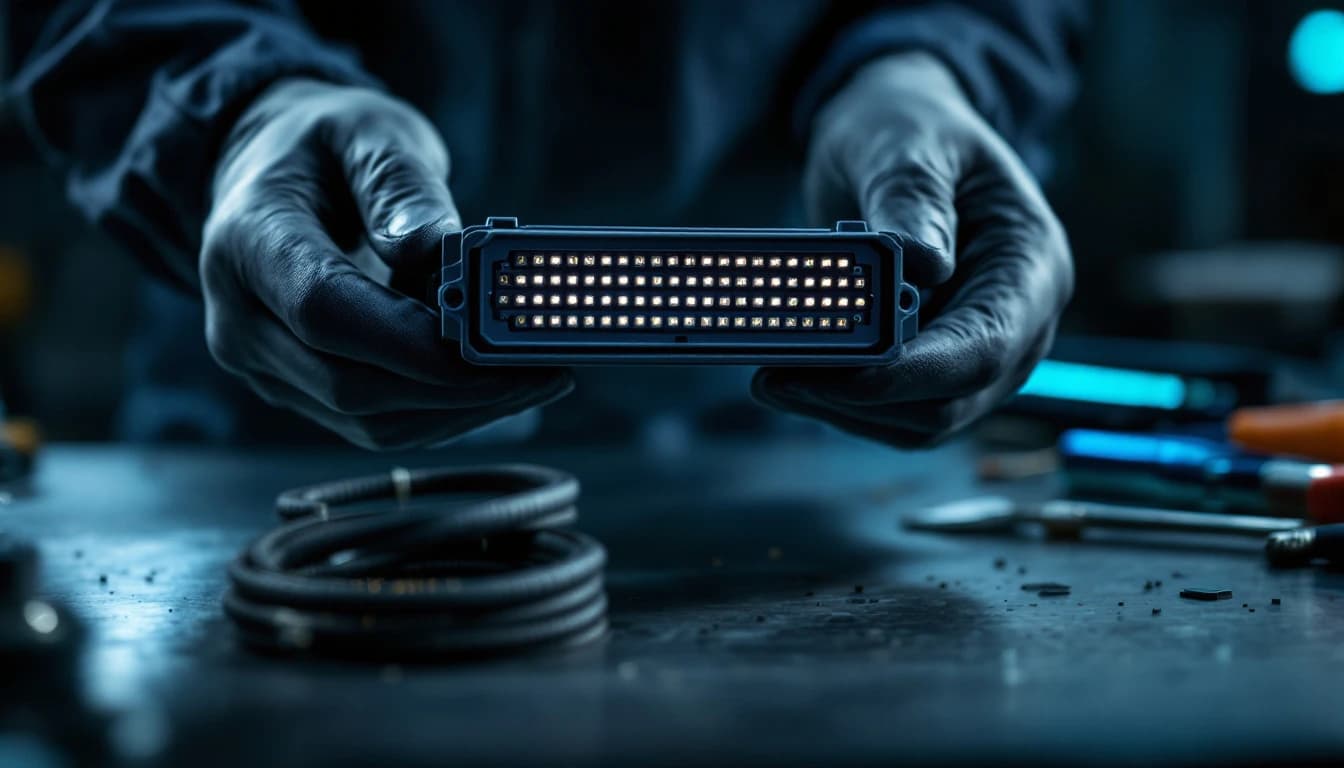
TCM Programming and Cloning: The Complete Transmission Control Module Replacement Guide
Who this is for
This guide is for four kinds of readers:
- Your scan tool shows lost communication with the TCM, or transmission fault codes that point at the controller rather than the gearbox, and you need a replacement path that actually works
- You swapped a transmission — junkyard unit, remanufactured unit, or an upgrade — and now the controller and the gearbox disagree about what they are bolted to
- You bought a used TCM online, plugged it in, and got harsh shifts, warning lights, a no-shift condition, or a car that will not even start
- You run a shop and want a fixed-price bench partner for the programming side of transmission jobs instead of scheduling every car into a dealer
The answer to all four is the same service: our TCM transmission programming service either clones your original TCM's data onto a donor or programs and configures a replacement for your vehicle — pure bench work, mail-in from anywhere in the country, $250 flat, with fitment verified by VIN and module label before you ship. What follows is the full picture: what this computer does, why it cannot be treated like a plug-and-play part, and how the two bench paths differ.
What a TCM actually does
An automatic transmission without its computer is just an expensive box of clutches. The transmission control module makes every meaningful decision:
- Shift strategy. The TCM decides which gear you should be in right now, based on vehicle speed, throttle position, engine load, temperature, and grade. Modern strategies are not simple speed thresholds — they are maps with dozens of interacting inputs, plus distinct modes for cold operation, towing, sport settings, and grade descent.
- Line pressure control. Every shift is a controlled handoff between hydraulic clutches. The TCM commands solenoids that set line pressure precisely — enough pressure to prevent slip (which burns clutches), not so much that the shift bangs. Getting this wrong in either direction shortens the transmission's life.
- Torque-converter lockup. The TCM decides when to lock the converter clutch for efficiency and when to let it slip for smoothness. Transmission efficiency is a meaningful slice of real-world fuel economy, which is why regulators at the U.S. Environmental Protection Agency track transmission technology adoption as part of fleet-efficiency trends, and why the engineering literature at SAE International is thick with lockup-strategy and shift-quality papers.
- Adaptive learning. This is the part most owners never hear about. As clutches wear and hydraulics age, the time and pressure needed for a clean shift drift. The TCM continuously measures actual shift behavior against its targets and corrects — storing learned adaptation tables unique to your transmission's wear state. A ten-year-old transmission shifts smoothly because its TCM has spent ten years learning it.
- Protection and diagnostics. Overtemperature strategies, limp-home modes, torque-reduction requests to the engine computer during shifts, and the fault codes your scan tool reads all live here.
The stakes are large because the population is large: well over 95 percent of new vehicles sold in the U.S. carry automatic transmissions of some form, per market reporting from Car and Driver, and the average vehicle on American roads is now roughly 12.5 years old by industry estimates reported by Consumer Reports and others. Old automatics with tired electronics are not an edge case — they are the national fleet.
Where TCMs live — external, integrated, and in between
"Replace the TCM" means physically different things on different vehicles, and knowing which architecture you have changes the job.
External standalone TCMs. Many platforms mount the TCM as its own box — under the hood, behind the glovebox, on a fender liner, under the driver's seat. These are the friendliest case for bench work: unplug, unbolt, ship. Plenty of GM, Ford, Chrysler, and Asian-brand applications use this layout, as do many European cars of the 1990s-2000s.
PCM-integrated control. Some vehicles fold transmission control into the powertrain control module — one computer runs both engine and gearbox. There is no separate TCM to replace; the transmission side lives inside the PCM's programming. If that is your architecture, the relevant bench services are PCM-side — for example our GM E38/E67/E92 ECM clone service for GM's engine controllers, where the clone carries the powertrain data across to a donor.
Valve-body-integrated mechatronics. The modern trend is to bolt the TCU directly onto (or into) the valve body inside the transmission — one assembly with the solenoids, sensors, and computer together, living in hot fluid. VW Group's DSG mechatronic is the most famous example, and it is different enough — with its own failure modes and its own component-protection wrinkles — that it has its own dedicated clone service and its own guide. ZF's widely used 8-speed and many Asian CVTs follow the same integrated philosophy.
The service this guide covers targets the first category and the removable-TCU cases: a transmission control module you can unbolt and put in a box. When you send your details for verification, the module label photo tells us instantly which world you are in.
TCM failure vs mechanical transmission failure — read this before buying anything
The most expensive mistake in this corner of car repair is replacing the wrong half of the system. Electronics and hardware can produce overlapping symptoms, but the patterns differ:
Symptoms that lean electronic (TCM or wiring):
- No communication with the TCM on a scan tool — the module has gone silent on the network
- Sudden, binary behavior: perfect yesterday, stuck in limp-home today, no gradual worsening
- Heat-correlated faults that appear when the module bakes and vanish cold — classic aging-electronics behavior, especially on TCMs mounted in hot locations
- Internal control module fault codes — the module reporting its own memory or processor faults
- Shifts commanded wrong rather than executed badly — wrong gear for conditions, no shift commanded at all, erratic hunting with no slip
- Water intrusion history — a flooded floorpan or leaking cowl above a cabin-mounted TCM is a well-known killer
Symptoms that lean mechanical (the transmission itself):
- Slipping — engine revs rise without acceleration during or between shifts
- Gradual worsening over weeks or months — wear announces itself slowly
- Burnt-smelling, dark fluid or metal in the pan — evidence of physical clutch material loss
- Noise — whining, grinding, clunking that tracks with speed or gear
- Harsh shifts that persist across temperature and conditions, especially paired with slip codes for specific clutches
A skilled diagnostician weighs the whole picture, and fluid condition plus stored codes usually tells the story. The honest rule: programming cannot fix metal. A TCM clone or replacement solves electronic failure; it does nothing for burnt clutches. Getting this call right matters financially, because the downside of guessing wrong is transmission-replacement money — commonly in the roughly $4,000-$7,000 range for a full replacement per Kelley Blue Book repair-cost guidance — against a $250 bench fee for the electronic path. And driveline trouble is a persistent theme in the dependability data: J.D. Power's vehicle dependability studies have measured the industry averaging roughly 190 problems per 100 vehicles in recent years, with powertrain complaints a steady contributor. If a failed TCM has also left you with safety-relevant behavior — unexpected loss of drive in traffic, for instance — it is worth knowing that unexpected powertrain behavior is a recognized complaint category at the National Highway Traffic Safety Administration, where you can also check your vehicle for open recalls before spending money.
"Half the TCMs that come across my bench were replaced by somebody guessing. The giveaway is always the story: 'it slipped for six months, then we put a used TCM in it.' Slip is friction material, not firmware. But when a customer tells me it drove perfect Friday and wouldn't leave the driveway Saturday, and the scanner can't even see the module — that's electronics, and a properly programmed replacement fixes it the first time." — Independent transmission rebuilder and diagnostics specialist, 20+ years in driveline repair (anonymized)
If your module's condition is genuinely unclear — intermittent faults, water exposure, a no-communication condition that might be wiring — say so when you text us. Bench evaluation can establish whether the module itself responds before you commit to a path.
Why a used TCM doesn't just plug in
Every junkyard and auction site is full of cheap TCMs, and nearly every one of them will disappoint the buyer who installs it bare. Four separate mechanisms are working against you:
1. VIN-lock. Modern TCMs store the vehicle identification number and are locked to it. Install a donor and the network notices the mismatch: depending on platform you get warning lights, stored theft or configuration faults, refusal to shift out of a default mode, or complete rejection. The VIN in the module has to become your VIN, and that is a programming operation.
2. Calibration and coding mismatch. One TCM part number serves many combinations — different engines, axle ratios, tire sizes, towing packages, market variants. The donor carries the calibration and configuration of the vehicle it came from. Even when it superficially works, wrong coding means wrong shift points, wrong pressure targets, and wrong speedometer-related math.
3. Adaptation tables. The donor spent its life learning a different transmission's wear. Its stored clutch-fill times and pressure trims are wrong for your hardware — the source of the harsh, flaring, lurching behavior people report after bare swaps. Some platforms relearn quickly; others shift badly for a long time or set plausibility faults before they get there.
4. Immobilizer participation. On some platforms the TCM is part of the anti-theft chain — the vehicle checks it during the start handshake. An unmarried donor on those platforms produces a crank-no-start, which is how a transmission part ends up causing what looks like a security failure. This is also why proof of ownership is required where immobilizer data is involved: the same operations that legitimately marry a module to your car are the ones vehicle-security regimes exist to control.
This is the same story told across the modern car — the full version is in our pillar on why used-module plug-and-play fails — and it is exactly the problem the two bench paths below are built to solve.
Two bench paths: clone your original, or program a replacement
The service offers two distinct routes, chosen by what condition your original module is in.
Path 1 — Clone. If your original TCM still communicates on the bench — even if it misbehaves in the car — we read its complete data and transfer it 1:1 onto a matching donor: VIN, calibration, coding, adaptation tables, and immobilizer data where the platform carries it. The donor becomes, electronically, your module. This is the preferred path whenever the original is readable, because it preserves your transmission's learned adaptation data and every piece of vehicle-specific configuration in one operation.
Path 2 — Program / configure. If the original is dead and unreadable, or you are supporting a transmission swap where the old data is the wrong data anyway, we program the replacement module for your vehicle: correct calibration for your configuration, VIN written, options coded. On this path the adaptation tables start fresh — see the relearn section below — but the module leaves the bench as a correct, married controller for your car rather than a stranger.
Both paths are $250 flat, and both start the same way: a technician verifies fitment by VIN and module label before you ship. Hardware revisions and calibration families matter; verification first is how we make sure the unit on the bench can actually become the unit your car needs.
Clone vs dealer programming — the comparison
| Bench clone / program by mail (this service) | Dealer programming | |
|---|---|---|
| Vehicle required on site | No — the module ships, the car stays home | Yes — car goes to the dealer, often by tow with a no-shift fault |
| Price | $250 flat, quoted before you ship | Hourly diagnostic plus programming charges, quoted after arrival |
| Used donor modules | Accepted — cloning is built for them | Frequently refused; many dealers program only new modules they supply |
| Adaptation data | Clone path preserves your transmission's learned tables | Fresh module starts from factory defaults — relearn required |
| Coverage | Multi-brand bench equipment across domestic, Asian, and European platforms | That dealer's brand only |
| Fitment check | VIN + module label verified before shipping | Parts counter lookup |
| Turnaround | Bench time measured in days, plus shipping each way | Scheduling backlog varies by dealer |
The dealer path is legitimate and sometimes the right answer — notably when you want a brand-new module under a factory parts warranty and the car is drivable. The bench path wins when the car cannot move under its own power, when the dealer will not touch a used donor, when there is no dealer within reasonable towing distance, or when the total math of tow plus diagnostic hours plus new-module parts pricing collapses against a used donor plus one flat $250 fee.
Adaptive data and relearn — what happens after replacement
Whichever path you take, understand what the adaptation tables mean for the first miles after installation.
After a clone: your transmission's own learned data rides along on the donor. Installation day feels like nothing happened — shift quality carries over, because the tables describing your gearbox's wear came with the data. Normal background adaptation simply continues.
After a fresh program: the module knows your vehicle but not your transmission's wear. Most platforms handle this with drive-cycle relearning — the TCM rebuilds its tables over a period of normal, varied driving, and some manufacturers publish specific relearn procedures (a sequence of steady accelerations and complete stops, or a scan-tool-commanded fast-learn where supported). Expect shifts that are slightly firm or slightly soft for a while, improving noticeably as the tables fill in. This is normal and is not a defect in the programming — it is the system doing exactly what adaptive control is designed to do. If shift quality is still degrading rather than improving after the relearn period, that points back at hardware, not the module.
This difference is also the practical answer to "clone or program?" — when the original is readable and the transmission is staying, clone. Fresh programming is for dead originals and changed hardware.
The mail-in workflow
- Verify first. Text us your VIN, your vehicle's year, make, model, and engine, a description of the problem, and clear photos of the TCM's label (part number and any service numbers). A technician confirms fitment and which path — clone or program — fits your situation. Nothing ships until this check passes.
- Proof of ownership where immobilizer data is involved — required before security-related data work is performed.
- Ship the module(s). Original plus donor for a clone; the replacement unit for a programming job. Ship to PO Box 120241, Arlington TX 76012 if you ship USPS — or 1168 W Pioneer Parkway, Arlington TX 76013 if you ship UPS or FedEx (UPS and FedEx cannot deliver to a PO Box) — anti-static bag, padded box, connectors protected.
- Bench work. Modules are powered on a regulated bench supply. Clone path: read the original, verify the read, transfer to the donor, confirm. Program path: write calibration, VIN, and configuration for your vehicle.
- Return with tracking via the customer-paid return-shipping tier you chose at checkout — from $14.95 standard, with faster options available. Install, perform the relearn if your path needs one, and drive.
Frequently asked questions
What are the symptoms of a bad TCM? The strongest signs are loss of scan-tool communication with the module, sudden binary failures (fine yesterday, limp-home today), heat-correlated faults that vanish when cold, internal control-module fault codes, and shifts commanded wrong rather than executed badly. Slipping, burnt fluid, gradual worsening, and noise point at the transmission hardware instead, and no module can fix those.
Can a used TCM be programmed to my car? Yes — that is exactly what the clone path does. We transfer your original module's VIN, calibration, coding, adaptation tables, and immobilizer data (where applicable) onto the used donor so it becomes electronically identical to your original. A used TCM installed bare, without this transfer, typically produces warning lights, wrong shifting, limp mode, or a no-start on immobilizer-participating platforms.
How much does TCM programming cost? Our bench service is $250 flat for either path — cloning your original onto a donor, or programming a replacement for your vehicle — plus customer-paid return shipping from $14.95 chosen at checkout. You supply the donor or replacement module, and a technician verifies fitment by VIN and module label before you ship so the fee is never spent on an incompatible unit.
Do I need the dealer to program a TCM? No — dealer programming is one path, not the only one. A bench service can clone or program the module by mail without the vehicle ever visiting anyone, which matters most when the car cannot drive, when the dealer refuses used donor modules, or when dealer parts-plus-labor pricing makes the repair uneconomical. The dealer route remains reasonable when you want a new module under factory parts warranty.
Will my transmission need a relearn after the module is replaced? After a clone, no meaningful relearn is needed — your transmission's learned adaptation tables transfer with the data, so shift quality carries over from day one. After a fresh programming job, yes: the module rebuilds its adaptation tables over a period of normal driving, and some platforms have published relearn procedures. Slightly imperfect shifts that steadily improve during that window are normal.
Is the TCM the same thing as a mechatronic unit? They are related but not identical. A TCM is the transmission computer; a mechatronic is an assembly that integrates that computer with the hydraulic valve body inside the transmission — VW/Audi DSG gearboxes being the best-known example. Standalone and removable TCMs belong with this service; DSG mechatronics have a dedicated clone service of their own because the hardware and security handling differ.
The bottom line
The TCM is the decision-maker behind every shift your automatic transmission makes — strategy, pressure, lockup, and years of quietly accumulated adaptive learning. When it fails, the fix is never just a used part in a box: VIN-lock, calibration coding, adaptation tables, and immobilizer participation all stand between a bare donor and a working car.
The bench service resolves that by mail, two ways: clone your readable original 1:1 onto a donor — preserving your transmission's learned data so it drives right immediately — or program a replacement from scratch for your vehicle when the original is dead or the hardware changed. Either path is $250 flat, verified by VIN and module label before you ship, with proof of ownership required where immobilizer data is involved and customer-paid return shipping from $14.95 at checkout.
First step costs nothing: gather your VIN and a clear photo of the module label, then start at the TCM transmission programming service page and text us the details. We confirm fitment and the right path before a single box ships.
Ship your module today
Flat-rate pricing, 24-hour bench turnaround, return speed your choice at checkout. Most jobs back on your bench within a week.
More from the Lab
Transmission in Limp Mode or Shifting Harsh? TCM vs Mechatronic vs Mechanical — A Diagnosis Guide
14 min · July 20, 2026
Car Module Repair vs Replacement vs Reprogramming: How to Decide Before You Spend
14 min · July 26, 2026
Can a Mail-In Service Really Program a Module to My VIN Without the Dealer?
13 min · July 26, 2026
Buying a Used Donor Module: The Checklist That Decides Whether It Will Actually Clone
17 min · July 26, 2026