

TIPM Replacement Done Right: Why a Used Chrysler TIPM Won't Accept Your Truck, and the One Step Dealers Charge $850 For
The most notorious module in the Chrysler world
Ask any independent shop which single part has generated the most misery across the 2011–2013 Chrysler, Dodge, Jeep and Ram lineup, and the answer comes back fast: the TIPM.
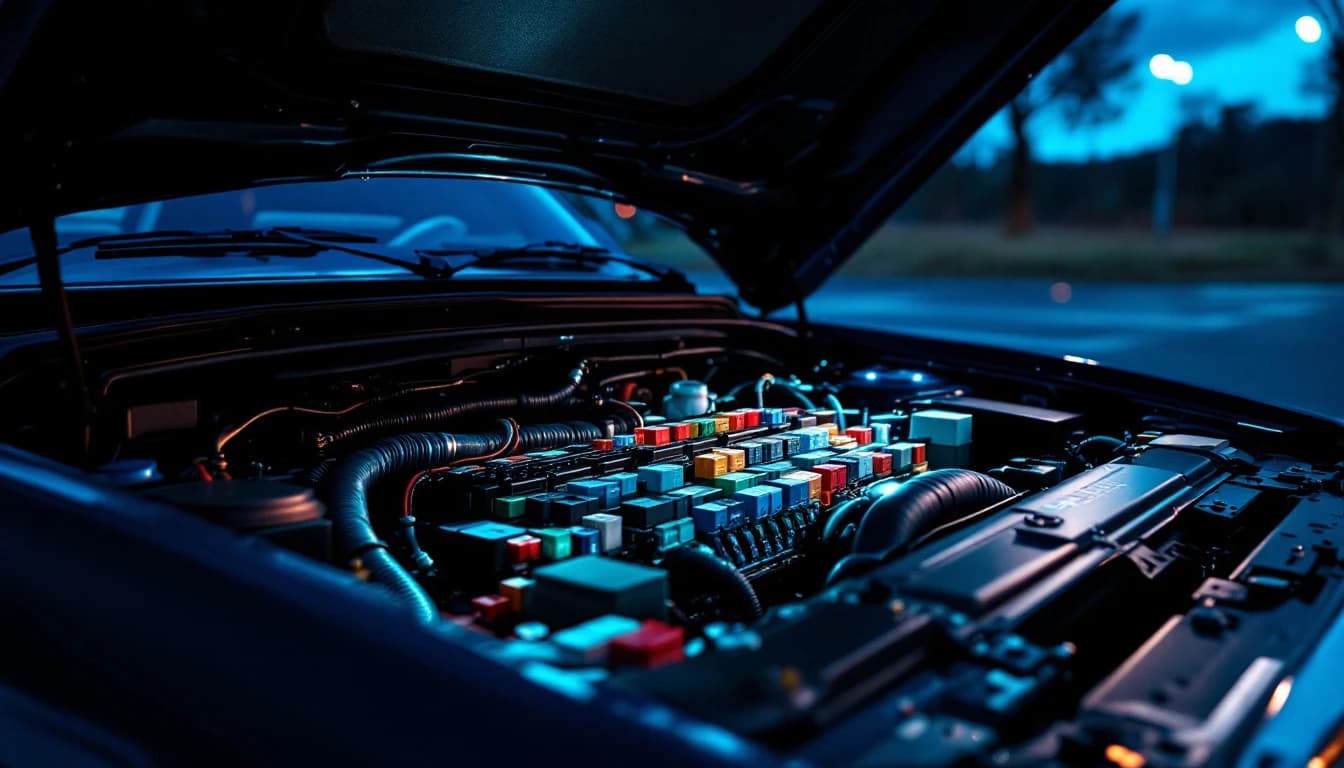
The Totally Integrated Power Module sits under the hood looking like an ordinary fuse box, and that appearance is deceiving. It is a fuse and relay box and a body computer in one sealed assembly — it distributes high-current power to the fuel pump, starter circuit, wipers, lighting and accessories, and it makes decisions about all of it. When it fails, it does not fail politely. Owners report fuel pumps that run continuously with the key out, no-crank conditions on a healthy battery, wipers that sweep on their own or refuse to park, horns sounding at random, and doors locking and unlocking without a hand near them.
The failure population is enormous because these years span the Ram 1500, Grand Cherokee, Durango, Town & Country, Grand Caravan, Journey, Charger, Challenger, 200 and Avenger. And because the part is expensive and the symptoms are dramatic, it has also become one of the most commonly mis-replaced modules on the road.
This guide covers what actually breaks, why the used-module shortcut fails, what the real fix costs in 2026, and — most importantly — how to tell whether you need a TIPM at all.
Before you buy anything: it may just be the relay
This is the section that saves readers the most money, so it comes first.
A very large share of "my TIPM failed" cases present as a single symptom: the fuel pump. Either it does not run and the vehicle will not start, or it runs constantly and will not shut off with the key out. That specific failure is frequently the fuel pump relay inside the TIPM, not the whole module — and the relay is a dramatically cheaper fix than the assembly.
Chrysler acknowledged the problem's scale, and an entire cottage industry of external relay bypass kits exists precisely because so many of these were relay failures wearing a module's clothing. If the fuel pump is your only complaint and the rest of the truck behaves normally, get that relay evaluated before you spend money on a module. Any shop that sells you a full TIPM without asking that question is not looking out for you — which is why we ask about it on our own TIPM product page before taking an order.
Where a module genuinely is the answer is when the failures are multiple and unrelated: fuel pump plus wipers, or no-crank plus phantom door locks, or accessories dead with no blown fuse. That pattern points at the computer side of the assembly rather than one relay.
Why the used TIPM you bought didn't work
Assume you have confirmed the module. You find a matching TIPM at a salvage yard for a hundred dollars, swap it in, and the vehicle does not accept it — or accepts it partially and throws a wall of faults.
Here is why. A TIPM stores the identity of the vehicle it came from. A used one is still that other truck's module, and there is a specific, widely misunderstood wrinkle about fixing that.
Technicians reach instinctively for the factory scan tool's Restore Vehicle Configuration routine, because on many Chrysler modules that is exactly the right move. On a used TIPM it does not do the job. In a Diagnostic Network thread on used TIPM programming, a mobile technician states it plainly after learning it the expensive way: a used TIPM will not change the VIN with restore vehicle configuration, and a separate procedure is required. Other technicians in the same discussion confirm the factory tool is designed around new part replacement rather than re-marrying a used one.
That single fact is why the salvage-yard path has such a poor reputation on these vehicles, and why a whole market of pre-programmed exchange units exists.
The self-configuration wrinkle — and its limit
There is a genuinely useful behavior in this generation that gets misquoted constantly, so it is worth stating precisely.
A virgin TIPM — one that has never been married to a vehicle, or has been properly reset — will collect what it needs from the vehicle on installation. It pulls the VIN from the powertrain control module and the vehicle configuration from the instrument cluster, and it does this with the ignition in the RUN position. Owners and technicians report the process taking on the order of ten to fifteen minutes with the key on, occasionally followed by an ABS initialization or a VIN re-entry.
You will see "twelve seconds" repeated in forum posts and product listings. Treat that with suspicion; practitioners who do these regularly describe minutes, not seconds, and planning for the shorter number is how people conclude the module failed when it was simply still learning.
The limit is the important part: this only works on a virgin module. A used TIPM that is still married to its donor will not self-configure, which brings the problem right back to where it started.
What actually fixes it
Three legitimate paths, in order of how often they apply:
Write your VIN at the module level. Chrysler-specific bench tooling can write the VIN directly to the module's memory rather than asking the vehicle to do it over the network. This is what turns a donor TIPM into your TIPM, and it is the approach behind most credible pre-programmed exchange units — including ours. It works on used modules precisely where the factory routine does not.
Reset the donor to virgin, then let the vehicle teach it. A properly reset module can then complete the self-configuration described above on installation. This is the path behind stock-and-ship inventory, since donors can be prepared before a customer ever calls.
Buy new and let the vehicle configure it. Expensive but straightforward, and the path a dealer takes.
What does not work is the thing most people try first: bolting in an untouched used module and hoping.
What it costs in 2026
The spread here is the widest of any module we sell, which is why the category attracts so many sellers.
Dealer replacement. A new module plus programming plus labor, with the vehicle usually arriving on a hook because it will not start. Owner reports and specialist quotes cluster around $849 and up for a dealer TIPM job on these vehicles, with rebuilt and exchange units commonly running $500–$850 through specialist rebuilders. Amazon listings for programmed Ram TIPMs sit in the same neighborhood.
Pre-programmed exchange. The specialist market — a module supplied with your VIN already written, shipped ready to install. Our programmed TIPM sits at $599 flat, which is the middle of that band with the programming already done and no vehicle downtime waiting on a bay.
Raw salvage core. Eighty to a hundred and fifty dollars, and — as covered above — non-functional until someone writes your VIN into it.
For context on why owners keep choosing repair over replacement on these vehicles at all: RepairPal data on this class of electrical repair, combined with the fact that these are now fifteen-year-old trucks and minivans in the second- and third-owner market, means a four-figure dealer bill is frequently more than the vehicle's owner is willing to spend. The pre-programmed module exists because the alternative is often the scrapyard.
"The TIPM is the only part I know of where the customer can do everything right — correct part number, careful install, clean connections — and still end up with a dead vehicle, because nobody told them the module has to be told which truck it lives in now. That conversation should happen before the sale, not after." — a master automotive locksmith (ALOA-credentialed) on our bench team
Getting the right module the first time
TIPM part numbers on these vehicles typically carry a 68-prefix, and they are not interchangeable across trims and equipment levels the way the identical-looking housing suggests. Two trucks of the same year and model can take different modules depending on options.
The rule that prevents nearly every bad outcome: read the part number off your existing module and have it verified against your VIN before anything ships. A supplier who will not do that check is transferring the risk of a mismatch onto you. It is a two-minute step that is the single biggest determinant of whether the repair goes smoothly.
What to expect at installation
Assuming a correctly programmed module:
- Disconnect the battery before removing the original. This is a high-current distribution point and it deserves respect.
- Transfer any fuses and relays as instructed — some suppliers ship a bare module.
- Install, reconnect, and turn the ignition to RUN. Give it the full ten to fifteen minutes to complete its handshake with the vehicle rather than assuming failure at minute two.
- Some applications want an ABS initialization afterward, and a small number need a VIN confirmation step.
If the vehicle does not behave immediately, resist the urge to start swapping parts. The overwhelming majority of "the replacement didn't work" reports on these are either an unprogrammed module, a part-number mismatch, or someone not waiting out the configuration period.
The hard reset worth trying first
Before concluding a module is dead, there is a free procedure that occasionally resolves TIPM misbehaviour, and it costs nothing but time.
The technique is a genuine hard reset — conductively bridging the disconnected battery cables to drain residual energy from the capacitors inside the module, forcing a true power-down rather than the partial sleep a simple battery disconnect produces. Practitioners report that this can clear codes and, in some cases, let a used TIPM-7 work in a vehicle.
It is not a cure for a genuinely corrupted module, and it will not solve the VIN-marriage problem described above. But on a vehicle exhibiting confused rather than dead behaviour, it is the cheapest thing on the list and it occasionally saves an entire repair. Disconnect the battery, follow a documented bridging procedure carefully, and give the vehicle its full configuration time afterward.
Why this work belongs on a bench
There is a reason credible TIPM work happens on a workbench rather than in a driveway, and it is the same reason that applies to every module-programming job.
Writing to a module's memory is the moment it is most vulnerable. A voltage sag, a dropped connection, or an interrupted session partway through a write leaves the module in a half-programmed state — which is precisely how modules get bricked. SAE International, whose J2534 standard defines how pass-through reprogramming is supposed to work, treats stable power and an uninterrupted communication link as preconditions for safe module programming rather than nice-to-haves.
On a bench, those conditions are controlled: a regulated supply holds voltage steady, the connection is short and undisturbed, and the result is verified before the part ever ships. In a driveway on a fifteen-year-old battery, none of that is true — which is why the failure stories in this category cluster around people attempting programming on the vehicle.
That control is also what makes the honest promise possible. A module verified powered-up and communicating on the bench before it goes in the box is a fundamentally different product from a used module someone pulled and listed.
The economics support the care. Automotive research firm iSeeCars has documented how routinely mainstream vehicles now cross 200,000 miles, and these Chrysler-family trucks and minivans are deep into second- and third-owner territory. A repair that has to be done twice frequently ends the vehicle's life, because the second bill exceeds what the owner is willing to spend.
Where the TIPM ends and other modules begin
Because the TIPM touches so much, it gets blamed for faults that live elsewhere. A no-start with the security light behaving oddly may be the powertrain control module and the SKIM immobilizer relationship rather than power distribution. Charging-system and ground faults imitate module failure convincingly. And on a vehicle this age, corroded connectors downstream of the module produce symptoms that look exactly like the module dropping circuits.
The general framework for sorting this out — deciding whether a module needs repair, replacement, or reprogramming — applies here more than anywhere, because the TIPM is the most expensive wrong guess in the Chrysler catalog. If you want the symptom-side breakdown first, our TIPM failure symptoms guide walks through what each pattern actually indicates.
Quick answers
Can I install a used TIPM without programming? No. A used TIPM stays married to the vehicle it came from, and it will not accept your vehicle until your VIN is written to it. This is the single most common failed repair in this category.
Why doesn't Restore Vehicle Configuration fix it? Because that factory routine is built around configuring a new module, not re-identifying a used one. Technicians report directly that a used TIPM will not change its VIN through that procedure, which is why a module-level VIN write is required.
Is my problem the TIPM or just the fuel pump relay? If the fuel pump is your only symptom, suspect the relay first — it is a far cheaper repair and it accounts for a large share of these complaints. If you have multiple unrelated failures at once, the module itself is the likelier answer.
How long does a TIPM take to configure after installation? Plan on ten to fifteen minutes with the ignition in RUN, not seconds. Some applications also want an ABS initialization afterward.
What does a TIPM replacement cost in 2026? A dealer job commonly runs $850 or more with the vehicle towed in. Pre-programmed exchange units from specialists generally fall in the $500–$850 band, with the programming already completed.
The bottom line
If your 2011–2013 Chrysler, Dodge, Jeep or Ram is doing something electrically inexplicable, the TIPM is a reasonable suspect — but check the fuel pump relay first if that is your only symptom, because it is frequently the whole story and costs a fraction as much.
If you do need the module, understand what you are actually buying. A used TIPM is hardware without an identity, the factory Restore Vehicle Configuration routine will not give it yours, and the VIN has to be written at the module level for the swap to work. That programming is the product. It is why a $100 core and a $599 programmed unit are not the same purchase, and why the dealer's $850-plus quote exists at all.
Verify your part number, confirm your seller programs rather than merely resells, and give the module its full configuration time on install. Get those three things right and this repair is straightforward — which is not something anyone has historically been able to say about a TIPM.
Ship your module today
Flat-rate pricing, 24-hour bench turnaround, return speed your choice at checkout. Most jobs back on your bench within a week.
More from the Lab
TIPM Replacement and Programming: New vs Used vs Rebuilt on Chrysler, Dodge, Jeep and Ram
15 min · July 28, 2026
TIPM Repair Chrysler Dodge Jeep Ram 2007-2018: Mail-In 2026
12 min · June 18, 2026

Chrysler PCM Replacement and SKIM: Why the Donor Computer Runs for Two Seconds and Dies
12 min · July 31, 2026
TIPM Failure Symptoms on Chrysler, Dodge & Jeep: Dead Fuel Pump, No-Start, Random Gremlins
11 min · July 13, 2026