
VW Touareg TDI ECU Faults: EDC16 and EDC17 Diagnosis, Water Ingress, and What a Bench Can Actually Recover
Who this is for
- Your Touareg, Cayenne, or Q7 TDI cranks and will not start, and a shop has told you the ECU is dead
- You are seeing a dead or flickering instrument cluster, no communication with the engine controller, or faults that come and go with weather
- Your scan tool has thrown implausible-signal faults on several circuits that have nothing to do with each other, and nothing you replace fixes it
- You have already fitted a used ECU and the car will not start, or now shows an immobilizer fault
- You are a shop trying to decide whether to condemn the controller or keep chasing wiring
If you are on the broader question of whether the car is immobilizer-locked or module-dead in the first place, start with our guide on telling an immobilizer or module fault apart. This article is the platform-specific version for the Touareg family, and it leads with the thing that causes most of these calls.
Start here: the ECU lives in a box that fills with water
This is the single most valuable thing anyone can tell a Touareg TDI owner, and it is the reason so many of these controllers arrive on a bench soaked.
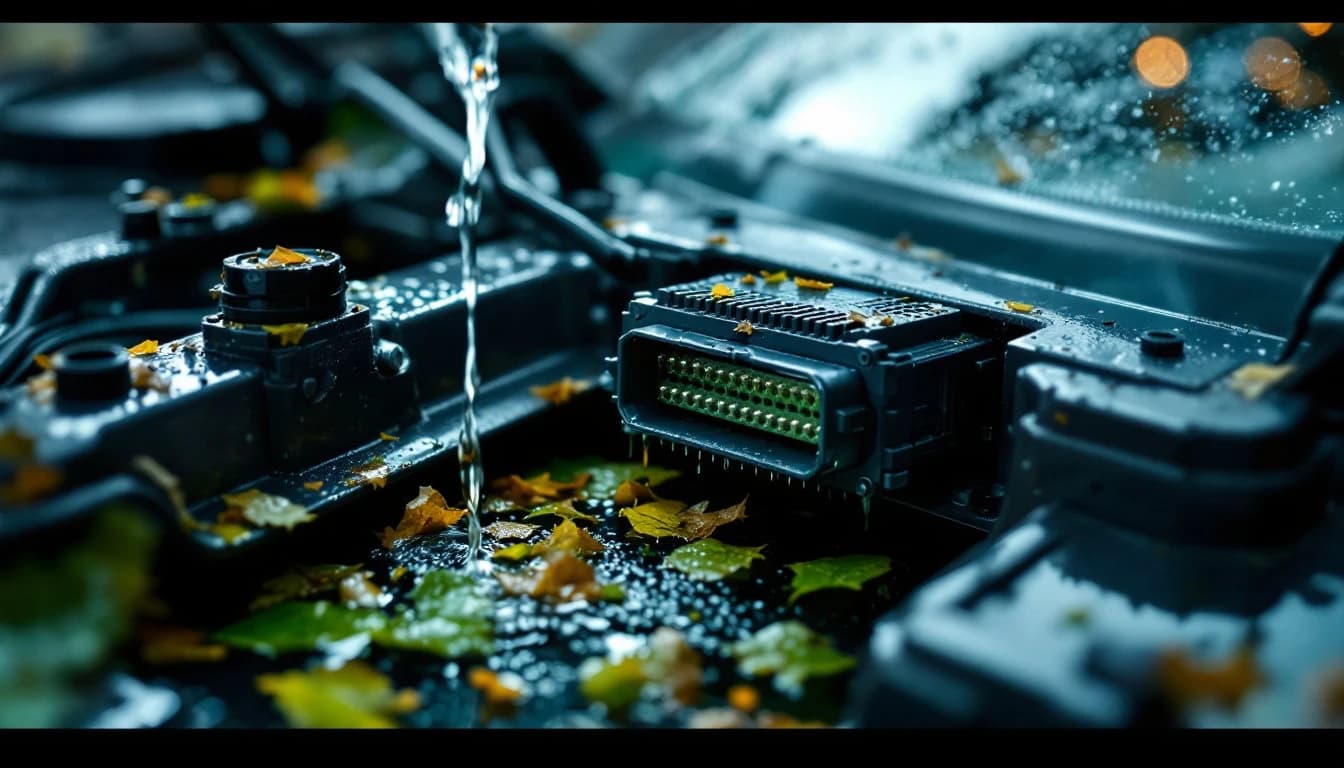
On the first-generation Touareg (7L, roughly 2004 through 2010) and on its close platform relatives, the engine control unit is mounted in a plastic electronics box in the plenum chamber — the trough under the windshield cowl, behind the engine bay, beneath the wiper arms and the black plastic water deflector. Lift the cowl trim and the water deflector and the E-box is right there, along with several other control units and connectors depending on the build.
That plenum trough is designed to collect the water that runs off the windshield and route it out through drain tubes at each end. Those drains are the failure point. They pass down through the front wheel arch area, they are small, and they sit directly under a place where leaves, pine needles, roof-rack grit, and general organic debris accumulate. Park a Touareg under trees for two autumns without cleaning the cowl and the drains block.
Once they block, the trough becomes a bathtub. Water sits in it, rises, and reaches the electronics box. From there it does three separate kinds of damage, and understanding that they are separate is what stops you from replacing the wrong thing:
1. It floods the connector pin field
The large ECU connectors have dozens of small pins packed tightly together. Water bridging adjacent pins creates leakage paths between circuits that are electrically unrelated. Over months, the copper corrodes and grows green oxide, and the contact resistance on individual pins climbs. This is the most common damage and it is often completely repairable — but it is also the one most often misdiagnosed as ECU failure, because the symptoms are wild.
2. It wicks into the housing and onto the board
Water that gets past the seal reaches the printed circuit board. On a board with conformal coating it may sit harmlessly for a while; where the coating is broken by a solder joint, a via, or a connector footprint, it starts electrochemical migration between traces. That produces intermittent faults first and permanent ones later.
3. It corrodes grounds and harness sections outside the ECU
The same water tracks along the loom. Ground points and shield terminations corrode, and now you have a controller reading through a compromised reference. A ground with 2 ohms of corrosion resistance in it will make a perfectly healthy ECU report nonsense.
The Touareg is not unique in having a plenum, but it is unusually punished by it because of how much sits in that box. On later Touaregs (7P, roughly 2011 onward) the packaging changed, but water in the plenum and in the underfloor areas remains a recognized complaint pattern — and once you factor in that the average light vehicle on U.S. roads is now well over twelve years old, most of these trucks have had a decade or more of leaf litter to work with.
The controllers themselves: EDC16 and EDC17
Two Bosch controller families cover almost every TDI in this platform group.
EDC16 is the earlier generation. On the 5.0L V10 TDI, the engine is managed by two EDC16 units working as a master and slave pair, one per bank — which matters enormously for diagnosis, because a fault on one unit produces half-engine symptoms and a comms fault on one unit can look like a total ECU failure. The 2.5L R5 TDI and the early 3.0L V6 TDI also sit in the EDC16 family, in the U and CP variants.
EDC17 replaced it on the later 3.0L V6 TDI, in CP-series variants. EDC17 brought a substantially different internal architecture: a more capable processor, a different flash and EEPROM layout, and a tighter security model around calibration access and immobilizer data. Practically, the difference for a repair is this — on EDC16 the immobilizer data lives in an accessible external serial EEPROM, while on EDC17 the immobilizer relationship is bound up with the controller's internal memory and its security access. Both are workable on a bench; they are not the same job.
Volkswagen's own owner and model resources and Audi's U.S. model information still document the shared architecture across these SUVs, and the diesel powertrains in that era were high-volume products across three brands — so donor controllers exist in the salvage market, which is exactly why donor-ECU questions come up constantly on this platform.
The symptom set water produces
Here is where owners and shops lose the most money: water damage does not present as one clean failure. It presents as a scattered, weather-dependent, self-contradicting mess. Recognizing the pattern is the diagnosis.
Crank, no start
The starter turns the engine normally and it never fires. On a diesel with no spark to lose, the usual culprits are fuel delivery, rail pressure, or an engine controller that is not commanding injection at all. If it is water, the ECU is often perfectly capable of running the engine but has lost a specific circuit — a crankshaft or camshaft signal, an injector driver return, or a supply pin — through a corroded contact.
Intermittent dead dash, no communication with the engine control module
You turn the key and the cluster is dark, or it lights and then drops out. A scan tool reports no communication with the engine controller. This is very frequently a power, ground, or CAN wiring problem in the wet zone, not a dead ECU. It also frequently changes with temperature and humidity, which is a strong tell.
Implausible signals on several unrelated circuits at once
This is the signature. You pull codes and find implausible-signal faults on the rail pressure sensor, the mass airflow sensor, a glow-plug circuit, and a brake switch — components that share no wiring, no supply, and no function. A single ECU does not usually fail in a way that takes out four unrelated inputs and leaves everything else working. A connector pin field bridged by moisture does exactly that. When you see a fault list that reads like a parts catalogue, stop ordering parts and go look in the plenum.
Immobilizer faults that are actually a corroded CAN line
On this platform the immobilizer conversation happens across the vehicle network between the cluster, the immobilizer function, and the engine controller. If the CAN pair is degraded by corrosion — one conductor with elevated resistance, or leakage between CAN-High and CAN-Low — that conversation fails, and the car reports an immobilizer fault. The immobilizer data may be completely intact. You are looking at a wiring fault wearing an immobilizer costume. This is the single most common false condemnation we see on these trucks, and it is why an immobilizer fault code should never on its own be treated as proof that the ECU needs replacing. If the fault is a genuine calibration-side block rather than a wiring problem, the pattern looks different — our P1570 code page and full write-up on the immobilizer-blocked ECU condition cover that case specifically.
Faults that follow the weather
If the car is fine in a dry week and troublesome after rain or a car wash, that is water. It is not a coincidence, it is not the fuel, and it is not the battery. Go and look in the cowl.
The first thing I do on one of these is pull the wiper arms and the cowl and put my hand in the box. Nine times out of ten it comes out wet or with a black leaf sludge in it, and every fault on the list suddenly makes sense as one problem instead of six. I have sent people home with a cleaned drain and a re-pinned connector who had a quote for a new controller in their pocket.
— Independent European driveability technician, 18+ years VW and Porsche diesel platforms (anonymized)
How to tell a failed ECU from wiring, grounds, and corrosion
Do this before you spend anything. It costs an hour and a flashlight.
1. Open the plenum and look. Wiper arms off, cowl trim off, water deflector off. Inspect the electronics box for standing water, water staining, silt, or leaf sludge. Check both drain tubes by pouring water into the trough and confirming it exits. Blocked drains are the root cause; clearing them is the permanent fix that stops the next controller dying too.
2. Inspect the ECU connectors, pin by pin. Unplug and look at the pin field under good light with magnification. You are looking for green or white oxide, discoloured plastic, a pin that has receded or spread, and moisture in the seal. Photograph it — it is the single most useful piece of evidence for any bench evaluation later.
3. Verify power and grounds under load. Check the ECU supply pins and the ground pins with the circuit loaded, not with a static meter reading. A corroded ground can look like zero ohms on an unloaded meter and drop half a volt when the starter turns. Note that some Touaregs carry two batteries; a weak second battery or a corroded interconnect produces symptoms that mimic a controller fault. Poor charging and grounding also kill the replacement module, which is why we wrote about charging-system and ground faults causing repeat module failures.
4. Check the CAN pair. With the ignition off and the network at rest, measure resistance across CAN-High and CAN-Low — a healthy two-terminator bus reads around 60 ohms. A reading near 120 suggests one terminating branch is missing, and a very low or unstable reading suggests a short or leakage. Then check for continuity and leakage to ground and to each other along the wet section of loom.
5. Only then consider the controller. If the box was dry, the pins are clean, the supplies and grounds are solid under load, and the bus checks out — now a failed controller is a reasonable conclusion. If any of the first four checks failed, fix that first and re-test. The National Highway Traffic Safety Administration collects owner complaints and safety data by VIN, and electrical and electronic complaints are consistently among the most-reported trouble areas in large-scale owner reliability work published by Consumer Reports — a large share of which resolve to wiring and connections rather than to the control module itself.
What a bench can and cannot recover
Once the module is off the car, there are three genuinely different conditions it can be in, and they have very different outcomes. This is the comparison that matters.
| Condition | What is actually wrong | Typical bench outcome | What it needs afterward |
|---|---|---|---|
| Corroded connector and surface contamination | Oxide bridging pins, silt in the housing, coating intact underneath | Usually recoverable — clean, de-oxidize, repair or replace affected contacts, re-seal | Clear the plenum drains or it happens again |
| Corroded board with lifted traces or damage under a device | Electrochemical migration has eaten traces, sometimes beneath a package where it cannot be reworked | Often not recoverable — data may still be readable for transfer to a donor | A donor controller, adapted to the vehicle |
| Failed driver or output stage, board otherwise clean | An injector, glow, or actuator driver has failed; the processor and memory are healthy | Frequently repairable at component level; data intact | Verify the circuit that killed it, or the new stage fails too |
| Intact board, locked or immobilizer-blocked calibration | Nothing is broken — the controller will not run because identity or security data does not match | Recoverable as a data and identity job, not a repair | Correct VIN and immobilizer handling for the platform |
| Water in the flash memory region, data unreadable | Original calibration and identity data destroyed | Data cannot be transferred; a donor must be adapted from scratch | Donor sourcing plus platform-correct immobilizer work |
The distinction to hold on to: a locked or immobilizer-blocked controller is not a broken controller. It is a data problem. Owners routinely scrap perfectly healthy units because the car would not start, when the board never had anything wrong with it.
That is exactly what a bench evaluation at $150 exists to determine. The unit goes on a regulated bench supply, communication is established, memory is read where it can be, and the outcome is a plain answer about which row of that table you are in — before you buy a donor or write off the controller.
The immobilizer and VIN side when a donor ECU is fitted
Say the original is genuinely unrecoverable and a used controller has been sourced. On this platform, fitting it is not the end of the job — the immobilizer relationship has to be resolved, and how you do that depends on the generation.
On EDC16, the immobilizer data sits in accessible controller memory. The clean path is to transfer the original vehicle's immobilizer data onto the donor so that the car sees the controller it expects, with the correct VIN written. When the original is readable, that is straightforward bench work. Where a platform is orphaned, or the original data is gone entirely, the legitimate alternative is an EDC16 TDI immo delete at $250 so the controller no longer waits on an immobilizer conversation it cannot complete.
On EDC17 and the wider VW and Audi range, the same problem is solved with a combined immo delete and VIN program at $250 — the controller is written with the correct VIN for the vehicle and the immobilizer dependency is resolved so the engine will run on the platform it is now installed in. If you want the deeper mechanics of what a VIN write and a security-access session actually consist of, that is covered in how module programming actually works, and the MED17 gasoline side of the same family is covered in our VW and Audi MED17 immo delete guide.
On the responsible-use framing, plainly: immobilizer delete work is offered for legitimate repair, restoration, off-road, competition, and orphaned-platform applications where legally permitted. Proof of ownership is required for any immobilizer, key, or security-related work — that is not a formality we can set aside. The customer is responsible for compliance with the law that applies to their vehicle and intended use. If a shop offers to do this work on a vehicle whose ownership you cannot document, that is a reason to walk away, not a bargain.
One more caution specific to the V10 TDI: because that engine runs a pair of controllers, a donor swap is a paired job. Replacing one unit without addressing how it relates to its partner produces a truck that runs on half the engine or does not start at all. Say up front which unit you have and whether both are in play.
Cost, turnaround, and the mail-in workflow
The work above is bench work: the vehicle stays where it is and the controller travels.
- Bench evaluation — $150. The right first step when it is unclear whether the unit is dead, locked, or fine. Comes back as an actual answer, not a guess.
- VW / Audi EDC16 TDI immo delete — $250.
- VW / Audi immo delete and VIN program — $250.
Return shipping is chosen at checkout and paid by the customer, from $24.95, with faster tiers available.
Ship the module USPS to PO Box 120241, Arlington, TX 76012, or UPS or FedEx to 1009 Oakwood Ln # 120241, Arlington, TX 76012 — couriers cannot deliver to a PO Box, so use the street address for those carriers. Pack it in an anti-static bag inside a padded box, and if the unit came out of a wet plenum, do not clean it, do not spray it with contact cleaner, and do not try to dry it with heat. Send it as it is with photographs of the connector pin field. Aggressive home cleaning has destroyed more recoverable boards than the water did.
Message us the VIN, the controller part number and Bosch number from the case label, the engine code, and a clear photo of the connectors, and we will tell you what is realistically recoverable before anything ships.
And do the boring thing that prevents the repeat: clear the plenum drains. A controller that goes back into a bathtub has a limited future no matter how well it was repaired. Broader ownership and long-term reliability coverage from outlets like MotorTrend and Hagerty has consistently flagged water management and electrical corrosion as the defining maintenance issue on aging European SUVs — and this platform is the textbook case.
Frequently asked questions
Why does my Touareg TDI show faults on several unrelated sensors at once? That pattern almost always means moisture or corrosion bridging pins in the ECU connector, not a failed controller. A single engine control unit rarely fails in a way that takes out four electrically unrelated inputs while leaving everything else working, so check the plenum electronics box and the connector pin field before replacing anything.
Where is the engine ECU on a VW Touareg? It sits in a plastic electronics box in the plenum chamber under the windshield cowl, reached by removing the wiper arms, the cowl trim, and the water deflector. That location is directly under the cowl drains, which is why blocked drains and water ingress are the dominant cause of ECU-related faults on this platform.
Can a water-damaged Touareg ECU be repaired? Often yes, if the damage is limited to the connector pin field and surface contamination — those are cleaned, de-oxidized, and re-contacted on the bench. If electrochemical migration has lifted traces or damaged the board beneath a component package, repair is usually not viable, though the original data can frequently still be read and transferred to a donor.
Is an immobilizer fault code proof that my ECU is dead? No, and treating it that way is the most expensive mistake on this platform. Degraded CAN wiring or corroded grounds can break the immobilizer conversation between the cluster and the engine controller while the controller and its stored data are perfectly intact, so verify the bus and the grounds before condemning the unit.
Do I need immo delete, or can the original data be transferred to a used ECU? Data transfer is the preferred route whenever the original controller can still be read, because the car then sees the identity it expects. Immo delete is the legitimate alternative when the original data is unrecoverable or the platform is orphaned, and it requires proof of ownership and compliance with the law for your vehicle and intended use.
Why does the V10 TDI complicate a donor swap? The 5.0L V10 TDI is managed by two EDC16 controllers working as a pair, so replacing one without addressing its relationship to the other produces a no-start or an engine running on half its cylinders. Identify which unit you have and whether both are involved before sourcing anything.
Should I clean or dry a wet ECU before sending it in? No. Send it exactly as it came out, in an anti-static bag, with photos of the connector pins. Contact cleaner, compressed air, and heat drying regularly spread contamination deeper into the housing or lift already-weakened traces, turning a recoverable unit into a scrap one.
The bottom line
On the Touareg, Cayenne, and Q7 TDI, the engine controller sits in a plenum box under a set of drains that block with leaf litter, and water in that box produces a symptom set — crank-no-start, an intermittently dead dash, communication failures, implausible faults across unrelated circuits, and immobilizer errors that are really corroded CAN — that looks like a dead ECU and usually is not.
Work the sequence in order: look in the plenum, inspect the pin field, load-test the supplies and grounds, check the CAN pair, and only then consider the controller. If it does come to the module, the outcome depends entirely on which condition it is in — a corroded connector is usually recoverable, a locked or immobilizer-blocked controller is a data job rather than a repair, and only a genuinely eaten board needs a donor.
Bench evaluation is $150, and the immobilizer work that follows is $250 for either the EDC16 TDI immo delete or the immo delete with VIN program, with proof of ownership required and customer-paid return shipping from $24.95 chosen at checkout. Whatever route you take, clear the cowl drains before the repaired or replaced unit goes back in — otherwise you are buying the same repair twice.
Ship your module today
Flat-rate pricing, 24-hour bench turnaround, return speed your choice at checkout. Most jobs back on your bench within a week.
More from the Lab
VW / Audi EDC16 TDI Diesel IMMO Delete Guide (2026)
12 min · June 18, 2026
VW & Audi PCR2.1 and EDC17: Immo-Off vs Clone on the Newer Bosch ECUs
10 min · August 7, 2026

VW & Audi Immobilizer Delete Cost and Turnaround: ME7, MED17, EDC16, and UDS
12 min · July 13, 2026

Remote GM Module Programming — SPS2 Without the Dealer Trip
8 min · August 23, 2026