
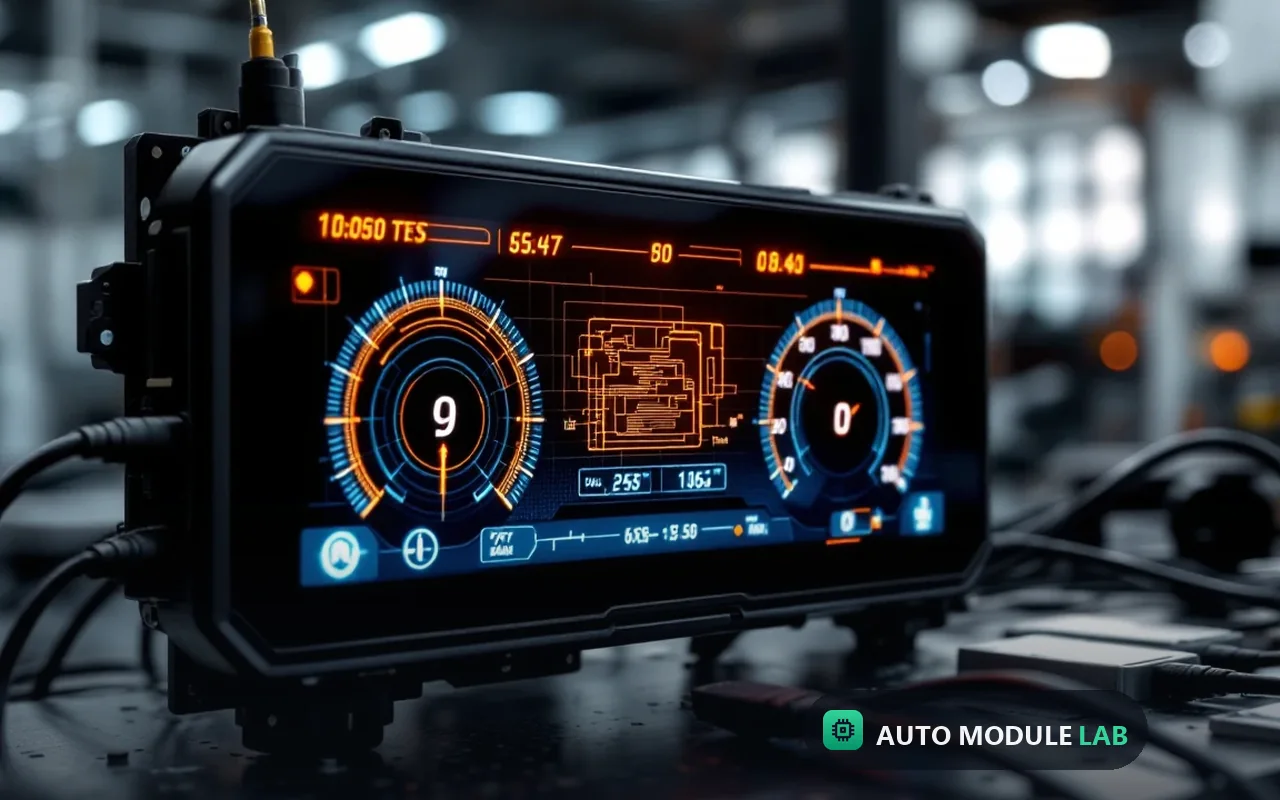
Instrument Cluster Repair + Legal Mileage Sync Explained: Dead Clusters, Pixel Failure, and Why a Replacement Cluster Must Show True Mileage
Who this is for
You're reading this because your dashboard is doing one of these things:
- The cluster is completely dead — no gauges, no backlight, no odometer, sometimes no crank
- The display flickers, resets, or works only when the cabin warms up (or only when it's cold)
- Pixels are dropping out of the odometer or message-center display, classic on BMW E38/E39/E46 clusters
- One or more gauges read wrong, sweep randomly, or sit at zero while the rest of the cluster works
- You already bought a used replacement cluster and discovered it shows the donor car's mileage, not yours
- You installed a replacement and now the car won't start, throws component-protection warnings, or refuses to recognize your key
Every one of those is bench work. The cluster comes out of the dash, ships to a workbench, gets diagnosed on a regulated power supply, and goes back in working — that's the whole model behind our instrument cluster repair and mileage sync service. This article walks through what a cluster actually is, how it fails, why the odometer reading lives inside it, and — the part that generates the most nervous emails — exactly where the legal line sits on mileage synchronization.
What an instrument cluster actually is
Calling it a "gauge cluster" undersells it badly. On anything built in roughly the last twenty-five years, the instrument cluster is a networked control module with its own processor, its own EEPROM memory, and its own list of jobs:
- It renders the gauges. Modern needles are driven by tiny stepper motors commanded over an internal bus, not by mechanical cables. The speedometer signal arrives as data on the CAN network, not as a spinning cable.
- It stores the odometer. On most platforms the legally meaningful mileage value is written into non-volatile EEPROM memory on the cluster's circuit board. Many vehicles keep a second copy in the engine computer or body control module — which matters enormously for legal sync, as we'll see.
- It participates in security. On a large share of European vehicles the immobilizer function physically lives in the cluster. VW and Audi are the textbook case: the cluster holds the immobilizer data that decides whether your key is allowed to start the car, which is why cluster replacement on those cars is a key-programming event, not just a swap — our VW/Audi cluster key programming service exists precisely because of that architecture.
- It gates options. Language, units, trim-level features, service reminders, and on some makes "component protection" flags that brick a module installed in a different vehicle until it's properly married.
Engineering bodies have tracked this migration from mechanical to electronic instrumentation for decades — SAE International publishes standards and technical papers covering everything from driver-information display design to in-vehicle network behavior, and the direction of travel has been one-way: more of the vehicle's identity and history lives in the cluster with every generation.
That's the background for the single most important sentence in this article: when you replace a cluster, you are replacing one of the places your vehicle's odometer history is stored. Handle that correctly and everything is clean and legal. Handle it wrong and you've created a titled lie.
How clusters die — the four big failure modes
1. Dead pixels and fading displays. The LCD segments in the odometer and message-center windows on many late-90s and 2000s clusters are connected by a heat-bonded ribbon cable whose conductive adhesive degrades with thermal cycling. Pixels drop out one column at a time until the display is unreadable. BMW E38, E39, and E46 clusters are the poster children — the fix is a proper ribbon-and-driver repair on the bench, not a junkyard roulette spin.
2. Total no-power failure. A dead cluster — no lights, no gauges, nothing — usually traces to a failed voltage regulator, a blown driver stage, or corrupted firmware after a voltage event (jump start gone wrong, alternator overcharge, battery installed backwards). Voltage events rarely respect module boundaries, by the way: the same surge that kills a cluster frequently takes out the keyless entry receiver on the same circuit, which is a separate bench fix covered by our keyless entry module repair service.
3. Gauge and stepper failures. Needles that stick, sweep to full scale, or read zero while the rest of the cluster works point to the stepper motors or their driver circuits. On some platforms this is an epidemic-level defect — GM's 2003-2006 full-size trucks are the most famous example, and we cover that whole saga in depth on the GM instrument cluster upgrade service side of the shop.
4. EEPROM corruption. The non-volatile memory that stores mileage, coding, and (on some makes) immobilizer data can corrupt after a voltage event or a botched flash. Symptoms range from a scrambled odometer display to a cluster that powers up but refuses to talk to the vehicle. This is recoverable more often than owners expect — the data structure is known, and a bench read usually tells us within minutes whether the original values can be restored.
What repair does not cover, so nobody is surprised: physically cracked or shattered lens glass, and backlight LED failure is a separate repair — message us photos first on that one. And there's one request we decline every single time, which brings us to the important part.
The legal line: mileage sync is not odometer rollback
Here is the distinction, stated as plainly as we can make it.
Mileage synchronization means writing the vehicle's true, documented odometer reading into a replacement cluster so the dashboard displays the mileage the vehicle has actually traveled. When your original cluster dies and you install a used one from a donor car, the donor's mileage comes with it. A donor cluster showing 89,000 miles installed in your 174,000-mile vehicle is now underreporting your mileage by 85,000 miles — and leaving it that way is itself a misrepresentation the moment the vehicle changes hands. Correcting the replacement cluster to your vehicle's true mileage is legal, necessary, and exactly what federal disclosure rules anticipate. It makes the odometer honest again.
Odometer fraud means altering an odometer to make a vehicle appear to have traveled fewer miles than it actually has, in order to deceive. That is a federal crime. The federal odometer statute — 49 U.S.C. chapter 327, originally enacted as part of the Motor Vehicle Information and Cost Savings Act — prohibits disconnecting, resetting, or altering an odometer with intent to change the mileage it displays, and it carries both criminal exposure and civil liability for violators (the full statutory text is maintained at Cornell Law School's Legal Information Institute).
This is not a paperwork technicality. The National Highway Traffic Safety Administration estimates that roughly 450,000 vehicles are sold each year in the United States with false odometer readings, and puts the annual cost of odometer fraud to American car buyers at well over 1 billion dollars. Carfax, which cross-references reported odometer readings across title, service, and inspection records, has estimated that roughly two million vehicles currently on U.S. roads have rolled-back odometers — and its year-over-year analyses have shown the problem growing, not shrinking, as digital odometers turned rollback from a screwdriver job into a laptop job.
The irony the fraud statistics reveal is that digital odometers made rollback easier for bad actors, not harder — which is exactly why legitimate shops have to be loud and specific about where they stand. So here is where we stand:
- We sync a replacement cluster only to the vehicle's documented true mileage — read from your original cluster, from the mirror copy stored in the ECU or body control module, or from written records (a recent state inspection report, title, or a clear photo of the original odometer before it died).
- We do not accept a number you'd simply like the odometer to say. If the documentation and the request don't line up, the job stops.
- We refuse rollback requests, full stop. No exceptions for "it's just for a show car," no exceptions for "the engine was replaced so the miles don't count" (engine replacement does not reset legal vehicle mileage — that's what disclosure statements are for).
- Federal odometer disclosure on any future sale of your vehicle remains your responsibility as the owner.
One more angle worth knowing: because many vehicles store mileage in more than one module, a rolled-back cluster is often trivially detectable — the cluster says 89,000 while the ECU quietly says 174,000. That mismatch is exactly what fraud investigators and diagnostic tools look for. Proper legal sync produces the opposite fingerprint: every module in the car telling the same true story.
"The tell is always the second module. A cluster can say whatever someone wrote into it, but the powertrain computer, the body module, the key memory — they keep their own counts. When I pull mileage from three places and get three different answers, somebody's been creative. A properly synced replacement cluster reads identical everywhere, and that's the only version of this work a legitimate shop should ever put its name on." — Independent European-vehicle diagnostics specialist, 20+ years in cluster and immobilizer repair (anonymized)
Repair the original vs replace and sync — how to choose
Both paths end with a working dashboard showing true mileage. The right one depends on what failed:
| Repair your original cluster | Replace with a donor + mileage sync | |
|---|---|---|
| Best for | Pixel failure, dead power stage, EEPROM corruption, flicker | Cracked housing, fire/water damage, unobtainable internal parts, trim upgrades |
| Mileage handling | Original mileage preserved (or restored from backup copy) | Donor mileage must be overwritten with your true documented mileage |
| Coding and options | Untouched | Must be matched or transferred; component protection cleared where present |
| Immobilizer risk | None — original security data stays put | On immo-in-cluster cars (VW/Audi and others), keys must be aligned to the new cluster |
| What you ship | Just the original cluster | The replacement cluster AND the original (or its EEPROM dump / documented reading) |
| Typical outcome | Plug-and-play reinstall | Plug-and-play reinstall after sync |
Two practical notes from the bench. First, when you're buying a donor cluster, match the part number and hardware version — a visually identical cluster with a different hardware revision can refuse to accept coding. Second, keep your dead original even after the swap: it's the cleanest possible source of your true mileage and coding data, and shipping it alongside the donor makes the sync bulletproof.
What the bench service does — and doesn't
What's included in the flat $200 service:
- Bench diagnosis on a regulated power supply — no guessing in the dash
- Pixel repair on the classic ribbon-failure clusters (BMW E38/E39/E46 and similar)
- Dead-cluster recovery: regulator, driver, and firmware-level faults
- EEPROM corruption recovery where the data structure permits
- Mileage sync of a replacement cluster to your documented true mileage
- Component protection cleared where present so the replacement activates properly
- Coding preserved — language, units, and options carry over when we sync from your original
- Bench verification before return, 24-hour turnaround once the part arrives, and a 6-month warranty on the repair work
What's not included, stated plainly:
- Cracked or shattered lens glass and physical screen damage (hardware we can't un-break)
- Backlight LED failure — separate repair, contact us with photos first
- Any mileage alteration that is not a sync to documented true mileage — rollbacks are refused, every time
Coverage runs across essentially every major make — BMW, Mercedes, Audi, VW, Porsche, Volvo, Land Rover, Jaguar, GM, Ford, Chrysler, Toyota, Honda, Nissan, Hyundai/Kia — analog and digital clusters both. If your vehicle is unusual, text us the year, make, model, and a photo of the cluster label before shipping and we'll confirm.
Why does this class of repair keep getting more relevant instead of less? Because the fleet keeps aging. S&P Global, whose mobility unit tracks vehicles in operation, has reported the average age of light vehicles on U.S. roads at roughly 12.5 years and climbing — a record every recent year it's been measured. Owner-reported problem rates tracked by J.D. Power in its dependability studies consistently place electrical and electronics issues among the most common complaint categories as vehicles age. Millions of vehicles are now old enough that their clusters are failing, but valuable enough that a $200 bench fix beats both the salvage yard gamble and a four-figure dealer replacement — when dealers can even still get the part.
The mail-in workflow
- Confirm first. Text us the year, make, model, VIN, and a description (or photo) of the symptom. If you're doing a sync, tell us the true current mileage and what documentation you have for it. We confirm the job before anything ships.
- Pull the cluster. On most vehicles this is a trim panel and a few screws. Take a photo of the odometer before removal if the display still works — that photo is gold for verification.
- Ship it. Anti-static bag, padded box, to PO Box 120241, Arlington TX 76012 if you ship USPS — or 1009 Oakwood Ln # 120241, Arlington TX 76012 if you ship UPS or FedEx (UPS and FedEx cannot deliver to a PO Box). For a mileage sync, ship BOTH the replacement cluster and your original (or its EEPROM dump, or your documented reading). Include a printed copy of your order confirmation, your VIN, and your return details.
- Bench diagnosis and backup. We power the cluster on a regulated supply, read and archive the EEPROM before touching anything, and diagnose the actual fault.
- Repair or sync. Pixel ribbon work, power-stage repair, EEPROM recovery, or a documented-true-mileage write to the replacement — whatever the job calls for, verified on the bench afterward.
- Return with tracking. 24-hour turnaround once the part is in hand. Return shipping is whatever tier you picked at checkout — Standard from $24.95, 2-day, or overnight — and reinstall is plug-and-play in most cases.
Frequently asked questions
Is mileage sync legal? Yes — syncing a replacement cluster to display your vehicle's true, documented mileage is legal and is the correct way to handle a cluster replacement. What's illegal under the federal odometer statute (49 U.S.C. chapter 327) is altering an odometer to misrepresent how far a vehicle has traveled. We do the first and refuse the second.
Where do you get my "true mileage" from? In order of preference: your original cluster's EEPROM, the mirror copy many vehicles keep in the ECU or body module, or written documentation — a recent inspection record, title mileage, or a dated photo of the working odometer. We cross-check when more than one source exists.
My original cluster is completely destroyed. Can you still sync a replacement? Usually, yes. Many vehicles store a second mileage copy in another module, and written records fill the gap when they don't. Send what you have and we'll tell you honestly whether it's enough.
Will my coding, language, and options survive? When we repair your original, everything stays untouched. When we sync from your original to a replacement, coding carries over and component protection (where present) is cleared so the new cluster activates properly.
I have a VW/Audi — will my key still start the car after a cluster swap? On those platforms the immobilizer lives in the cluster, so a straight swap will typically crank-no-start. The cluster needs immobilizer alignment, which is its own service — see our VW/Audi cluster key programming service and text us before shipping so we scope the whole job at once.
Can you fix my BMW E39 pixel dropouts? Yes — E38/E39/E46 pixel repair is one of the most common jobs on the bench. Proper ribbon-and-driver repair, full pixel function restored, original mileage and coding untouched.
What won't you do? Roll an odometer back, write a mileage you can't document, or "reset" mileage because of an engine swap. Federal law is unambiguous, the multi-module mileage records in your own car would contradict it anyway, and it's not who we are.
The bottom line
An instrument cluster is a computer that happens to hold your gauges — and your odometer, your coding, and on plenty of platforms a piece of your anti-theft system. When it fails, there are exactly two honest paths: repair the original on the bench, or install a replacement and sync it to the vehicle's true, documented mileage. Both are routine, flat-rate work here: $200, 24-hour turnaround from receipt, 6-month warranty, return shipping chosen at checkout from $24.95, all performed at our Arlington, Texas workshop.
The line we will not cross is the one federal law draws: sync means making the odometer true, and rollback means making it lie. With hundreds of thousands of misrepresented vehicles sold every year according to NHTSA, the used-car market doesn't need any help being dishonest — and every cluster that leaves this bench reads the same true number in every module in the car.
Start at the instrument cluster repair and mileage sync service page, or text us your VIN, symptom, and mileage documentation and we'll confirm the job before you ship anything.
Ship your module today
Flat-rate pricing, 24-hour bench turnaround, return speed your choice at checkout. Most jobs back on your bench within a week.
More from the Lab
GM Instrument Panel Coded: VIN, Mileage + Theft Deterrent
12 min · August 17, 2026
Swapping In a Used Instrument Cluster: VIN, True-Mileage Transfer, and the Immobilizer Trap
13 min · July 30, 2026

Instrument Cluster Replacement Programming: VIN, Mileage, Immobilizer Data and Configuration Explained
15 min · July 28, 2026
Instrument Cluster Repair: What Is Actually Fixable, What Is Replace-Only, and What It Costs
15 min · July 26, 2026