
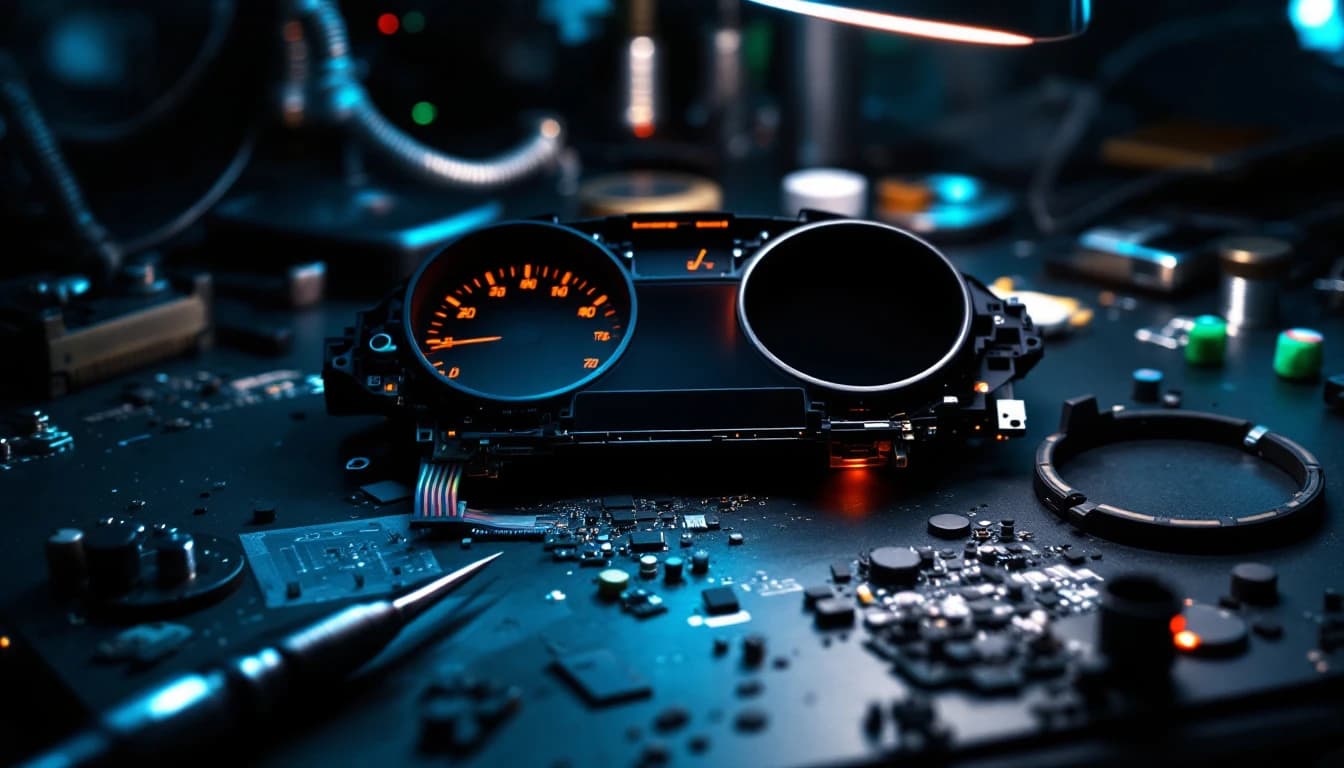
Instrument Cluster Not Working? Dead Gauges, Black Screen, and No-Communication Diagnosis
When the panel goes dark
Few dashboard failures feel as sudden as a dead instrument cluster. One drive the gauges are fine; the next, the needles are pinned at zero, the screen is black, or a warning-light storm lights up for no reason you can find. Because the cluster — the instrument panel cluster, or IPC — is how you read speed, fuel, temperature, and every warning the car wants to tell you, losing it is both a safety problem and a genuinely stressful one.
The good news is that a dead cluster is diagnosable, and the failure almost always narrows to one of a handful of causes. The better news is that many of the internal failures are repairable on a bench, with your original cluster and its mileage preserved — no VIN programming, no immobilizer dance, because it is still your cluster. The part worth understanding before you spend money is which failures are cheap and external, which are internal to the cluster, and why "just buy a used one" is rarely as simple as it sounds.
This is a symptom-first guide. Find the pattern that matches your car below, and it will point you toward the likely cause and the right fix.
Read the symptom first — what your dashboard is telling you
Different failures look different. Match yours.
All gauges dropped to zero
Every needle sits at rest — speedometer, tach, fuel, temperature all reading nothing — even with the engine running. If the screen and lights are otherwise alive, this points toward the gauge-drive side: failed stepper motors (the tiny motors that move each needle) or a board fault feeding them. If everything is dead including lights, suspect power or ground first (see below). A single needle stuck or lazy while the others work is a classic single-stepper-motor failure — common, and repairable.
Dead pixels, lines through the LCD, or a fading display
The information display — odometer, trip, menu — shows missing rows of pixels, horizontal or vertical lines, or characters that fade in and out. This is almost always the LCD itself or its ribbon connection: the flexible ribbon cable that links the glass to the board develops a cold or cracked joint, and pixels drop out where the connection is failing. It is one of the most repairable cluster faults there is, and it does not mean the whole cluster is dying.
Flickering, dim, or dead backlight
The gauges and display work but the lighting flickers, dims unevenly, or a section goes dark. This is typically failed backlight LEDs or their solder joints on the board — a soldering-level repair, not a full-cluster replacement.
Black screen at ignition — cluster completely dead
Turn the key and the cluster shows nothing: no sweep, no lights, no display. Before condemning the cluster, rule out the cheap external causes — a blown cluster fuse, a corroded or loose ground, or a wiring/connector fault at the cluster plug. If power and ground are confirmed good at the connector and the cluster is still dark, the fault is internal: commonly a board power-supply failure (a failed capacitor or voltage regulator on the cluster board).
"No communication with cluster" on a scan tool
You plug in a scanner and it cannot reach the cluster module, or the car behaves oddly — no-start, other modules complaining — because the cluster has fallen off the network. Modern clusters are nodes on the CAN bus, and they both display data and pass it along. A cluster that has lost communication can be an internal board/CAN-transceiver failure, or a bus wiring problem. This one needs proper diagnosis because a dead node can disrupt other modules on the same bus.
Warning-light storm — every light on for no reason
ABS, airbag, traction, check-engine and more all illuminate at once, or flicker together. Counterintuitively this is often not a fault in each of those systems — it is the cluster misreading or losing the network messages that drive the warning lamps, so it lights everything defensively. A cluster fault can masquerade as a dozen system failures at once.
The cheap causes to rule out first
Before anyone talks about repairing or replacing a cluster, eliminate the inexpensive external causes. A surprising share of "dead cluster" calls are none of the above internal failures.
- Fuse. A blown cluster or instrument fuse kills the panel instantly and completely. It is the first thing to check and the cheapest thing to fix. A fuse that blows again immediately points to a short worth chasing before you spend on anything else.
- Ground and power at the connector. A corroded, loose, or broken ground behind the cluster produces flicker, partial operation, or a total blackout. Confirm clean power and a solid ground at the cluster connector before condemning the module — this is exactly the kind of intermittent electrical fault that mimics an internal failure.
- Connector seating and pins. A cluster plug that has backed out, or a spread/corroded pin, causes dropouts that come and go with bumps and temperature.
- Battery and charging health. Low or noisy system voltage can make a cluster behave erratically. A weak battery is worth ruling out — the National Highway Traffic Safety Administration has long treated instrument-panel warning and display integrity as a safety-relevant function, and unstable voltage is a common source of flaky panel behavior.
If the fuse is good, power and ground are clean at the connector, and the cluster is still dead or glitching, the fault is inside the cluster — and that is where bench repair enters.
What actually fails inside a cluster
Instrument clusters are electronics, and they fail in a small, well-understood set of ways. Understanding them tells you why repair is so often the right answer.
Cold-solder joints. Years of heat cycling — hot dash in summer, cold soak in winter — fatigue the solder connections on the cluster board until they crack microscopically. A cracked joint is an intermittent or dead connection: a needle that quits, a backlight section that dies, a display that flickers. Reflowing or repairing the joint restores it. This is one of the most common and most fixable cluster failures.
Stepper-motor failure. Each needle is moved by a tiny stepper motor soldered to the board. They wear and fail, most famously on a generation of GM full-size trucks and SUVs where cluster stepper-motor failure was widespread enough to become an industry-known issue — MotorTrend and Hagerty have both covered gauge and cluster failures on popular platforms as recurring high-mileage complaints. A dead or erratic single gauge is the signature; replacing the stepper motor fixes it. These failures cluster on older, higher-mileage vehicles — and the fleet keeps aging: reporting aggregated by outlets like Car and Driver has noted the average vehicle on U.S. roads is now more than 12 years old, precisely the age range where solder joints, capacitors, and stepper motors begin to give out. Owner-satisfaction studies from J.D. Power have likewise found display and technology-related complaints ranking among the fastest-growing problem categories owners report.
LCD and ribbon failure. The display glass connects to the board through a flexible ribbon. The ribbon's bonded connection degrades and pixels drop out in lines and blocks. Repairing or reconnecting the ribbon — or replacing the LCD — brings the display back.
Capacitor and board-power failure. Electrolytic capacitors and voltage regulators on the cluster board age and fail, and when the board's power supply goes, the whole cluster can go dark. Component-level board repair addresses it.
CAN / communication faults. The cluster's network transceiver or its bus connection fails and the module drops off the CAN bus — the "no communication" case. Diagnosis has to separate an internal transceiver failure from a bus-wiring problem, because they look similar from the scan tool.
A technician who repairs these units for a living put the repair-versus-replace question plainly:
"Nine times out of ten the customer's original cluster is fixable — a stepper motor, a reflowed joint, a ribbon. What people don't realize is that swapping in a junkyard cluster is the harder job, not the easier one, because now I've got to marry it to the VIN and sync the true mileage before the car will even behave. If your original board isn't cracked or burned, repairing it keeps your miles and your identity right where they belong." — Independent instrument-cluster repair specialist, 17+ years in dash electronics (anonymized)
Notice what these have in common: they are electronics failures repairable at component level. Your original cluster, with your mileage and your VIN identity already inside it, is very often fixable — which is why a cluster repair with mileage sync at a flat $200 is frequently the cleaner path than hunting a replacement. Fixing your original sidesteps the entire programming problem we are about to describe, because nothing about the car's identity changes.
Why a replacement cluster is NOT plug-and-play
This is the trap. A dead cluster feels like a straightforward swap — pull the bad one, drop in a used or new one, done. On most modern cars it is not, for two reasons that catch people out.
Mileage lives inside the cluster. The odometer reading is stored in the cluster's memory, not somewhere central in the car. A donor cluster from a salvage yard carries its mileage. Install it raw and your dashboard now shows the wrong odometer — the donor car's miles, not yours. To make a replacement read correctly, the mileage has to be synchronized to your vehicle's true mileage. Done legitimately, this means writing your car's actual, documented mileage into the replacement so the odometer tells the truth. It is a repair operation, not a way to change what a car has driven — more on that below.
The cluster is tied to VIN and immobilizer on many platforms. On a lot of modern vehicles the cluster is a security participant: it stores the VIN and takes part in the immobilizer handshake that lets the engine start. A donor cluster carries the donor's VIN. Install it and the car may throw a mismatch, refuse to start, or run with security faults, because the cluster and the rest of the car disagree about identity. The replacement has to be programmed to your VIN and married into your car's security before it works.
So a replacement cluster is really two jobs: physically fitting it, and then programming it — VIN, immobilizer marriage where applicable, and true-mileage sync — so the car accepts it. Skip the programming and you get a wrong odometer, a no-start, or a warning-light storm. This is exactly why cluster work is so often a bench service: the donor unit is programmed to your car on the bench, then returned ready to install.
GM cluster upgrades, swaps, and radio/HMI VIN unlock
Two related jobs come up constantly on GM vehicles and deserve their own note.
A cluster upgrade or swap — fitting a higher-trim or newer cluster, or replacing a failed one with a compatible donor — runs into the same VIN-and-mileage requirement as any replacement, plus the swap has to be compatibility-checked. A GM instrument cluster upgrade or swap is a flat $300 bench service that programs the replacement to your VIN and syncs it to your true mileage so it drops in and reads correctly. We walk through the specifics of that job in the GM instrument cluster upgrade and swap guide.
The other GM job is the radio / HMI / cluster VIN unlock. GM infotainment head units and human-machine-interface modules also carry VIN locking, so a used radio or HMI from another car stays locked until it is unlocked and re-programmed to your vehicle. A GM HMI / radio / cluster VIN unlock is a flat $250 service that clears the donor lock and ties the module to your VIN. If you bought a used GM radio or cluster expecting it to just work and it did not, this is why — the VIN lock is doing its job.
Because any of this touches VIN and immobilizer identity, cluster and HMI programming requires proof of ownership — vehicle registration or title matching your ID — before the work is done. That is standard for anything tied to a car's security, and any shop that skips it should give you pause.
Repair vs replace — the honest comparison
| Factor | Repair your original cluster | Program a replacement cluster |
|---|---|---|
| Mileage | Preserved — it never leaves your cluster | Must be synced to your true mileage |
| VIN / immobilizer | Unchanged — still your cluster | Must be programmed to your VIN and married |
| Best for | Cold-solder, stepper, LCD, backlight, board faults | Cluster physically destroyed or unavailable to repair |
| Typical bench cost | Flat $200 cluster repair + mileage sync | $300 GM upgrade/swap; $250 GM HMI/radio VIN unlock |
| Proof of ownership | Required for any mileage/security work | Required — VIN programming is security work |
| Plug-and-play after? | Yes — reinstall your fixed original | Only after VIN + mileage programming |
| Odometer accuracy | Original reading retained | Set to your documented true mileage |
| Return shipping | Customer-paid, from $14.95 | Customer-paid, from $14.95 |
The pattern the table makes clear: repairing your original is almost always the cleaner path when the cluster is physically intact, because it dodges the entire VIN-and-mileage programming problem. Replacement makes sense when the original is destroyed or genuinely unrepairable — and then the programming is not optional, it is the whole reason the swap works.
Mileage sync, done legitimately
Because mileage lives in the cluster, any cluster repair or replacement has to deal with the odometer — and this is where it matters to be precise and lawful.
Legitimate mileage sync means writing the vehicle's true, documented mileage into a repaired or replacement cluster so the odometer continues to read correctly. When you fix a cluster whose memory was affected, or program a donor cluster into your car, the odometer must be set to the actual miles the vehicle has driven. The customer certifies the true mileage; the sync reflects reality. Federal law under the National Highway Traffic Safety Administration treats odometer accuracy as a consumer-protection matter — NHTSA has estimated that more than 450,000 vehicles are sold each year in the U.S. with false odometer readings, costing buyers well over $1 billion annually. Organizations like the National Insurance Crime Bureau and vehicle-history services such as Carfax track odometer rollback as a real and measurable cost to buyers — which is exactly why a reputable shop syncs only to true mileage and will not roll a number back to misrepresent a car's history. We covered the legal framing in depth in is odometer mileage correction legal; the short version is that syncing to true mileage during a legitimate repair is a normal, lawful operation, and rolling back to deceive a buyer is fraud. We do the former, never the latter.
And one more limit worth stating plainly: software does not repair mechanical or physical damage. A cluster whose board or display is cracked, water-damaged, or burned may be beyond repair; programming cannot bring back a component that is physically destroyed. The bench read tells us honestly whether your original is fixable or whether a programmed replacement is the right call.
The mail-in workflow
A cluster repair or programming job is a bench service — you ship the part, not the car. The sequence:
- Describe the symptom. Text us your vehicle year, make, model, and exactly what the cluster is doing — dead gauges, black LCD, lines through the display, no-communication error, warning-light storm — plus your VIN.
- Confirm the job. We tell you whether it reads as a repairable internal fault or a replacement-plus-programming job, and confirm the service and flat price before anything ships.
- Provide proof of ownership for any VIN, immobilizer, or mileage work — registration or title matching your ID.
- Remove and ship the cluster to PO Box 120241, Arlington TX 76012 if you ship USPS — or 1168 W Pioneer Parkway, Arlington TX 76013 if you ship UPS or FedEx (UPS and FedEx cannot deliver to a PO Box), packed well in an anti-static bag and padded box.
- Bench diagnosis and read. On arrival the cluster is powered on a regulated bench supply and read before any change.
- Repair or program. We repair the internal fault and sync to your certified true mileage, or program a replacement to your VIN and true mileage.
- Return with tracking via the flat-rate return tier you chose at checkout — customer-paid, from $14.95.
Frequently asked questions
Why did all my gauges suddenly drop to zero? All needles resting at zero usually points to a gauge-drive fault inside the cluster — failed stepper motors or a board issue feeding them — if the lights and display are otherwise alive. If everything is dead including the backlight, check the cluster fuse, power, and ground at the connector first, because a blown fuse or bad ground kills the whole panel and is the cheapest fix.
Can a dead instrument cluster be repaired instead of replaced? Yes, very often. The common internal failures — cold-solder joints, stepper motors, LCD ribbon faults, backlight LEDs, and board-power capacitors — are all component-level repairs, and fixing your original cluster preserves your mileage and VIN identity so it drops right back in. Repair is usually cleaner than replacement when the cluster is physically intact.
Why won't a used cluster from the junkyard just work in my car? Because mileage is stored inside the cluster and many clusters are tied to the car's VIN and immobilizer. A donor unit carries the other car's mileage and identity, so it will show the wrong odometer and may cause a no-start or security faults until it is programmed to your VIN and synced to your true mileage on a bench.
What does "no communication with cluster" mean? It means a scan tool cannot reach the cluster over the car's CAN bus — the cluster has dropped off the network. The cause is either an internal board or CAN-transceiver failure inside the cluster, or a bus-wiring problem. It needs proper diagnosis because a dead cluster node can disrupt other modules sharing the same bus.
Is changing the mileage on a cluster legal? Syncing a repaired or replacement cluster to the vehicle's true, documented mileage is a normal, lawful repair operation, and the customer certifies the true reading. Rolling an odometer back to misrepresent a car's history is fraud and is illegal — a reputable shop syncs only to true mileage and never falsifies it.
Do I need proof of ownership for cluster work? Yes for anything touching VIN, immobilizer, or mileage — registration or title matching your ID. That work is security-related, so proof of ownership is standard, and any shop willing to reprogram identity or mileage without it should worry you.
The bottom line
A dead instrument cluster — zeroed gauges, a black or lined LCD, a flickering backlight, a no-communication error, or a full warning-light storm — is alarming but diagnosable. Rule out the cheap external causes first: fuse, ground, power, and connector. If those are clean and the panel is still wrong, the fault is inside the cluster, and the internal failures — cold-solder joints, stepper motors, LCD ribbons, backlight LEDs, and board capacitors — are the repairable kind.
That repairability is why fixing your original is so often the right move: it keeps your mileage and your VIN identity intact and drops straight back in. A replacement can work too, but it is never truly plug-and-play — mileage lives in the cluster and the cluster is tied to your VIN and immobilizer, so a donor unit must be programmed to your car and synced to your true mileage before it reads right or even starts.
Whichever path fits, it is a bench job: a cluster repair with mileage sync at $200, a GM cluster upgrade or swap at $300, or a GM HMI/radio/cluster VIN unlock at $250 — all done on a regulated bench, mileage synced only to your true, certified reading, proof of ownership required for identity work, and returned with tracking on a customer-paid shipping tier from $14.95. Text us the symptom and your VIN and we will tell you honestly whether your original is repairable or whether a programmed replacement is the right call.
Ship your module today
Flat-rate pricing, 24-hour bench turnaround, return speed your choice at checkout. Most jobs back on your bench within a week.
More from the Lab
Instrument Cluster Repair: What Is Actually Fixable, What Is Replace-Only, and What It Costs
15 min · July 26, 2026

Is Odometer Correction Legal? Mileage Sync After a Cluster Repair, Explained
12 min · July 10, 2026
Instrument Cluster Repair + Legal Mileage Sync Explained: Dead Clusters, Pixel Failure, and Why a Replacement Cluster Must Show True Mileage
11 min · July 9, 2026
How to Know Which Module Actually Failed Before You Ship It: A Pre-Ship Diagnostic Checklist
16 min · July 26, 2026